 Image: NASA, public domain
The year without a summer
In June 1816 it snowed in Albany, New York, and frost killed the crops of New England in every month of the summer. In Switzerland the rain barely stopped from May to September and the harvest failed; in Ireland and Germany the price of grain doubled and people died of hunger and of the typhus that followed it. In a villa on Lake Geneva a party of English visitors, kept indoors by the weather, told ghost stories, and one of them, Mary Shelley, began Frankenstein. Nobody in Europe or America knew that the cause lay in Indonesia, where a volcano few of them had heard of had erupted fourteen months earlier.
Tambora, April 1815
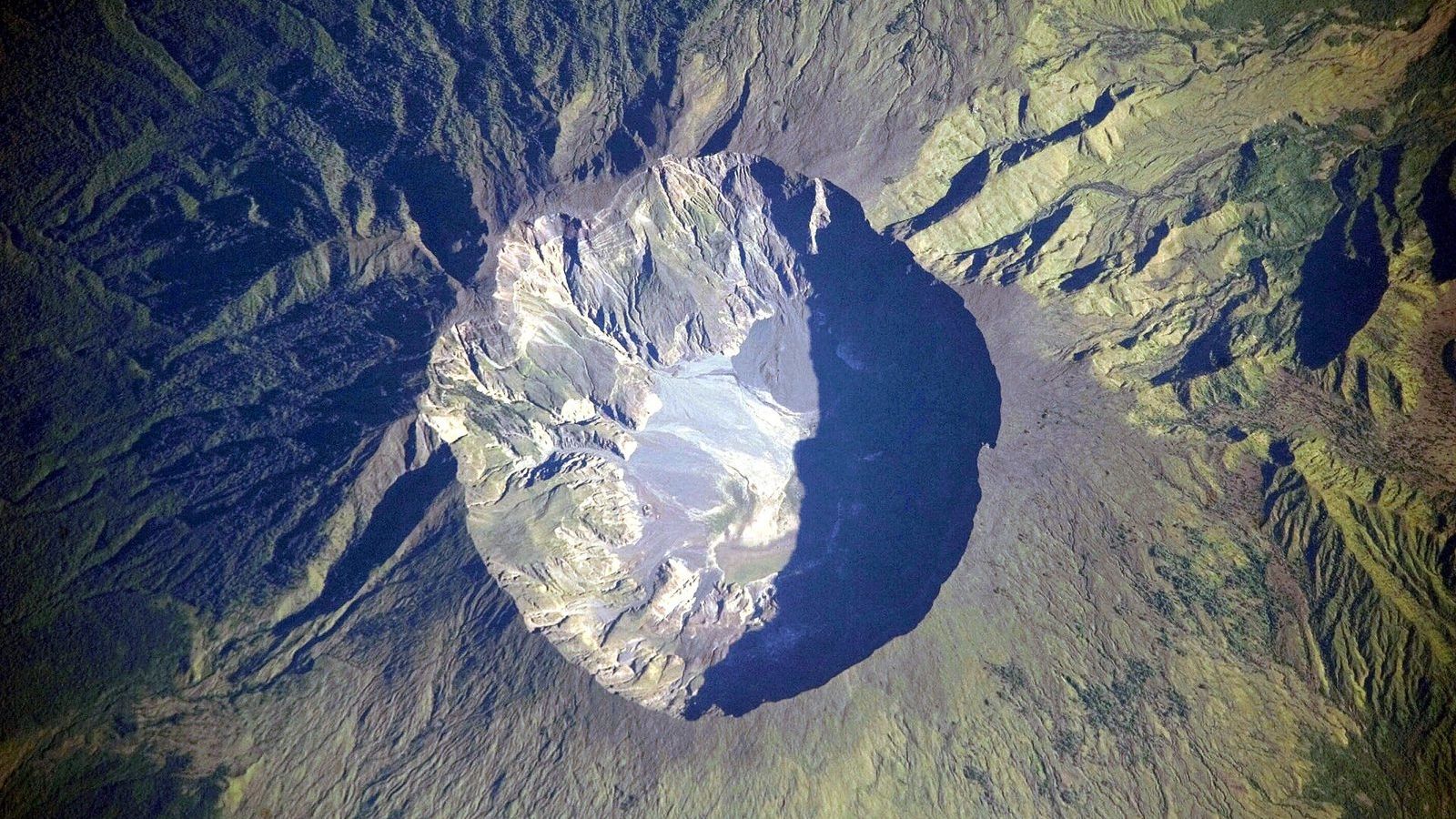
Tambora stands on the Sanggar peninsula of the island of Sumbawa, east of Bali. In 1815 it was one of the highest mountains in the archipelago, about 4,300 m. After a few years of rumbling, it erupted on 5 April 1815 with explosions heard 1,400 km away, and on the evening of 10 April the eruption reached its climax: a column that pierced the stratosphere, pyroclastic currents that ran to the sea on every side, and a darkness that lasted two days as far as Java. When it was over the mountain was about 2,850 m high, with a caldera 6 km across and more than a kilometre deep where the summit had been.
The eruption threw out 30 to 50 cubic kilometres of dense rock, which is about 100 to 150 cubic kilometres of tephra. On the Volcanic Explosivity Index that is a 7, the only one of the last thousand years, and about ten times Pinatubo in 1991 and a hundred times Mount St Helens in 1980. The deaths on Sumbawa and Lombok, from the currents, the ash, and the famine and disease that followed the destruction of the crops, are estimated at 71,000 at least, and some historians put the figure far higher. The kingdom of Tambora itself, with its own language, was destroyed entirely.
Sulfur, not ash
The part of the eruption that reached Europe was not the ash. Ash falls out of the air in days. What stayed up was the sulfur. Tambora's magma released about 60 million tonnes of sulfur dioxide into the stratosphere, the dry, stable layer of the atmosphere above about 15 km, where there is no rain to wash anything out. Over a few weeks the sulfur dioxide reacted with water vapour to form droplets of sulfuric acid a fraction of a micrometre across, and the winds of the stratosphere carried the droplets around the globe and towards both poles.
Those droplets are the mechanism. They are small enough to stay aloft for a year or two, and they scatter sunlight. Part of the sunlight that would have reached the ground is sent back to space, and the ground and the lower atmosphere cool. The effect is measured as the optical depth of the aerosol veil, a number that says how much of the direct sunlight is lost; a veil with an optical depth of 0.15 takes out about 14 percent of the direct beam. The cooling lasts as long as the veil, and the veil thins with an e-folding time of about a year, which means that each year about a third of it remains.
The sulfur also left a record. Snow that fell on Greenland and Antarctica in 1815 and 1816 carried the sulfate down with it, and the layers are still there in the ice. Ice cores from both poles show the Tambora spike, and from its size the mass of sulfur that reached the stratosphere is estimated, which is where the 60 million tonnes comes from. The same cores show that 1815 followed another large eruption, in 1808 or 1809, whose volcano has never been identified, and that the decade of the 1810s was the coldest in the northern hemisphere for at least five hundred years.
The year without a summer
The summer of 1816 in Europe and eastern North America was, by the tree-ring and instrumental reconstructions, about half a degree to a degree colder than the decades around it, with far larger anomalies in particular months and places. That does not sound like much. It was enough. Crops need a growing season, and a season cut short by frost at both ends, under a sky that rained for weeks, fails. In New England the corn did not ripen, and the year is remembered as eighteen hundred and froze to death. In the Rhineland, Switzerland, and the north of Italy the harvest of 1816 was the worst of the century, and the famine of 1816 to 1817 was the last great subsistence crisis of western Europe. In Yunnan in China the rice failed for three years. In India the monsoon faltered, and some historians link the cholera epidemic that began in Bengal in 1817 to the disruption.
None of the people who lived through it connected the weather with a volcano. The connection was made slowly. Benjamin Franklin had suggested in 1784 that the cold winter after the Laki eruption in Iceland was caused by the haze, but the idea had not become general knowledge. The sulfur mechanism was understood only in the twentieth century, and the quantitative link between Tambora and 1816 was made in the 1980s, when ice cores and climate models became good enough to test it.
What Pinatubo measured
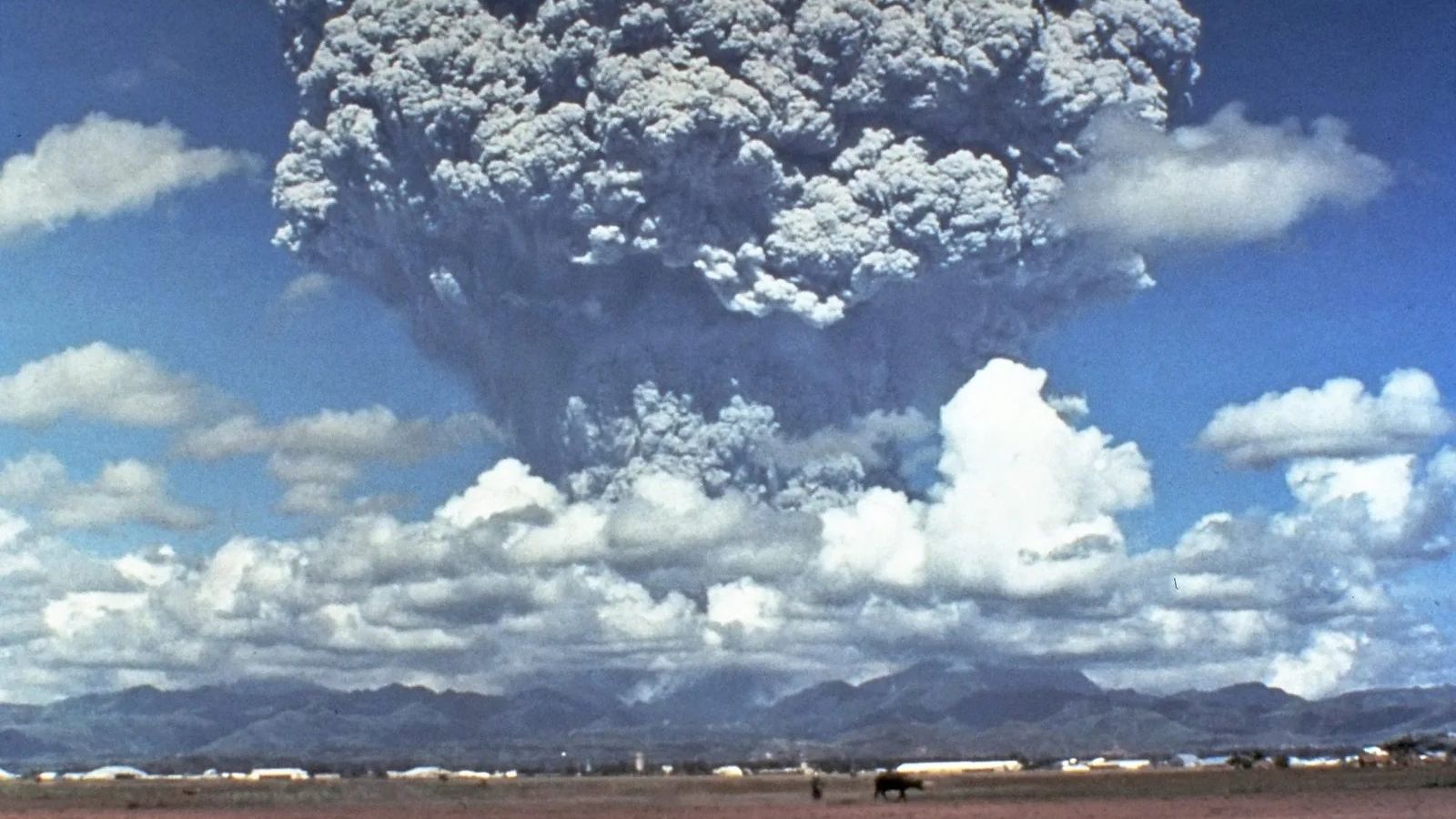
The test came on 15 June 1991, when Pinatubo in the Philippines erupted about 5 cubic kilometres of magma and put 17 to 20 million tonnes of sulfur dioxide into the stratosphere. It was the first large eruption to happen under satellite observation, and the veil was watched from the start: the sulfur dioxide cloud circled the Earth in three weeks, the aerosol spread to both hemispheres within months, and the optical depth peaked at about 0.15 in the months that followed. At the top of the atmosphere the veil reduced the net sunlight by about 4 watts per square metre at its peak, which is larger than, and of opposite sign to, the warming that all the greenhouse gases added since the industrial revolution exert today. The global average temperature fell by about 0.5 °C in 1992, and recovered in about two years as the veil fell out. Climate models run in 1991 had predicted the cooling before it happened, and the match was a test the models passed.
The decay can be worked out. If the veil thins with an e-folding time of one year, then after one year about 37 percent of the Pinatubo aerosol remained, after two years about 14 percent, and after three years about 5 percent, which is why the cooling was over by 1994. Tambora's sulfur load was about three times Pinatubo's, and the cooling of 1816 was about twice as large and no longer, because a denser veil forms larger droplets that fall out faster: the climate effect of an eruption grows more slowly than its sulfur. A super-eruption ten times the size of Tambora would not cool the planet ten times as much, which is one of the few consoling facts in the subject.
The limits of the effect
Three things keep the volcanic effect on climate short. The aerosol falls out in a year or two. Only sulfur that reaches the stratosphere counts, so an eruption whose column stays in the troposphere, however large, does little. And the carbon dioxide of an eruption is negligible: Pinatubo released about 50 million tonnes of it, which is about what human activity releases in half a day. Volcanoes cool the planet for a year or two; they do not warm it on any time scale a person would notice.
The physics, the Pinatubo data, and the ice-core record of the last two thousand years, in which the eruptions of 536 and 540 gave the coldest decade of all, are the subject of Unit 8 of the masterclass, which closes the Foundation masterclass with the volcano in the Earth system. The stratospheric aerosol record since 1850, with the Krakatau, Agung, El Chichón, and Pinatubo peaks, is published by NASA's Goddard Institute for Space Studies and is the tool of that week. Clive Oppenheimer's review of the Tambora eruption and its consequences is the standard account of the eruption itself.