Explosive Eruptions
Why magma explodes: the gas dissolved at depth, the bubbles that grow on the way up, and the fragmentation that turns liquid rock into ash and pumice. The unit lays out the eruption styles from Hawaiian to ultra-Plinian, the eruption column and the rule that its height grows with the fourth root of the eruption rate, tephra fall and the thinning of a deposit with distance, and the Volcanic Explosivity Index with its physics. Vesuvius in AD 79, Mount St Helens in 1980, Pinatubo in 1991, Eyjafjallajökull in 2010, and Hunga in 2022 are the worked cases.
On an afternoon in the year AD 79 a cloud rose from Vesuvius that a seventeen-year-old across the bay compared to a pine tree, with a trunk of great height that spread into branches at the top. Unit 1 quoted his letter; this unit explains what he saw. A magma that pours out as lava at Kīlauea tears itself into dust and pumice at Vesuvius, Pinatubo, or Hunga, and the difference is made by the gas dissolved in the melt, the viscosity that decides whether the gas can escape, and the rate at which the magma reaches the vent.
1 From bubble to fragment
Unit 3 gave the two facts that explosive volcanism rests on. The first is that a rhyolite melt can hold about 4 wt% of water (4 percent of its mass) at 100 MPa, about 4 km below the surface, and far less as the pressure falls. The second is that a cubic metre of such a melt, brought to the surface, holds enough water to make several hundred cubic metres of steam. Between the first bubble and the vent, that expansion has to go somewhere.
1.1 Bubble growth on the way up
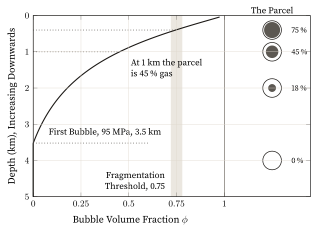
Once a rising melt has reached the pressure at which it is saturated, the water it can no longer hold leaves it as bubbles, and two things make the bubbles grow. The first is diffusion, in which water molecules move through the melt into the bubble, because the melt around it still holds more water than it can keep at that pressure, and the bubble gains mass. The second is decompression, in which the gas already in the bubble expands as the pressure on it falls; for an ideal gas the volume grows in inverse proportion to the pressure, so halving the pressure doubles the volume. Both effects accelerate toward the surface, because each kilometre of ascent removes a larger fraction of the pressure that remains (from 2 km to 1 km it halves, and from 1 km to the surface it falls to nothing), so a magma that was a liquid with a few scattered bubbles at 2 km can be a foam a few hundred metres below the vent, as Figure 1 and the worked example show for the rhyolite of Unit 3.