

Lava Flows and Effusive Eruptions
A basalt with little gas and low viscosity pours rather than explodes. The unit takes a lava flow apart (channel, levées, crust, core, tube, and flow front), explains pāhoehoe and ʻaʻā, derives the speed of a lava sheet from Jeffreys's equation, and shows why the effusion rate, more than the volume, decides how far a flow reaches. Fissure eruptions and the dykes that feed them, lava fountains and lava lakes, and the 2018 eruption of Kīlauea from the first fissure to the collapse of the summit are the worked cases.
On the evening of 3 May 2018 a crack opened across a street in Leilani Estates, a subdivision on the lower east flank of Kīlauea, and began to spit lava between the houses. Nobody died in the three months that followed, which is the usual outcome of an eruption of this kind, and 716 homes and other buildings were buried under rock, which is the other usual outcome. This unit is about the liquid itself, how it is organized as it moves, what sets its speed and its reach, how it leaves the ground as a fountain or a fissure, and what the eruption of 2018 taught the observatory that watched it.
1 The anatomy of a lava flow
Unit 3 gave the two properties that decide whether a magma pours or explodes. A basalt of Hawaiʻi or Iceland reaches the surface at 1,100 to 1,250 ° C with a melt viscosity of 10 to 1,000 Pa s, from the viscosity of honey to a hundred times stiffer, and with less than one percent of dissolved water, so its bubbles rise, grow, and escape through a liquid that gets out of their way. The gas leaves as a fountain or a quiet fume, and the degassed liquid runs downhill. An eruption of this kind, in which most of the magma leaves the vent as liquid rather than as fragments, is called effusive, and the liquid at the surface is lava. The explosive end of the range, where the gas cannot escape and tears the magma apart, is the subject of Unit 6, and the two ends meet in this unit’s own eruptions, whose fountains throw fragments into the air before the lava settles into a channel.
1.1 Channel, levées, crust, and core
A lava flow is not a river. A river is the same liquid from bank to bed, but a lava flow builds its own banks, grows a solid roof over itself, and ends in a wall of rubble that advances by falling over. Figure 1 shows the parts. Lava leaves the vent and runs down the steepest line of the slope in a channel, the fast central stream where the liquid is deepest and the surface is still red. The channel is bordered by levées, banks of lava that stopped flowing and solidified at the edges, where the shear stress is smallest and a lava with a yield strength cannot move (Unit 3 explained the mechanism). Levées grow by overflow, as a channel that surges spills a layer over its own banks, and they can end up several metres high, so that a channel runs between walls of its own making. Over the whole surface a crust forms within seconds, because a lava surface radiates about 220 kW from every square metre (the worked example of Unit 3), and beneath the crust the core stays liquid for hours, days, or years depending on the thickness. The flow ends at the flow front, where the lava is coolest and stiffest, and the front advances by pushing its own crust ahead of itself or by breaking out through it.
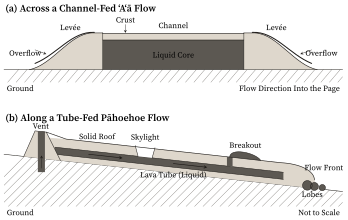
When the crust over a channel thickens and joins across the whole width, the channel becomes a lava tube, a pipe of solid rock with liquid lava running through it, open to view only through skylights where a piece of the roof has fallen in. Section 3 shows that this roof is the best insulation a lava can have. Where the lava inside a tube or under a crust finds a weak spot, it pours out as a breakout, a new small flow on top of the old, and a long eruption builds a flow field of many overlapping flows, lobes, and breakouts rather than one simple sheet. The Puʻu ʻŌʻō flow field of Kīlauea, built between 1983 and 2018, covers about 144 km\(^{2}\), the area of a square 12 km on each side, and consists of thousands of such flows laid one over another.
1.2 Pāhoehoe and ʻaʻā
Hawaiian basalt comes in two surface textures, and every volcanologist uses the Hawaiian words for them, which Clarence Dutton (1841-1912) of the United States Geological Survey brought into the scientific literature in his report of 1884 on the volcanoes of Hawaiʻi. Pāhoehoe is smooth, glassy, and often ropy, because its thin skin wrinkles as the liquid beneath drags it forward; the word means smooth, unbroken lava. ʻAʻā is a rubble of sharp, spiny fragments, called clinker, that covers a dense core; the word means stony, rough lava, and the first sound of it, the ʻokina, is a glottal stop, the catch in the throat in the middle of "uh-oh", while the macron on the ā marks a long vowel. Figure 2 shows the two side by side. A pāhoehoe flow advances as a set of small lobes, each a few tens of centimetres across, that swell like a balloon, burst, and send out the next lobe, so the front is quiet and slow. An ʻaʻā flow advances as a wall of clinker several metres high that moves like the tread of a tractor: the core pushes forward, the clinker on top tumbles down the front, and the flow runs over its own rubble with a sound like breaking plates.