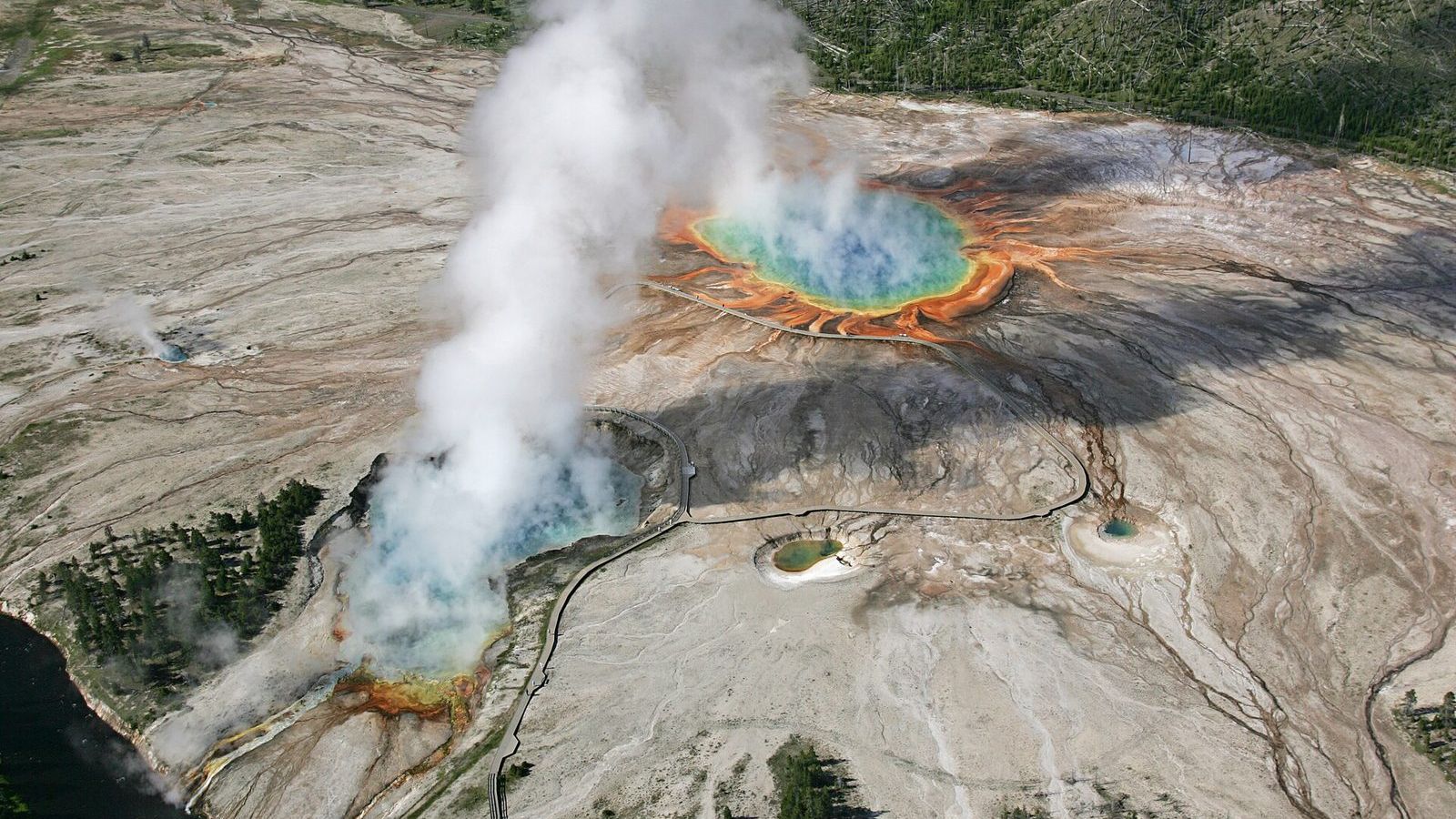
 Image: Jim Peaco, National Park Service, public domain
Is Yellowstone overdue?
The arithmetic that makes Yellowstone sound overdue goes like this. The caldera has had three great eruptions, about 2.08 million, 1.3 million, and 631,000 years ago. The gaps between them are about 780,000 and 670,000 years, a mean of about 725,000. It has been 631,000 years since the last one, so the next is due in about 90,000 years, which on a geological clock is any day now. Every part of that paragraph except the dates is wrong, and the Yellowstone Volcano Observatory has been explaining why for twenty years. Here is the explanation, with the numbers the observatory actually watches.
The three eruptions
Yellowstone sits over a hotspot, a plume of hot mantle that has stayed roughly fixed while the North American plate moved south-west over it at a few centimetres a year, leaving a track of older calderas across the Snake River Plain of Idaho back to about 17 million years ago. The present caldera is the latest of the chain. Its first great eruption, the Huckleberry Ridge Tuff of about 2.08 million years ago, erupted about 2,450 km³ of magma and left a caldera that reached beyond the present park. The second, the Mesa Falls Tuff of about 1.3 million years ago, was much smaller, about 280 km³, and is often left out of the count. The third, the Lava Creek Tuff of about 631,000 years ago, erupted about 1,000 km³ and formed the caldera of today, 45 by 70 km, whose rim the park roads cross without anyone noticing.
Since then the caldera has erupted about thirty times, all of them lava flows of rhyolite, the last about 70,000 years ago, and none of them explosive on the scale of the three. The park's geysers and hot springs are the heat of the system reaching the surface, and they are the sign that the system is alive, not that it is about to erupt.
Why a mean is not a schedule
Two intervals do not make a rhythm. With three events there are two gaps, and they differ by more than a hundred thousand years; a fourth eruption could come at any interval from a few thousand years to several million without contradicting anything the record says. More fundamentally, the processes that lead to a caldera eruption, the slow accumulation of rhyolite melt in the crust and the final assembly of an eruptible body, are not a clock that resets at each eruption and counts down to the next. The magma system of today is what matters, and it can be looked at directly.
The arithmetic, for what it is worth, goes like this, for what it is worth. If great eruptions happened at random with a mean spacing of 725,000 years, the probability of one in any given century would be 100 divided by 725,000, about 0.014 percent, or one in 7,000, and that probability would be the same whether the last eruption was 631,000 or 63 years ago. That is the correct way to use a mean spacing, and it gives a number too small to plan a life around. The observatory's own estimate of the annual probability of a caldera-forming eruption is of the same order, around one in 700,000, and it adds that the number is poorly known because the rate itself is poorly known.
What is under the park
In 2015 Hsin-Hua Huang and colleagues at the University of Utah published the first seismic image of the whole magma system, built from the travel times of earthquake waves through the crust. There are two bodies. An upper one, 5 to 17 km down, is about 10,000 km³ in volume and about 9 percent melt. A lower one, 20 to 50 km down, is about 46,000 km³ and about 2 percent melt. The rest is crystal: the bodies are mush, in the sense that Unit 9 of the masterclass explains, and the melt in the upper body, a few hundred to perhaps 900 km³ if it were gathered together, is spread through a crystal framework from which it cannot erupt. A caldera-forming eruption needs a few hundred cubic kilometres of melt collected in one eruptible body, and the image shows no such body. The paper was reported, inevitably, as the discovery of an enormous magma chamber under Yellowstone; what it discovered was that the chamber is mostly solid.
What the observatory watches
The Yellowstone Volcano Observatory, run by the US Geological Survey with the National Park Service, the University of Utah, and the state surveys of Wyoming, Montana, and Idaho, watches three things. Earthquakes: the park has 1,500 to 2,500 a year, most too small to feel, many of them in swarms of hundreds over a few days or weeks that come and go without consequence. Deformation: the caldera floor rises and sinks by a few centimetres a year in cycles that last years to decades, up by about a metre between 1923 and 1984, down afterwards, up again around 2004 to 2010, and sinking slowly since 2015, as hydrothermal fluids and small amounts of magma move about under it. And the hydrothermal system: the geysers, the gas, and the hydrothermal explosions, of which the one at Biscuit Basin on 23 July 2024, which threw rocks and boiling water over a boardwalk, was a small and ordinary example.
None of these is a sign of an eruption. A real warning, the observatory says, would be a combination that has not been seen: earthquakes migrating upward over weeks, uplift of metres rather than centimetres over a focused area, and a change in the gas, together and sustained, as at Pinatubo in 1991 or Kīlauea in 2018. Such a sequence would take weeks to months at least, and it would be visible on instruments that report in real time to a public website. The most likely volcanic event at Yellowstone in any given century is a hydrothermal explosion or, much more rarely, a lava flow, and the park's hazard planning is built around those; a caldera eruption is far down the list.
Where the question comes from
The word overdue comes from thinking of a volcano as a clock, and the clock from the three dates, and the three dates from the fact that the Yellowstone hotspot is one of the best-studied volcanic systems on Earth, so that its history is known in a way that the histories of Toba or Campi Flegrei are not. The question is asked of Yellowstone because the answer is available, and the answer is no. The observatory's weekly articles, Caldera Chronicles, have addressed it more than once, in plain language and with the data behind it, and they are the best thing to read for anyone who has been worried by a documentary.
Unit 14 of the masterclass works through the three eruptions, the seismic image, and the return period arithmetic, with the Poisson statement in words and in a formula, and Unit 16 returns to Yellowstone's unrest beside that of Campi Flegrei and Taupō with a research spotlight by the observatory's scientist-in-charge on where forecasting stands. The observatory's own pages, with the monthly update, the earthquake catalogue, and the deformation plots, are at the Yellowstone Volcano Observatory.