

Magma and Its Properties
A magma is a silicate melt with crystals and dissolved gas, in proportions that change on the way up. The unit explains why silica makes a melt viscous, the four controls on viscosity (temperature, composition, dissolved water, and crystals) with real values, the density that makes magma rise and sometimes stop, how the temperature of lava is measured, and how much water and carbon dioxide a magma can hold at depth. It closes with the field measurement of viscosity on flowing lava and the table of the four magma types.
A volcano is a machine for moving magma, and everything the machine does depends on what the magma is like: how stiff it is, how heavy it is, how hot it is, and how much gas it holds. Two volcanoes fed by the same amount of melt can behave in opposite ways, one pouring out a river of lava that a person can walk away from, the other blasting the same mass of rock into the stratosphere, and the difference lies in a few properties that can be measured and, to a useful degree, calculated. This unit takes magma apart into its three components, explains what sets its viscosity, density, temperature, and gas content, and shows how each of these is measured, in the laboratory and on a flowing lava.
1 Melt, crystals, and gas
Magma is molten rock below the surface, and it is never a simple liquid, because it is made of three parts, a melt, crystals, and gas. The melt is the liquid itself, a hot solution of silicon, oxygen, aluminium, iron, magnesium, calcium, sodium, potassium, and a dozen minor elements. Crystals grow in the melt as it cools, so that most magmas arrive at the surface carrying a few percent to half their volume of solid mineral grains, such as olivine and plagioclase feldspar in a basalt or quartz and feldspar in a rhyolite. The gas is present in two forms: dissolved in the melt at depth, where the pressure keeps it in solution, and as bubbles once the pressure has fallen enough for it to come out. Water and carbon dioxide make up most of it, and sulfur, chlorine, and fluorine compounds make up most of the rest. The proportions of the three parts change on the way up. A magma that leaves its storage region as a crystal-poor, bubble-free liquid may reach the vent as a froth of bubbles with a quarter of its remaining melt turned to crystals, because cooling makes crystals and decompression makes bubbles, and both happen during ascent.
When magma reaches the surface it is called lava, and what is left of the gas escapes into the air. Frozen lava keeps a record of the three parts. A melt that cools too fast for crystals to grow freezes into glass, which is obsidian when it is dense and dark. A melt that freezes while full of bubbles makes pumice, a glass foam light enough to float on water, from a silica-rich magma, or scoria, a darker and heavier bubbly rock, from a basalt. Crystals that grew before the eruption sit in all of these as visible grains.
1.1 The silicate network
The melt is a liquid, but a strange one. In a basalt some 85 percent of the atoms of the melt are silicon, oxygen, and aluminium, and in a rhyolite 95 percent. Silicon and oxygen bind in a fixed geometry, in which each silicon atom is surrounded by four oxygen atoms at the corners of a tetrahedron, a pyramid with four triangular faces. Two tetrahedra can share one oxygen atom, which then links two silicon atoms and is called a bridging oxygen. In pure molten silica every oxygen is a bridge and the tetrahedra form one endless three-dimensional network. To make such a liquid flow, bridges must break and form again, and that costs energy, so molten silica at 1,700 ° C is still about a million times more viscous than honey. Figure 1 shows the idea drawn flat.
Aluminium can take the place of silicon in a tetrahedron when a sodium or potassium ion sits beside it to balance the charge, so aluminium counts as part of the network. The other oxides break the network. Calcium, magnesium, iron, and the sodium and potassium that are not paired with aluminium cannot sit inside a tetrahedron, so where they enter the melt a bridge opens and two non-bridging oxygens appear, each attached to only one silicon. A basalt has about 50 wt% silica and plenty of calcium, magnesium, and iron, so its network is cut into short pieces that slide past one another easily. A rhyolite has about 75 wt% silica and little of the network breakers, so its tetrahedra are joined in long chains and sheets, and the melt is stiff. This is the reason behind the single most useful rule in volcanology, which Unit 1 states and this unit explains: the more silica a magma has, the more viscous it is. Silica content, to recap, is the mass fraction of silicon dioxide, \(\mathrm{SiO_2}\), in the rock, from 45 to 52 wt% in a basalt to above about 69 wt% in a rhyolite.
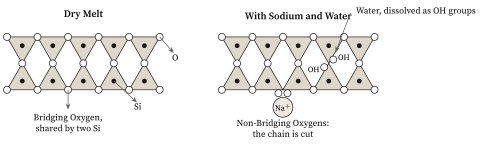
Water does the same job as sodium, and does it better. A water molecule that dissolves in a silicate melt reacts with a bridging oxygen and turns it into two hydroxyl (OH) groups, one on each silicon, and the bridge is gone. One percent of water by mass is a great many molecules, because a water molecule is light compared with the oxides of the melt (its mass is less than a third of that of a silica unit, \(\mathrm{SiO_2}\)), so a few percent of dissolved water cuts a rhyolite network into fragments and lowers its viscosity by several orders of magnitude. The reaction has a limit: once the melt holds about 2 wt% of water, most of what is added beyond that stays as whole water molecules between the fragments, as Edward Stolper showed in 1982, which is one reason the first percent does the most work. Section 5 returns to how much water a melt can hold and why it fits into rock at all.
2 Viscosity and its four controls
Viscosity is the resistance of a fluid to flow. Imagine a layer of fluid between two flat plates, and push the upper plate sideways. The force you apply divided by the area of the plate is called the shear stress, and the speed of the upper plate divided by the thickness of the layer is called the rate of shear. The fluid deforms at a rate proportional to the stress, and the viscosity \(\eta\) is the ratio of the two, the shear stress divided by the rate of shear. Its SI unit of measurement is the pascal second (Pa s), because a stress in pascals is divided by a rate in units of one per second. A fluid whose viscosity does not depend on how hard it is pushed is called Newtonian, and a crystal-free silicate melt is one, which is what makes the models of this section possible. The values volcanologists meet span more than twelve powers of ten (twelve orders of magnitude, as this is usually said), so they are written as powers of ten, and the model of the next section works with the logarithm of the viscosity rather than with the viscosity itself. Water at 20 ° C has about \(10^{-3}\) Pa s, honey about 10 Pa s, a basalt at its eruption temperature between 10 and 1,000 Pa s, which is honey to peanut butter, and a dry rhyolite melt at 800 ° C about \(10^{11}\) Pa s, which is stiffer than window putty and closer to a glass that still creeps. Four things set where a magma falls on this ladder.
2.1 Temperature and composition
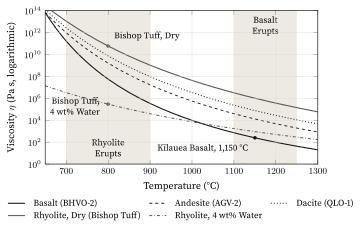
The first two controls act together, and the cleanest way to see them is a model that predicts the viscosity of a crystal-free melt from its chemical composition and temperature. The one in general use was published in 2008 by Daniele Giordano, James K. Russell, and Donald B. Dingwell, who fitted more than 1,770 laboratory measurements on melts of all compositions, with and without water, to one formula with 18 fitted numbers: one value that every melt shares, the viscosity that all melts approach at very high temperature, and 17 coefficients that carry the composition. Figure 2 shows its curves for four real rocks: a Kīlauea basalt, an andesite and a dacite that serve as reference materials of the United States Geological Survey (rock powders whose compositions have been measured by many laboratories, so that they are known precisely), and the rhyolite of the Bishop Tuff, the deposit of the great eruption of Long Valley in California about 767,000 years ago. Table 1, after the first worked example, gives the two compositions the examples use.
Three things stand out in Figure 2. First, the curves are ordered by silica at every temperature, with three to four powers of ten between the basalt and the dry rhyolite. Second, every curve falls steeply with temperature, and the slope is steeper for the silica-rich melts, so that the rule of thumb of a factor of ten per 100 ° C fits the basalt near 1,150 ° C only roughly (the model gives a factor of seven) and understates the rhyolite near 800 ° C (a factor of a hundred). Third, the two effects add up in nature, because a rhyolite also erupts 300 to 400 ° C cooler than a basalt. A dry rhyolite at its own eruption temperature is therefore a hundred million times stiffer than a basalt at its own eruption temperature, far beyond the thousand to ten thousand times that the silica alone gives at one and the same temperature.
| Oxide (wt%) | Kīlauea Basalt | Bishop Tuff Rhyolite |
|---|---|---|
| \(\mathrm{SiO_2}\) | 49.9 | 77.4 |
| \(\mathrm{TiO_2}\) | 2.73 | 0.07 |
| \(\mathrm{Al_2O_3}\) | 13.5 | 12.4 |
| Iron oxides (as FeO) | 11.1 | 0.78 |
| \(\mathrm{MnO}\) | 0.17 | 0.04 |
| \(\mathrm{MgO}\) | 7.23 | 0.07 |
| \(\mathrm{CaO}\) | 11.4 | 0.51 |
| \(\mathrm{Na_2O}\) | 2.22 | 3.80 |
| \(\mathrm{K_2O}\) | 0.52 | 4.89 |
| \(\mathrm{P_2O_5}\) | 0.27 | 0.01 |
2.2 Dissolved water
The third control is the one that makes silica-rich volcanism possible at all. Figure 2 includes a second rhyolite curve, for the Bishop Tuff melt with 4 wt% of dissolved water, and it lies five powers of ten below the dry curve at 800 ° C. Water acts on the viscosity exactly as Section 1 described, by cutting the bridges of the network, and the first percent does most of the work, because it finds the most bridges to cut. The effect on a basalt is far smaller, since its network is already in pieces: 1 wt% of water lowers the viscosity of the Kīlauea basalt at 1,150 ° C by a factor of about seven, compared with a factor of 600 for the first percent in the rhyolite.
2.3 Crystals and bubbles
A melt with crystals in it is a suspension, and a suspension is more viscous than its liquid alone because the liquid must flow around the particles. Albert Einstein (1879-1955) showed in 1906 that a small volume fraction \(\phi\) of rigid spheres (the share of the volume that the spheres occupy, so that \(\phi = 0.1\) means 10 percent) raises the viscosity by the factor \(1 + 2.5\phi\). That formula fails as soon as the spheres are crowded enough to disturb one another’s flow, and the extension in use in volcanology, the Einstein-Roscoe relation, which dates from 1952, replaces it by a formula in which the viscosity rises without limit as the fraction approaches the value at which the particles touch.
Ten percent of crystals raise the viscosity by half, 30 percent by a factor of five or six, and beyond 40 percent the curve turns upward so fast that a magma with 50 to 55 percent crystals behaves as a solid for any practical purpose, which is why lavas with more than about half crystals are almost never seen to flow. Bubbles behave in a more complicated way than crystals, because they can change shape. A bubble that keeps its round shape acts like a rigid particle and raises the viscosity, but a bubble that is stretched by the flow slides along with it and lowers the viscosity instead, and which of the two happens depends on how fast the magma is sheared relative to how fast the bubble can spring back. Field measurements on bubbly Hawaiian lava, in the research spotlight below, show the second case.
2.4 When lava stops being a liquid
A crystal-free melt is Newtonian, but a lava with crystals and bubbles usually is not. The commonest departure is a yield strength, a stress below which the lava does not flow at all, because its crystals have built a loose framework that must be broken before anything moves. A fluid with a yield strength behaves like toothpaste: it holds its shape under a small load and flows under a large one. In a lava flow the stress that drives the lava downhill comes from the weight of the lava above, so it is largest in the deep, fast-moving centre of the channel and smallest at the thin edges. The margins therefore stop while the middle keeps going, and the stopped margins build the walls, called levées, that line every ʻaʻā channel. The yield strengths measured on Hawaiian and Etnean lavas are of the order of 100 to 1,000 pascals, tiny by the standards of rock but enough to hold a sheet of lava a few centimetres thick on a gentle slope. Many lavas also become less viscous when they are sheared faster, which is called pseudoplastic, or shear-thinning, behaviour.
3 Density and buoyancy
Magma rises because it is lighter than the rock around it, and it stops where it is not. The density of a melt depends on its composition more than on anything else. A basaltic melt, rich in heavy iron and magnesium, has about 2,600 to 2,700 kg/m³ at its eruption temperature, and a rhyolitic melt about 2,300 to 2,400 kg/m³, which is a little more than twice the density of water, 1,000 kg/m³. The rocks they rise through are denser: the mantle rock in which basalt forms has about 3,300 kg/m³, solid basalt about 3,000, and the granite and gneiss of the continental crust about 2,700. The pressure these rocks exert at a depth \(z\) is the lithostatic pressure of Unit 1, \(P = \rho g z\) with \(\rho\) the rock density and \(g = 9.81\unit{m\,s^{-2}}\), which comes to about 27 MPa for every kilometre of crust and 100 MPa at a depth of about 4 km.
The force that drives a melt upward is the difference between the weight of the rock it displaces and its own weight. For each cubic metre of basaltic melt in the mantle it is \((3{,}300 - 2{,}700)\unit{kg\,m^{-3}} \times 9.81\unit{m\,s^{-2}} \approx 5{,}900\unit{N}\), a force equal to the weight of 600 kg, which is why melt leaves its source rock as soon as there is a connected path. In the crust the margin shrinks, because the same basalt in granitic crust of 2,700 kg/m³ is barely buoyant, and where the crust is lighter still, or the melt has grown heavier by losing its light components to crystals, the magma reaches a level of neutral buoyancy and spreads sideways instead of rising. This is one reason, though not the only one, why basalt collects in reservoirs a few kilometres below the volcanoes it feeds. A rhyolite melt at 2,300 kg/m³ is lighter than any crustal rock and would rise freely if its viscosity allowed.
The density of a magma with crystals and bubbles is the volume-weighted mean of its parts. Olivine has about 3,300 kg/m³ and plagioclase about 2,700, so crystals raise the density of a basalt by a few percent at most, but steam at 10 MPa, about 400 m down, has only about 20 kg/m³, so a magma that is 30 percent bubbles has only 70 percent of the density of its melt. At 75 percent bubbles, the fraction at which a magma breaks into fragments, it has a quarter of the density of its melt, which is less than the density of water. A froth of magma in a conduit therefore gains buoyancy as its bubbles grow, which is why it accelerates upward so violently.
4 The temperature of magma
Basalt erupts at about 1,100 to 1,250 ° C, andesite at about 950 to 1,100 ° C, dacite at about 800 to 1,000 ° C, and rhyolite at about 700 to 900 ° C. The order follows the silica content, because silica-rich melts form at lower temperatures, by partial melting of crust or by the crystallization of a basalt, as Unit 2 touches on. The ranges are wide because every volcano has its own history, and a value such as “basalt erupts at 1,200 ° C” is a textbook average, not a measurement. The measurements come in four kinds, three made on the hot lava and one on the cooled rock.
A thermocouple is a junction of two metals that produces a voltage depending on its temperature. Pushed into flowing lava on a steel rod and left until it stops rising, it gives the most direct value there is, and the Hawaiian Volcano Observatory still takes such readings where a flow can be approached. A pyrometer measures the brightness of the glow at one wavelength and converts it to a temperature with the physics of the next section, from a safe distance. A thermal camera does the same for every pixel of an image in the infrared, usually at wavelengths of 8 to 14 micrometres, and is the workhorse of monitoring, with one caveat: it sees the surface, and the surface of a lava is always a cooling crust, so a thermal image of a flow shows mostly values far below the interior temperature and only a few hot cracks near it.
The fourth kind reads the temperature from the rock after the event: the composition of the glass between the crystals, and of pairs of minerals that grew together, depends on the temperature at which they formed in ways that laboratory experiments have calibrated, so a quenched sample, one cooled too fast for its glass and minerals to change, carries its own thermometer. The Hawaiian Volcano Observatory uses the magnesium content of the glass in this way for every Kīlauea eruption, and its values for the 2020 to 2023 eruptions were 1,144 to 1,170 ° C.
4.1 The colour of glowing lava
Every object radiates light whose spectrum, the amount it gives off at each wavelength, depends on its temperature, which is the law that Max Planck (1858-1947) found in 1900 and the astronomers’ standard way of taking the temperature of a star. Two consequences of Planck’s law are all this unit needs. The wavelength at which the radiation is strongest is inversely proportional to the absolute temperature, by Wien’s displacement law, \(\lambda_{\max} T = 2.898\times10^{-3}\unit{m\,K}\), where the unit is a metre times a kelvin, and the total power radiated by each square metre of surface grows with the fourth power of the absolute temperature, by the Stefan-Boltzmann law, \(\sigma T^{4}\) with \(\sigma = 5.67\times10^{-8}\unit{W\,m^{-2}\,K^{-4}}\). Both laws hold for an ideal radiator, a black body; a lava surface radiates about 95 percent of that, a fraction called its emissivity, and a thermal camera must be told this correction.
For lava at 1,150 ° C, which is 1,423 K, the peak lies at 2.0 micrometres, in the near infrared, well beyond what the eye can see. What the eye sees is the short-wavelength tail of the spectrum, and because that tail steepens with temperature, the colour of the glow is a thermometer that works without any instrument. A surface that has just begun to glow, visible in the dark as a faint red, is at about 525 ° C; dull red means about 700 ° C, cherry red about 900, orange about 1,000 to 1,100, and yellow about 1,100 to 1,200 ° C, with the whole glow brightening as the fourth power of the temperature along the way. Figure 3 shows the scale at work on a lava lake, and the interactive element below computes the colour and the radiated power from Planck’s law for any temperature a reader chooses.

5 Water and carbon dioxide in the melt
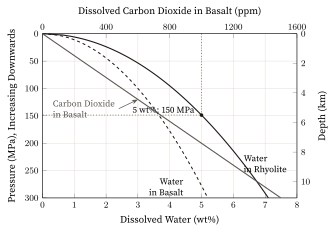
The gas of a magma is not a separate ingredient at depth. It is dissolved, molecule by molecule, in the melt, as carbon dioxide is dissolved in a bottle of sparkling water before the cap is removed. The amount that a melt can hold, its solubility, depends on the pressure above all, and it is the fall of pressure on the way up that turns dissolved gas into bubbles. Section 1 explained how water enters a silicate melt: it reacts with the network and is bound into it chemically as hydroxyl groups, and whole water molecules join them once the melt holds a few percent. That chemical bond is what lets a few percent of water fit into rock at all, and the higher the pressure, the more of both forms the melt takes up. At the pressures of the upper crust, up to a few hundred megapascals, the dissolved water content of a melt grows roughly with the square root of the pressure.
Figure 4 draws the law with the pressure increasing downward, so that the surface is at the top of the diagram and the depth can be read on the right. The shape of the curve carries the whole story of an explosive eruption. A melt that holds exactly as much water as it can is saturated, and one that holds less is undersaturated. A rhyolite with 4 wt% water is undersaturated at 200 MPa, where the melt could hold 6 wt%, so nothing happens as it rises until it reaches the depth where the curve passes through 4 wt% and the melt becomes saturated. From that depth on, every further metre of ascent forces water out of solution, slowly at first and then faster, because the curve is steepest near the surface: of the 4 wt% a rhyolite holds at 100 MPa, half is still dissolved at 25 MPa, about 1 km down, and nearly all of it has left by the time the pressure has dropped to one megapascal.
5.1 Why carbon dioxide leaves first
Carbon dioxide dissolves in a silicate melt as carbonate groups, and it dissolves poorly. Its solubility grows in proportion to the pressure, which is Henry’s law, the rule that the amount of a gas a liquid can hold is proportional to the pressure of that gas, and the constant is small: a basalt holds only about 500 parts per million by mass at 100 MPa, about one sixtieth of the water the same basalt holds at that pressure. The grey line in Figure 4 shows it.
The consequence is that carbon dioxide leaves a magma far deeper than water does. The basalt that feeds Kīlauea arrives from the mantle with several thousand parts per million of carbon dioxide; the estimate of Gerlach and colleagues in 2002, from the gas output of the summit and the rate of magma supply, is about 0.7 wt%, or 7,000 ppm. A melt with even 2,000 ppm is saturated at 400 MPa (2,000 ppm divided by 5 ppm per MPa), which is about 15 km down, so Kīlauea’s magma, with several times that, is making carbon dioxide bubbles before it has left the mantle. By the time it reaches the summit reservoir a few kilometres below the caldera, nine tenths of its carbon dioxide has come out of solution and travels with it as gas, which the summit then breathes out. The water, with its far greater solubility, stays dissolved until the last kilometre. A volcano therefore breathes carbon dioxide from magma that is still deep and water from magma that is nearly at the surface, and the proportion of the two in the gas at the vent tells a volcanologist how deep the magma that is degassing lies. Sulfur, chlorine, and fluorine dissolve in between, and sulfur dioxide is the gas that satellites can measure from orbit; the measurement of these gases and what their fluxes reveal is beyond the Foundation units.
5.2 What a crystal remembers
How does anyone know how much water the Bishop Tuff held, or how much carbon dioxide reaches Kīlauea, when the gas has long since escaped? The answer is the melt inclusion: a droplet of melt, a few tens of micrometres across, that was trapped inside a growing crystal and sealed off from the rest of the magma (Figure 5). The crystal acts as a pressure vessel, so when the magma erupts and the droplet quenches to glass, it keeps the dissolved water and carbon dioxide it had when the crystal closed around it, and an analysis of the glass with a fine beam of electrons or ions, a microbeam analysis, gives the gas content of the magma at depth. With the solubility laws of this section the volcanologist can then run the first-bubble example backwards and find the pressure, and so the depth, at which the crystal grew. Quartz crystals of the Bishop Tuff hold inclusions that have kept the water of a rhyolite magma for 767,000 years, and the roughly 4 wt% of water that the basaltic magmas of volcanic arcs carry on average, which Unit 2 discusses, was measured in hundreds of inclusions from volcanoes around the world. The method has a well-known trap: as the inclusion cools, the glass shrinks more than its host and a bubble opens in the droplet, and much of the carbon dioxide moves into that bubble. When Penny Wieser and her colleagues measured both the glass and the bubble of inclusions from the 2018 eruption of Kīlauea, they found that the bubbles held most of the carbon dioxide, so that storage depths computed from the glass alone had been too shallow.

6 The four magma types
The properties of this unit sort themselves by silica, and Table 2 collects them for the four magma names of Unit 1, with the values the later units use. Every entry is a range, because every magma has its own temperature, water content, and crystal load, and a reader who has followed the unit can reconstruct any entry from the composition, the temperature, and the two laws.
| Property | Basalt | Andesite | Dacite | Rhyolite |
|---|---|---|---|---|
| Silica (wt%) | 45 to 52 | 57 to 63 | 63 to about 69 | above about 69 |
| Eruption temperature (° C) | 1,100 to 1,250 | 950 to 1,100 | 800 to 1,000 | 700 to 900 |
| Melt viscosity (Pa s) | 10 to \(10^{3}\) | \(10^{3}\) to \(10^{5}\) | \(10^{5}\) to \(10^{7}\) | \(10^{6}\) to \(10^{9}\) |
| Melt density (kg/m³) | 2,600 to 2,700 | about 2,500 | about 2,400 | 2,300 to 2,400 |
| Typical water (wt%) | 0.1 to 1 (arcs about 4) | 2 to 5 | 3 to 6 | 3 to 7 |
The two ends of the table are the two kinds of volcano. A basalt is hot, fluid, and poor in water, so its gas escapes gently through a liquid that flows out of the way. A rhyolite is cool, holds several percent of water, and turns from a flowing liquid into something close to a solid as that water leaves, so the gas cannot escape and tears the magma apart. The andesites and dacites in between can do either, and often do both in one eruption. Where each type comes from, and why basalt is by far the most common, is the subject of Unit 4.