The lava lake of Nyiragongo seen from the crater rim: a network of glowing red cracks across a dark crust, with columns of white steam rising from it.
Nyiragongo, DR Congo
A night eruption of Etna: a jet of yellow and orange lava below a glowing red cloud, above a black ridge.
Etna, Italy, 30 July 2011
A stream of red lava running down the dark, steep Sciara del Fuoco slope of Stromboli to the sea after sunset.
Stromboli, Italy, 19 September 2014

Volcanology Masterclass 12-Week Program in
Volcanology

Study volcanoes one unit per week and learn how magma forms, rises, and erupts, and how volcanologists read the signs before an eruption.

  • Certificate
  • Online
  • Join a community of 2000+

Photos: Cai Tjeenk Willink, CC BY-SA 3.0, source; gnuckx, CC BY 2.0, source; Unukorno, CC BY 3.0, source. Cropped.

Our alumni study at

Volcano-tectonic earthquakes. Sharp onsets and high frequencies, as rock breaks around magma that forces its way up. Illustrative trace, 60 seconds.
The lava lake of Erta Ale seen from the rim of its pit: a black crust broken by bright orange cracks and two glowing upwellings, below a layered grey wall.
Erta Ale, Ethiopia, 2001. Photo: Hervé Sthioul, CC BY 2.5, source

1,150 °C

About the program

The Volcanology Masterclass takes you through volcanology one unit at a time. You enrol, and from then on a new unit reaches you every week. Each unit is a chapter written for this program, with worked examples on real eruptions, photographs and historical engravings, and the published research of volcanologists who are active today.

A quiz completes every unit and opens the next. At the end you sit a final exam and receive a certificate with a public verification page.

Structured. A fixed sequence of units that starts with the tools of the field and ends with the questions volcanologists are working on now.

Demanding and fair. Each idea is tested on real eruptions and real measurements, and every calculation is shown step by step.

Recognized. A certificate and a transcript, both with a verification ID that anyone can check online.

How the program works

1,120 °C

Who is this program for?

For high school students, university students, and lifelong learners. You need no prior knowledge of geology or volcanoes: Unit 1 gives every participant the same toolkit.

High School Students

You want to know why one volcano pours out lava quietly while another explodes. The masterclass prepares you for earth science olympiads and for a degree in geology or earth sciences.

  • School mathematics is enough
  • Certificate for applications
  • Theory for earth science olympiads

University Students

You study geology, geography, physics, or environmental science and want volcanoes in one sequence, with real numbers. Use it alongside your degree or as the base of a first research project.

  • Worked examples on real eruption data
  • Current research papers
  • A tool of the field each week

Lifelong Learners

You have stood on the rim of a crater or followed an eruption on a webcam late at night. The masterclass explains what you saw, step by step, with the methods volcanologists use.

  • No deadlines, pause any time
  • Unit 1 explains every tool
  • Read on screen or as PDF

1,090 °C

How does it work?

Six steps take you from enrolment to your certificate.

Aerial view of the Holuhraun fissure eruption: an orange lava fountain, a channel of lava, and grey steam over a dark lava field.
Holuhraun, Iceland, 4 September 2014. Photo: peterhartree, CC BY-SA 2.0, source
  1. Step 1: Enrol

    Create your account with your email address, choose your masterclass, and pay the Tuition Fee. Your program starts at once.

  2. Step 2: Receive your unit

    Unit 1 arrives immediately and every further unit on a Monday, as a web page and as a PDF to keep.

  3. Step 3: Study

    Work through the text, the worked examples, the eruption data, and the photographs, and answer the questions in the text as you go. A day later we send further reading, including research papers that are free to read.

  4. Step 4: Take a quiz for every unit

    Each unit has its own quiz: ten questions, open book, no time limit. You submit it before the next unit is sent to you.

  5. Step 5: Sit the final exam

    50 questions across the units of your masterclass in 60 minutes, open book. You pass with 70% and have up to 3 attempts.

  6. Step 6: Earn your certificate

    Certificate and transcript as PDF, each with a verification ID and a personal link you can share.

The program in detail

Long-period events. A gentler start and a slow, ringing wave, as gas and fluid resonate in cracks below the volcano. Illustrative trace, 60 seconds.
1,060 °C

Topics
Sixteen units in three groups. Foundation covers the first eight, Advanced the first twelve, and Advanced + Supervolcanoes all sixteen.

The grey, billowing ash column of Mount St Helens rising above a sea of cloud.
Mount St Helens, USA, 18 May 1980. Photo: Donald A. Swanson, USGS, public domain, source

Units 1 to 8

Magma, Lava, and Eruptions

Where magma comes from and why it rises, what sets its temperature and viscosity, how lava flows advance, why some eruptions explode into columns of ash, and how volcanoes shaped the air, the oceans, and the climate.

  1. The Volcanologist's Toolkit
  2. The Melting of the Mantle
  3. Magma and Its Properties
  4. Volcanoes and Plate Tectonics
  5. Lava Flows and Effusive Eruptions
  6. Explosive Eruptions
  7. Volcanic Landforms
  8. Volcanoes and the Earth System

Full curriculum

1,020 °C

Research presented in the program

Each unit contains a research spotlight: the published work of a volcanologist who is active today, explained at your level and linked to the original paper.

Two drum seismographs: paper wrapped around rotating drums, covered in lines of ink with dark bursts where the ground shook.
Drum seismographs in the Thomas A. Jaggar Museum, Hawaiʻi Volcanoes National Park. Photo: Ken Lund, CC BY-SA 2.0, source
A drum seismogram shown light on black: rows of ink lines, several of them thickened by long bursts of regular, rolling waves.
Harmonic tremor on a real drum seismogram, shown in negative. Record: USGS, public domain, source

The scientists named here are not contributors to the Volcanology Masterclass, are not affiliated with it, and have not endorsed it. The program presents and explains their published research, with references to the original papers.

All research spotlights

980 °C

Tuition Fee

Choose the masterclass that fits you. One Tuition Fee, paid once, covers every unit, the quizzes, the final exam, and your certificate.

8 weeks

Foundation

The fundamentals of volcanology: magma, lava, eruptions, and the volcano in the Earth system.

Tuition Fee$35$39
Enrol in Foundation
  • 8 weekly units as web page and PDF
  • Quiz and further reading for every unit
  • Final exam, certificate, and transcript
Topics in this program
  1. 01
    The Volcanologist's Toolkit
  2. 02
    The Melting of the Mantle
  3. 03
    Magma and Its Properties
  4. 04
    Volcanoes and Plate Tectonics
  5. 05
    Lava Flows and Effusive Eruptions
  6. 06
    Explosive Eruptions
  7. 07
    Volcanic Landforms
  8. 08
    Volcanoes and the Earth System
  9. 09
    Magma Reservoirs and Crystal Mush
  10. 10
    Volcanic Gases
  11. 11
    Pyroclastic Currents, Lahars, and Volcanic Risk
  12. 12
    Monitoring and Forecasting Eruptions
  13. 13
    Super-eruptionsCalderas and Super-Eruptions
  14. 14
    Super-eruptionsToba, Yellowstone, and Taupō
  15. 15
    Super-eruptionsLarge Igneous Provinces and Flood Basalts
  16. 16
    Super-eruptionsRestless Calderas Today
16 weeks

Advanced + Supervolcanoes

The full program plus four units on calderas, super-eruptions, flood basalts, and the restless calderas of today.

Tuition Fee$85$119
Enrol in Advanced + Supervolcanoes
  • 16 weekly units as web page and PDF
  • Quiz and further reading for every unit
  • Final exam, certificate, and transcript
Topics in this program
  1. 01
    The Volcanologist's Toolkit
  2. 02
    The Melting of the Mantle
  3. 03
    Magma and Its Properties
  4. 04
    Volcanoes and Plate Tectonics
  5. 05
    Lava Flows and Effusive Eruptions
  6. 06
    Explosive Eruptions
  7. 07
    Volcanic Landforms
  8. 08
    Volcanoes and the Earth System
  9. 09
    Magma Reservoirs and Crystal Mush
  10. 10
    Volcanic Gases
  11. 11
    Pyroclastic Currents, Lahars, and Volcanic Risk
  12. 12
    Monitoring and Forecasting Eruptions
  13. 13
    Super-eruptionsCalderas and Super-Eruptions
  14. 14
    Super-eruptionsToba, Yellowstone, and Taupō
  15. 15
    Super-eruptionsLarge Igneous Provinces and Flood Basalts
  16. 16
    Super-eruptionsRestless Calderas Today

Tuition fees are one-time payments and include applicable taxes. Secure payment by card through Stripe.

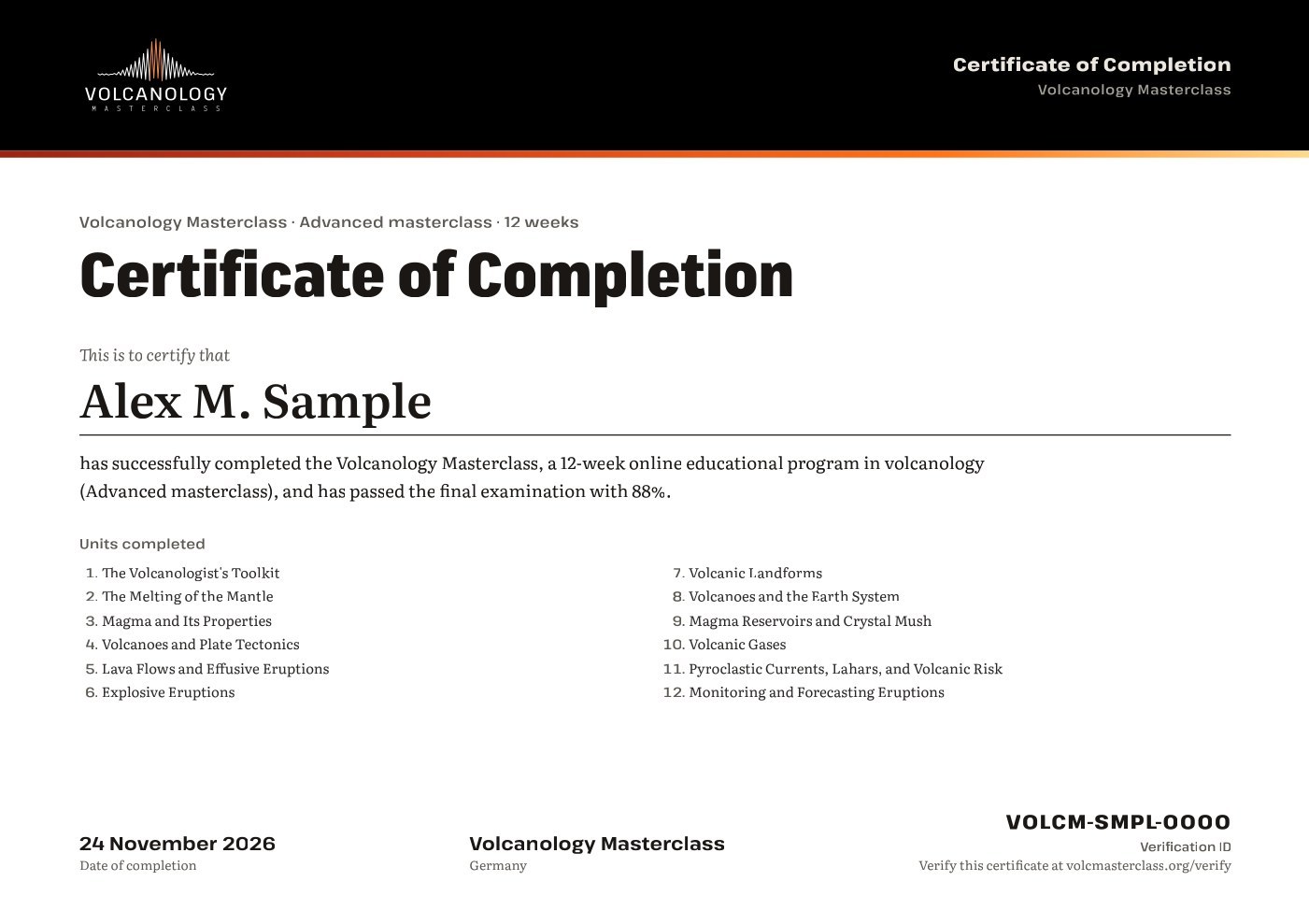
Sample certificate of completion of the Volcanology Masterclass

940 °C

Your certificate

Participants who pass the final exam receive an official certificate of completion. It states your name, the masterclass, its duration, and the units you completed.

Certificate and transcript. The transcript lists your score in every unit quiz and in the final exam.

Verifiable. Both documents carry a verification ID that can be checked on this website.

Shareable. Your personal verification link shows your result to universities, scholarship committees, and employers.

First page of Unit 3: Magma and Its Properties

900 °C

Sample unit

Read one complete unit before you enrol, exactly as participants receive it: the full text with its worked examples, eruption data, photographs, and research spotlight.

Unit 3, 17 pages

Magma and Its Properties

A magma is a silicate melt with crystals and dissolved gas, in proportions that change on the way up. The unit explains why silica makes a melt viscous, the four controls on viscosity (temperature, composition, dissolved water, and crystals) with real values, the density that makes magma rise and sometimes stop, how the temperature of lava is measured, and how much water and carbon dioxide a magma can hold at depth. It closes with the field measurement of viscosity on flowing lava and the table of the four magma types.

The unit opens with six questions

  1. What is a magma made of, and how do its three parts (melt, crystals, gas) change as it rises?
  2. Why is a rhyolite millions of times more viscous than a basalt at its own eruption temperature, and how much does 100 °C change the viscosity?
  3. How does dissolved water make a stiff melt runnier, and how does a few percent of water fit into rock at all?
  4. How much water can a magma hold at 4 km depth, and why does carbon dioxide leave it far deeper than water?
  5. Why does a lava flow with 50 % crystals behave like a solid, and what gives an ʻaʻā flow its walls?
  6. How is the viscosity of a flowing lava measured in the field, and what values come out?
Harmonic tremor. A steady, rolling signal that can last minutes or days, often as magma and gas move beneath the vent. Illustrative trace, 60 seconds.
The perfect cone of Mayon with an ash plume rising from its summit, seen across the roofs of Daraga at dusk.

820 °C

Academic community

Masterclass participants come from all over the world, and when you complete the program you stay part of a network that keeps you close to volcanology.

2000+Volcanology learners in our community
90+Countries represented
300+Schools and universities represented
Mayon, Philippines, erupting, seen from the church of Daraga, Albay. Photo: Jaycee Esmeria, CC BY-SA 4.0, source

Magma-Connect

Our alumni program introduces former participants to one another across countries: for study advice, exchange about university applications, and shared projects.

Opportunities

Past participants hear from us about scholarships, competitions, field schools, and other academic opportunities in volcanology and the earth sciences.

A place in volcanology

The program shows you how volcanoes are studied and where that work happens, at universities and at volcano observatories, so that your next step is an informed one.

The academic community

740 °C

Frequently asked questions

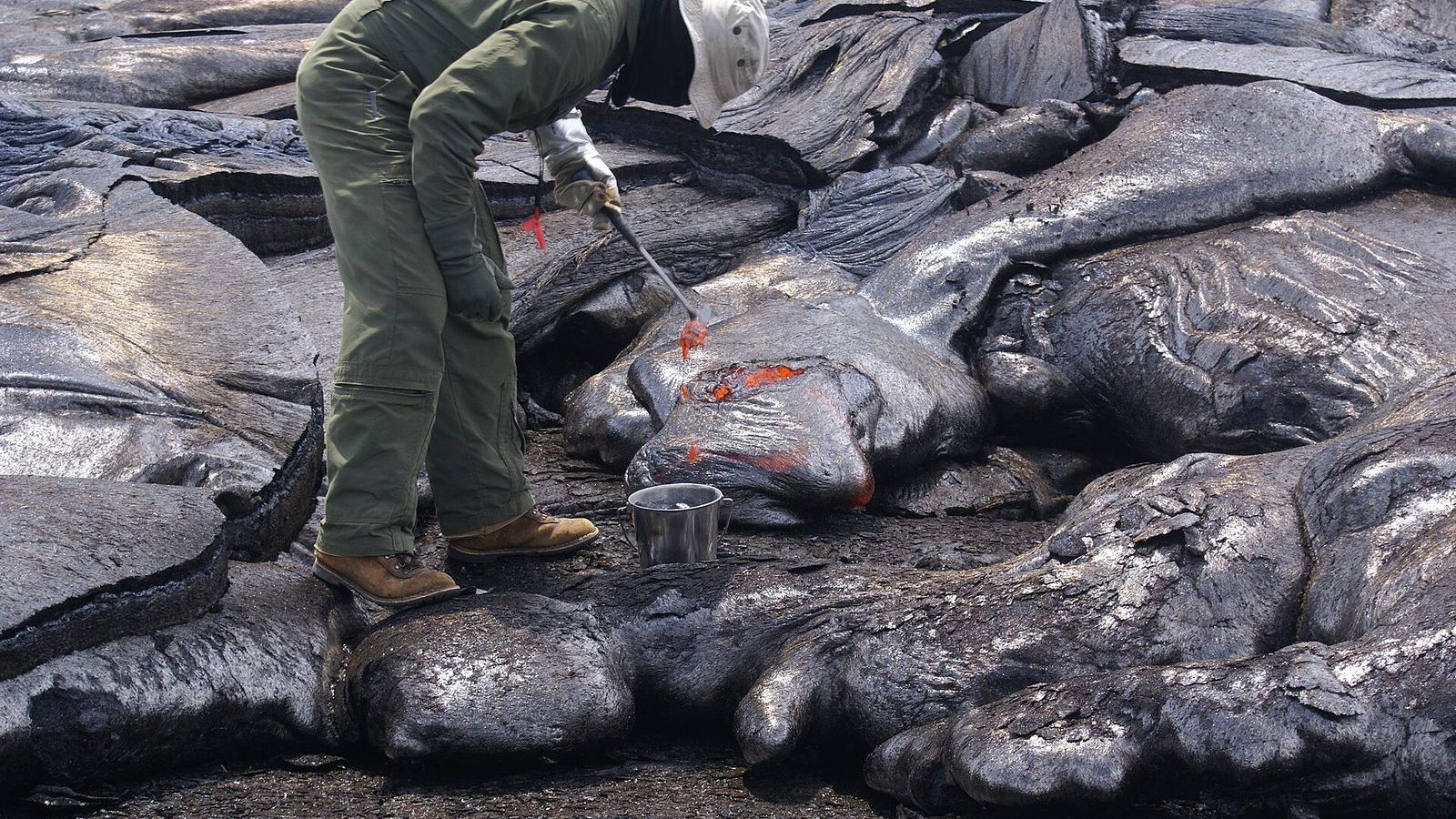
A geologist in a hard hat and protective clothing bends over a lobe of fresh pāhoehoe and scoops molten lava with a long tool, a bucket of water at his feet.
A geologist of the Hawaiian Volcano Observatory samples fresh pāhoehoe at Kīlauea. Photo: USGS, public domain, source
Who is this program for?

For high school students, university students, and lifelong learners. High school students use it to get ahead in geology, geography, and the Earth sciences, to prepare a university application, or to train for the Earth science olympiads. University students in geology, geography, physics, chemistry, environmental science, or engineering take it next to their degree, before a field course in Iceland, Italy, or Hawaiʻi, or as the base of a first project with real eruption data. Lifelong learners, among them many who have stood on a crater rim or followed an eruption on a webcam, use it to understand what they saw. The Foundation masterclass suits a first contact with the subject; the Advanced masterclass goes on to magma reservoirs, volcanic gases, hazards and risk, and the monitoring and forecasting of eruptions.

What do I need to know before I start?

School mathematics is enough: percentages, powers of ten, simple equations, the sine and tangent of a slope angle, and reading a graph, a map, and a table. You do not need prior knowledge of geology, chemistry, or physics, and no unit requires a calculator model, software, or programming. Unit 1 introduces every tool the later units use, among them the quantities that describe a magma (temperature, density, viscosity, and silica content), the conversion of pressure into depth, the logarithmic scale of the Volcanic Explosivity Index, and the world catalogue of eruptions. The later units of the Advanced masterclass use the exponential function and simple physics, such as buoyancy and the flow of a viscous liquid, and explain each step.

How does a week in the program look, and how much time does a unit take?

On Monday you receive the unit by email, as a web page and as a PDF. A day later we send further reading, including current research papers that are free to read, and during the week a free tool of the field, such as the world catalogue of volcanoes or a satellite map of sulfur dioxide, with two things to try in it. You study the unit and take the open-book quiz of ten questions. After you submit it, you see your result with explanations, and the next unit follows on the next Monday. Most participants spend three to five hours on a unit, including the quiz. Units with longer worked examples, such as the one on explosive eruptions or the one on monitoring and forecasting, take more time if you redo the calculations yourself, which we recommend.

Can I finish the program in less than 12 weeks?

Yes. A new unit is scheduled for every Monday, but once you have submitted the quiz of a unit you can ask for the next one ahead of schedule, from your dashboard or from the email we send you. The earliest moment is 24 hours after the previous unit was sent. We recommend the weekly rhythm, because the material needs time to settle, but the pace is your decision.

What happens if I fall behind or have to pause?

Nothing is lost. The next unit is only sent once you have submitted the quiz of the current one, so the program waits for you. You can pause for a week or for a term and continue at any time. There is no penalty and no deadline.

How does the final exam work?

After the last unit you sit the final exam online: 50 multiple-choice questions across the units of your masterclass, drawn individually for each participant, with a time limit of 60 minutes. It is open book. You pass with 70% correct answers. If you do not pass, you can try again after 3 days with new questions, up to 3 attempts in total.

All questions

A lava lake glowing red at dusk inside a deep crater, with a column of steam and gas rising from its edge.
Lava lake in Halemaʻumaʻu, Kīlauea, at dusk, 1 February 2014. Photo: USGS, public domain, source

650 °C

Stay up to date

New program dates, offers, and the occasional article about eruptions and the people who study them. You can unsubscribe at any time.

Eruption onset. Tremor grows over minutes, then an explosion saturates the record. Illustrative trace, 60 seconds.
The top of an arching lava fountain at Kīlauea against a pale sky.

Begin your 12 weeks in volcanology

Lava fountain at Kīlauea, Hawaiʻi, 1983. Photo: J. D. Griggs, USGS, public domain, source