 Image: Shreyashmohite5025 (CC BY-SA 4.0)
When a continent floods with lava
The largest volcanic events in the history of the Earth were not explosions. They were floods: basalt poured out of fissures tens of kilometres long, in flows that each covered thousands of square kilometres, repeated hundreds of times over a few hundred thousand years, until a region the size of a country lay under a kilometre or two of lava. Geologists call the result a large igneous province, and the lavas a flood basalt. Nothing of the kind has happened since humans existed, and nothing in the modern world comes closer to it than the Laki eruption of 1783, which was one flow's worth. Three of the five great mass extinctions are dated to within a few tens of thousands of years of a province's eruption.
The catalogue
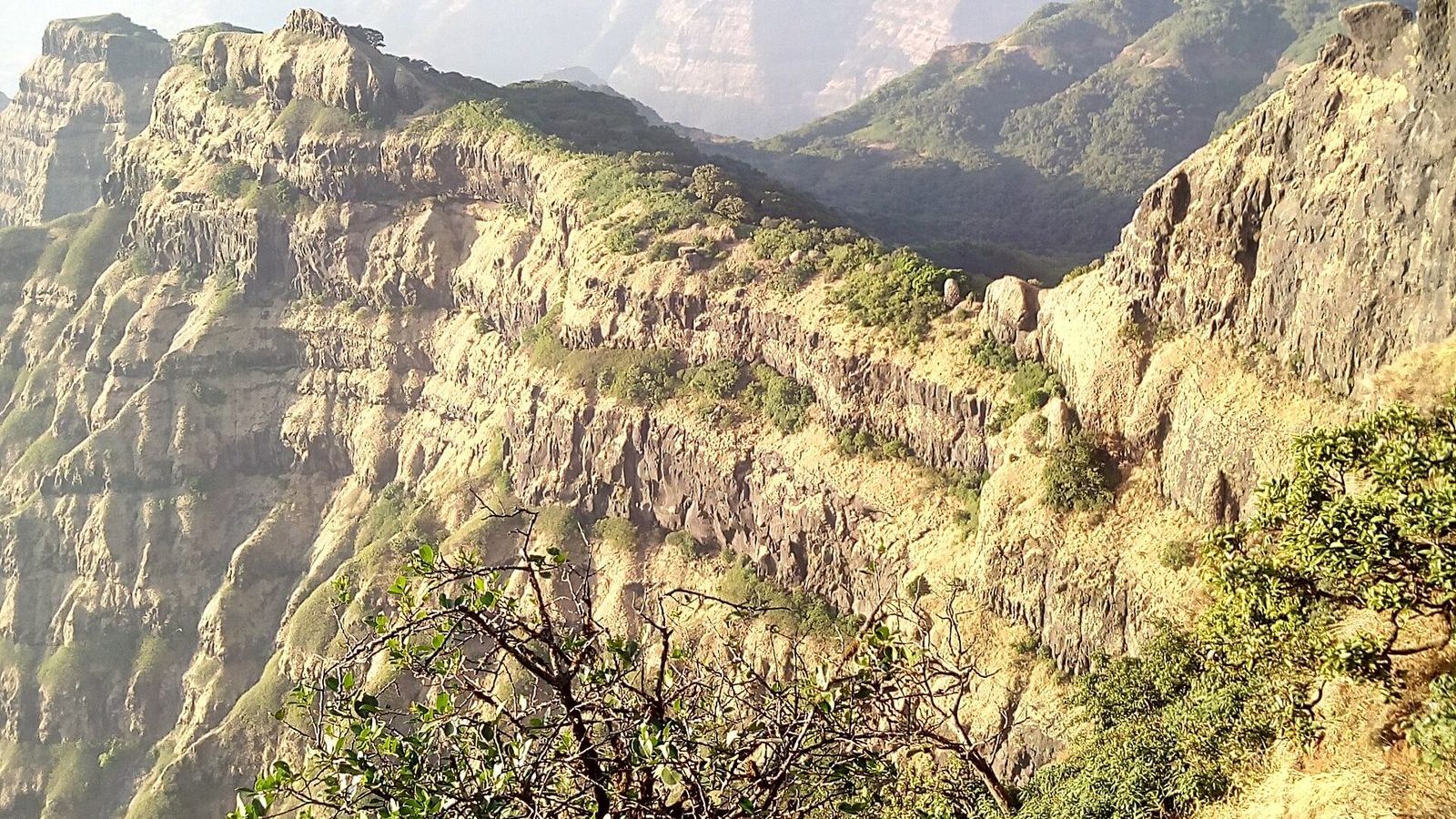
The provinces are known by their names on the map. The Columbia River Basalt of Washington and Oregon, erupted between 16.7 and 5.5 million years ago with most of its 210,000 km³ in the first million years, is the youngest and the best studied, because its flows are exposed in the canyons of the Columbia and the Snake and can be walked across one by one. The Deccan Traps of western India, about 66 million years old, hold about a million cubic kilometres and stand in the stepped hills of the Western Ghats, whose steps, called traps from the Swedish word for stairs, gave the provinces their name. The Siberian Traps, about 252 million years old, hold at least three million cubic kilometres and cover a region of Siberia larger than western Europe. The Central Atlantic Magmatic Province of about 201 million years ago is split between four continents that were one when it erupted. The North Atlantic province of 62 to 55 million years ago is the one that Iceland still sits on, and the Paraná-Etendeka of about 134 million years ago lies on either side of the South Atlantic in Brazil and Namibia. Under the sea, the Ontong Java plateau of about 120 million years ago is the largest of all, tens of millions of cubic kilometres, and almost nobody has seen it.
The volumes of the older provinces are reconstructions. Erosion has removed much of the lava, the continents have split through some of them, and what survives in Siberia is partly the sills and dykes that fed the flows rather than the flows themselves. The catalogue kept by the Large Igneous Provinces Commission gives the estimates and their sources, and the uncertainties are large.
A single flow
The scale of a province is hard to picture, so take one flow. The Roza member of the Columbia River Basalt, erupted about 14.5 million years ago, is a set of flows from a fissure system about 150 km long that together hold about 1,300 km³ of basalt and covered more than 40,000 km², from the fissures in eastern Washington to the Pacific coast. Mapped in detail, the flows show that the lava advanced as inflating lobes of pāhoehoe rather than as a single sheet, the same way a Kīlauea flow field grows, with a crust that formed and was lifted by lava injected beneath it, at a scale a thousand times larger. The eruption that made it lasted, by the estimates of Thorarinsson and Self, perhaps a decade.
Scale it from Laki. The Laki eruption in Iceland in 1783 to 1784 erupted 14.7 km³ of basalt in eight months from a fissure 27 km long and released about 120 million tonnes of sulfur dioxide, about 8 million tonnes per cubic kilometre of lava. Scaling that yield to the Roza, 1,300 km³ would release about 10,000 million tonnes of sulfur dioxide, about 500 times Pinatubo's 17 to 20 million. Spread over a decade, that is about fifty Pinatubos a year, every year, for ten years, from one flow of a province that produced hundreds. Laki's haze alone hung over Europe for a summer and cooled the following winter; a fifth of Iceland's people died in the famine after its fluorine killed the livestock. The Deccan Traps hold about 70,000 Lakis.
What makes them
The leading explanation is the plume head. A plume of hot mantle rising from great depth has a bulbous head, perhaps a thousand kilometres across, that arrives under the lithosphere, spreads, and melts in bulk by decompression, producing an enormous volume of basalt in a short time; the plume's narrow tail then feeds a hotspot for tens of millions of years afterwards. The model fits the provinces that connect to living hotspots: the Deccan to Réunion, the Paraná to Tristan da Cunha, the North Atlantic province to Iceland, each joined by a track of volcanoes across the ocean floor. It fits less well where no track exists, and the alternatives, convection driven at the edge of a thick continental root, or the sinking of a dense slab of lithosphere that lets hot mantle rise to replace it, are argued for some provinces. The debate is real and the masterclass presents it as one.
The extinctions
The Siberian Traps erupted at about 252 million years ago, and the end-Permian extinction, the largest in the history of life, which removed perhaps 90 percent of marine species, is dated at 251.9 million years. The Central Atlantic province erupted at about 201 million years ago, and the end-Triassic extinction is dated at 201.4 million. The Deccan Traps erupted across 66 million years ago, and the end-Cretaceous extinction, which ended the dinosaurs, is dated at 66.0 million, the same age as the Chicxulub impact in Mexico, so that the Deccan case is a debate about two causes rather than one. Three coincidences at that precision are hard to dismiss, and the dating has become precise enough to test them. For the Siberian Traps, Seth Burgess and colleagues showed in 2017 with uranium-lead dates on zircons that about two thirds of the lava had erupted before the extinction began, and that the extinction coincided with the first pulse of sills intruding the sedimentary basin beneath the lavas, where they cooked coal, limestone, and evaporites and released their carbon and sulfur. In their reading the lavas were not the killer; the sills were.
The mechanism in every case is the gas. A province releases sulfur, which cools the planet for years at a time, and carbon dioxide, which warms it for tens of thousands of years, because the weathering that removes carbon dioxide from the air works on a longer time scale than the eruption. The result, in the Siberian case, was warming of several degrees, ocean acidification, and oxygen-poor seas, with the sulfur giving sharp cold snaps along the way, over a span long enough to exhaust the capacity of life to adapt. The paper is open access.
The other giant
Volcanology has two kinds of giant, and they are opposites. The super-eruption is explosive, lasts days, and empties a caldera in one event; the flood basalt is effusive, lasts hundreds of thousands of years, and never produces a column that anyone would call dramatic. On the Volcanic Explosivity Index a flood basalt barely registers. On the scale of what it does to the planet, the flood basalt is the more dangerous by far, because its gases keep coming for longer than the climate can absorb them. The last one, the Columbia River Basalt, had erupted most of its volume by 15 million years ago, and there is no sign of the next.
Unit 15 of the masterclass gives the catalogue, the plume head model and its rivals, the inflated sheet flow as the mechanism, the gas yields, and the dating of the Siberian Traps in its research spotlight, and Unit 8 explains the sulfur and carbon dioxide effects that the giants scale up. The catalogue of the provinces, with ages and volumes, is kept by the Large Igneous Provinces Commission.