 Image: Norbert Nagel (CC BY-SA 3.0)
The volcano under Naples
Vesuvius has the fame, but the volcano that worries the Osservatorio Vesuviano most is on the other side of Naples. Campi Flegrei, the Phlegraean Fields, is a caldera about 12 km across whose eastern rim is under the city's western districts and whose floor holds the town of Pozzuoli, the suburbs of Bagnoli and Agnano, a university campus, and about 500,000 people in the zone that would have to be evacuated before an eruption. The floor of the caldera has been rising since 2005, by more than 1.3 m by 2024, and the earthquakes that come with the uplift reached magnitude 4.4 in May 2024 and 4.6 in March 2025, the strongest in forty years. Nobody knows whether it will erupt. What is known is a great deal, and here is the summary.
A caldera with a history
The caldera was made by two eruptions. The first, the Campanian Ignimbrite of about 39,850 years ago, erupted some hundreds of cubic kilometres of magma and spread ash from Naples to Russia; it is the largest eruption in Europe in the last 200,000 years. The second, the Neapolitan Yellow Tuff of about 15,000 years ago, is the soft yellow rock that Naples is built of and built on. Since then the caldera has erupted dozens of times from vents scattered across its floor, each building a small cone or crater: the Solfatara, the Astroni, Monte Nuovo. The last eruption was Monte Nuovo, which grew in a week from 29 September 1538 to a cone 130 m high, after decades of uplift that had driven the sea back from Pozzuoli's shore. That eruption is the model the observatory has in mind: small, local, and preceded by years of the kind of unrest that is happening now.
The bradyseism
The ground of Campi Flegrei moves up and down by metres on a time scale of years to centuries, and the movement has a name of its own, bradyseism, the slow earthquake. The evidence stands in the Roman market of Pozzuoli, the so-called Serapeum, whose three marble columns carry a band of holes bored by marine molluscs up to about 7 m above the floor, which shows that the floor was under the sea for a long period in the Middle Ages before it rose again. Charles Lyell put the columns on the frontispiece of the Principles of Geology in 1830 as proof that the land can rise and fall without a catastrophe, and the columns have been the field's thermometer of the caldera ever since.
The modern record began in 1950. The ground rose about 0.7 m between 1950 and 1952, about 1.7 m between 1969 and 1972, and about 1.8 m between 1982 and 1984, each time centred on Pozzuoli. The 1982 to 1984 episode brought more than 10,000 earthquakes, the largest of magnitude 4.0, and damaged the old town of Pozzuoli, the Rione Terra, so badly that it was evacuated and about 40,000 people were moved out in October 1984. No eruption followed. The ground then sank by nearly a metre over the following twenty years, as it had after each earlier episode, and the fear subsided with it.
The present episode began in 2005. The uplift was slow at first, a few centimetres a year, and has accelerated: about 10 cm a year in 2023, with the total since 2005 passing 1.3 m in 2024, which is close to the level of 1984. The earthquakes have grown with it. A magnitude 4.2 in September 2023 was the largest in forty years until the magnitude 4.4 of 20 May 2024 and the magnitude 4.6 of 13 March 2025 passed it. The alert level has been at yellow, the second of four, since December 2012.
What is pushing
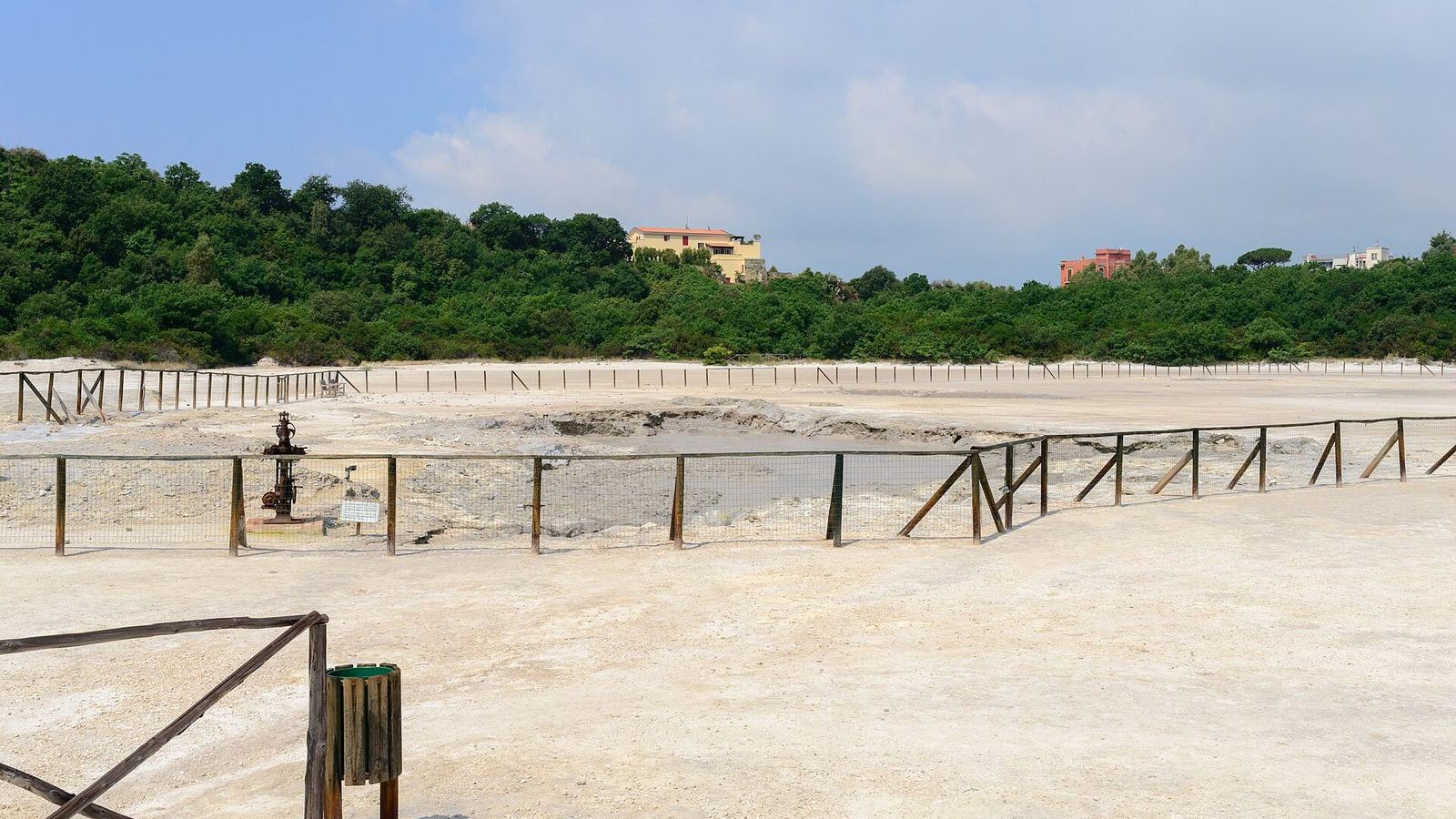
The argument among the scientists is about what is doing the pushing, and the argument matters because the answer decides how dangerous the unrest is. One reading is that the uplift is driven by magma arriving in a reservoir at about 3 to 4 km depth, where the geodetic source of the uplift sits. The other is that the pressure comes from the hydrothermal system, the hot water and gas in the rock at 2 to 3 km, which is being fed by gas from a deeper magma body at about 8 km, and which can inflate the ground without any magma coming near the surface. The gas measured at the Solfatara crater and the Pisciarelli fumaroles has changed over the episode in ways that fit a deep magmatic source heating the shallow system, and the deformation can be modelled either way. Most of the scientists involved think both are true in some proportion, and that the proportion is the thing to watch.
A worked number shows the scale. The 1982 to 1984 uplift of 1.8 m at its centre is well fitted by a Mogi source, a pressurized point in an elastic crust, at a depth of about 3 km. For such a source the volume change is the central uplift times π times the depth squared, divided by 1 minus Poisson's ratio: 1.8 × 3.14 × 3,000² / 0.75, which is about 68 million cubic metres, or about 0.07 km³. That is small, a twentieth of what Kīlauea erupted in 2018, and it is the volume change of the source, which could be magma, or gas and water, or both. The present episode has produced a comparable total over twenty years.
Reading the earthquakes against the uplift
Christopher Kilburn of University College London and his colleagues at the observatory proposed in 2017 a different way to read the episodes. In their model the crust above the source first stretches elastically, with few earthquakes, and then, as it approaches its strength, begins to break, so that the number of earthquakes grows ever faster with each centimetre of uplift. Comparing the three episodes since 1950, they found that the breaking stage was reached earlier in each one, as if the crust had not healed between them: the episodes accumulate rather than reset, and the caldera, in their reading, has been moving towards the state in which the crust can open a path for magma. The paper, which is open access, does not say that an eruption is coming; it says that the margin is smaller than it was, and the earthquakes of 2024 and 2025 have been read in its light.
The city
The civil protection plan divides the caldera into a red zone of about 500,000 people, who would be moved before an eruption, and a yellow zone of a further 800,000 who could be affected by ash. The plan assumes 72 hours for the evacuation of the red zone, by road, rail, and sea, once the alert level reaches red, and the exercises that have tested parts of it have shown how hard it would be. The science can give days to weeks of warning for a small eruption of the Monte Nuovo kind, if the signs are clear, and it may not be able to say where in the caldera the vent would open until the last hours. In 2024 the government passed a decree on the caldera's buildings, and the schools of Pozzuoli ran evacuation drills. The question the observatory is asked every week is whether this is 1984 again, an episode that will end in subsidence, or the run-up to the first eruption since 1538, and the honest answer in its bulletins is that the data do not yet say.
Unit 16 of the masterclass, the last of the program, works through Campi Flegrei's record as a table of episodes, the hydrothermal and magmatic readings of the unrest, the elastic-brittle model with its research spotlight, and the decisions a city on a caldera faces; Unit 12 supplies the Mogi model the worked number uses. The weekly bulletins, with the uplift at the Rione Terra and the earthquake count, are published in Italian by the Osservatorio Vesuviano and are readable with a browser's translation function.