 Image: Bureau of Land Management, public domain
The largest eruption you have never heard of
The largest explosive eruption that geologists have found happened about 28 million years ago in what is now south-western Colorado, and it has no popular name, no documentary, and no anniversary. The volcano is the La Garita caldera, a hole 35 by 75 km in the San Juan Mountains that few people have heard of because it is so large and so eroded that it does not look like a volcano at all. The deposit is a rock called the Fish Canyon Tuff. Its volume, about 5,000 cubic kilometres of magma, makes it about twice Toba, five times the largest Yellowstone eruption, and a hundred times Tambora, and the story of how that number was arrived at is a lesson in how the big numbers of volcanology are made.
The San Juan volcanic field
Between about 35 and 23 million years ago the region that is now the San Juan Mountains was one of the most violent volcanic provinces in the history of North America. As the subducting plate under the western United States steepened and withdrew, hot mantle rose under the thickened crust, and the crust melted on a scale that produced at least fifteen caldera-forming eruptions in the San Juan field alone, in a cluster of overlapping calderas that Peter Lipman of the US Geological Survey spent a career mapping. The Fish Canyon eruption, at about 28 million years, was the largest of them and the largest known anywhere.
The magma was a dacite, unusually rich in crystals, about 45 percent by volume, of plagioclase, sanidine, quartz, biotite, and hornblende, and remarkably uniform from the bottom of the deposit to the top. Volcanologists call rocks like it monotonous intermediates, and their uniformity says that the reservoir was a single, well-mixed body of crystal mush a thousand cubic kilometres and more in size, held near the temperature at which it would freeze for a long time before something, perhaps an injection of hotter magma from below, remobilized it and let it erupt. One of its minerals, the sanidine, has a second life: because the Fish Canyon Tuff is so uniform and so well dated, its sanidine is the standard against which argon dating laboratories around the world calibrate their instruments, and the best current age for it, 28.2 million years, is one of the most carefully measured ages in geology.
Measuring 5,000 cubic kilometres
Nobody saw the eruption, so the volume comes from the deposit, and the deposit is in two parts. Outside the caldera, the pyroclastic currents of the eruption spread a sheet of ignimbrite over about 15,000 km² of the surrounding country, the outflow sheet, which is tens to hundreds of metres thick where it is preserved and which has been eroded away over most of its original area. Inside the caldera, the currents that could not escape, and the roof that collapsed into the emptying reservoir, filled the hole with ignimbrite more than a kilometre thick, the intracaldera fill, which is now exposed in the walls of canyons cut through it.
The method is to map the thickness of each part, multiply thickness by area, and add. The outflow sheet is measured in outcrops and drill holes, with the thickness contoured across the map and the eroded part estimated from the pattern of what remains. The intracaldera fill is measured in the canyon walls and in the geophysical soundings of the caldera's depth. The sum, in Lipman's estimates and in the compilation of Mason, Pyle, and Oppenheimer in 2004, is about 5,000 km³ as dense rock, with an uncertainty of perhaps a third either way. The uncertainty is dominated by the parts nobody can measure: the outflow that has been eroded, and the finest ash, which rose with the currents as a co-ignimbrite cloud and fell over a continent in a layer too thin to survive 28 million years. For the Toba eruption, 74,000 years old, the far-travelled ash can still be found in India and the ocean cores and adds a large fraction to the total; for La Garita it is gone, and the 5,000 is a minimum.
The magnitude follows from the volume. At a density of about 2,500 kg/m³ for a crystal-rich dacite, 5,000 km³ is 5 × 1012 m³ × 2,500 kg/m³ = 1.25 × 10¹⁶ kg. The logarithm of that is 16.1, and 16.1 minus 7 gives a magnitude of 9.1. A magnitude 9 eruption is ten times a magnitude 8, and if the rule that each magnitude step is about ten times rarer than the one below held at the top of the scale, a magnitude 9 would be expected about once in 170,000 years and the last 500 million years should hold a few thousand of them. The record holds a handful. Either the rule breaks down at the top, because the crust cannot hold reservoirs much larger than this, or the record is missing almost all of them, and the answer, as with most questions about the largest eruptions, is probably both.
What the eruption was like
The deposit says a surprising amount about the day. The Fish Canyon Tuff has almost no fall deposit at its base, which means the eruption began with little of the tall Plinian column that opens most explosive eruptions and went almost at once into the collapsing, fountaining phase that feeds pyroclastic currents. The currents ran in every direction from a ring of vents that opened along the fault as the roof began to sink, at temperatures high enough that the deposit welded into a dense rock as it settled, and they buried the country around the caldera under a hot sheet that cooled over years. The whole eruption probably lasted days to weeks. Afterwards the caldera floor, a block of crust 35 by 75 km, rose again in the middle as the reservoir refilled, a resurgent dome that is still a mountain. There was no human being on Earth to see it, and the nearest living animals were the mammals of the Oligocene.
Why the big ones are old
There is a pattern in the list of the largest eruptions. The biggest of all is 28 million years old; the next tier, including the Huckleberry Ridge Tuff of Yellowstone, is about 2 million years old; the Toba eruption, 74,000 years old, is the largest of the last million years; and the largest of the last 10,000 years, Tambora, is a hundred times smaller than Toba. Part of the pattern is real: provinces like the San Juan field, where the crust was melted on that scale, are rare and last a few million years. But a larger part is the record. The chance that a deposit survives to be mapped falls with its age, and the chance that it is recognized as one eruption rather than several falls too. The research spotlight of Unit 1 of the masterclass shows how steeply the count of large eruptions falls with age in the global database, far more steeply than any change in the Earth could explain. The largest eruption you have never heard of is, in all probability, not the largest that ever happened.
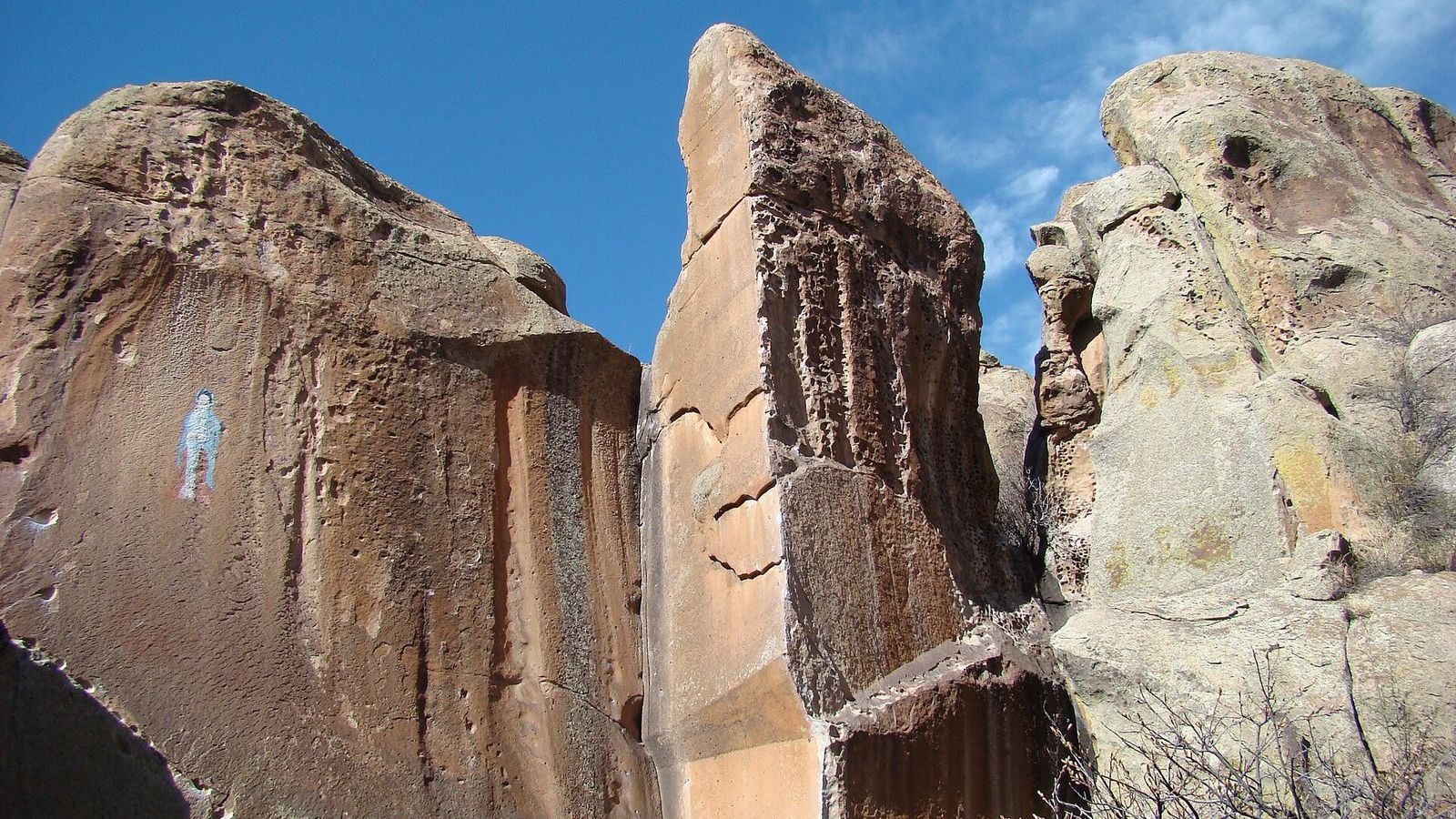
The Fish Canyon Tuff can be walked on. The cliffs and spires of Penitente Canyon on the edge of the San Luis Valley, where this article's cover photograph was taken, are carved from it, and the eroded ash of the Wheeler Geologic Area is another part of the same deposit. Unit 13 of the masterclass works through the caldera, the ignimbrite, and how a volume this size is measured, with La Garita as its example of the top of the scale. The compilation of the largest eruptions by Mason, Pyle, and Oppenheimer (2004) is where the ranking comes from.