 Image: Chapsorini (CC BY-SA 4.0)
There is no such thing as a supervolcano
Ask a volcanologist about supervolcanoes and you will get a small wince before the answer. The word was popularized by a BBC television programme in 2000 and has been attached since to Yellowstone, Toba, Campi Flegrei, and any other caldera that a headline needs, usually with the words overdue, catastrophic, and civilization in the same sentence. It has no definition in the science. What the science has is a definition of a super-eruption, a list of the calderas that have produced one, and a return period with an honest uncertainty. The real subject is less dramatic than the word and more interesting.
The definition
A super-eruption is an explosive eruption of magnitude 8 or more. The magnitude is the logarithm of the erupted mass in kilograms minus 7, so magnitude 8 means 1015 kg of magma, which at a density of about 2,400 kg/m³ is a little over 400 km³ of dense rock, or roughly 1,000 km³ of the bubbly tephra that the eruption actually throws out. On the Volcanic Explosivity Index, which uses that bulk volume, it is a VEI 8. The threshold was set out in a report of the Geological Society of London in 2005 and has been the working definition since. It is a line drawn on a continuous scale rather than a boundary in nature; an eruption of magnitude 7.9 is not a different kind of thing.
For scale, Tambora in 1815, the largest eruption of the last thousand years, was magnitude 7.0 and about 40 km³ of dense rock, a tenth of the threshold. Pinatubo in 1991 was about 5 km³, Mount St Helens in 1980 about 0.4. A super-eruption is a hundred times Pinatubo at least.
What produces one
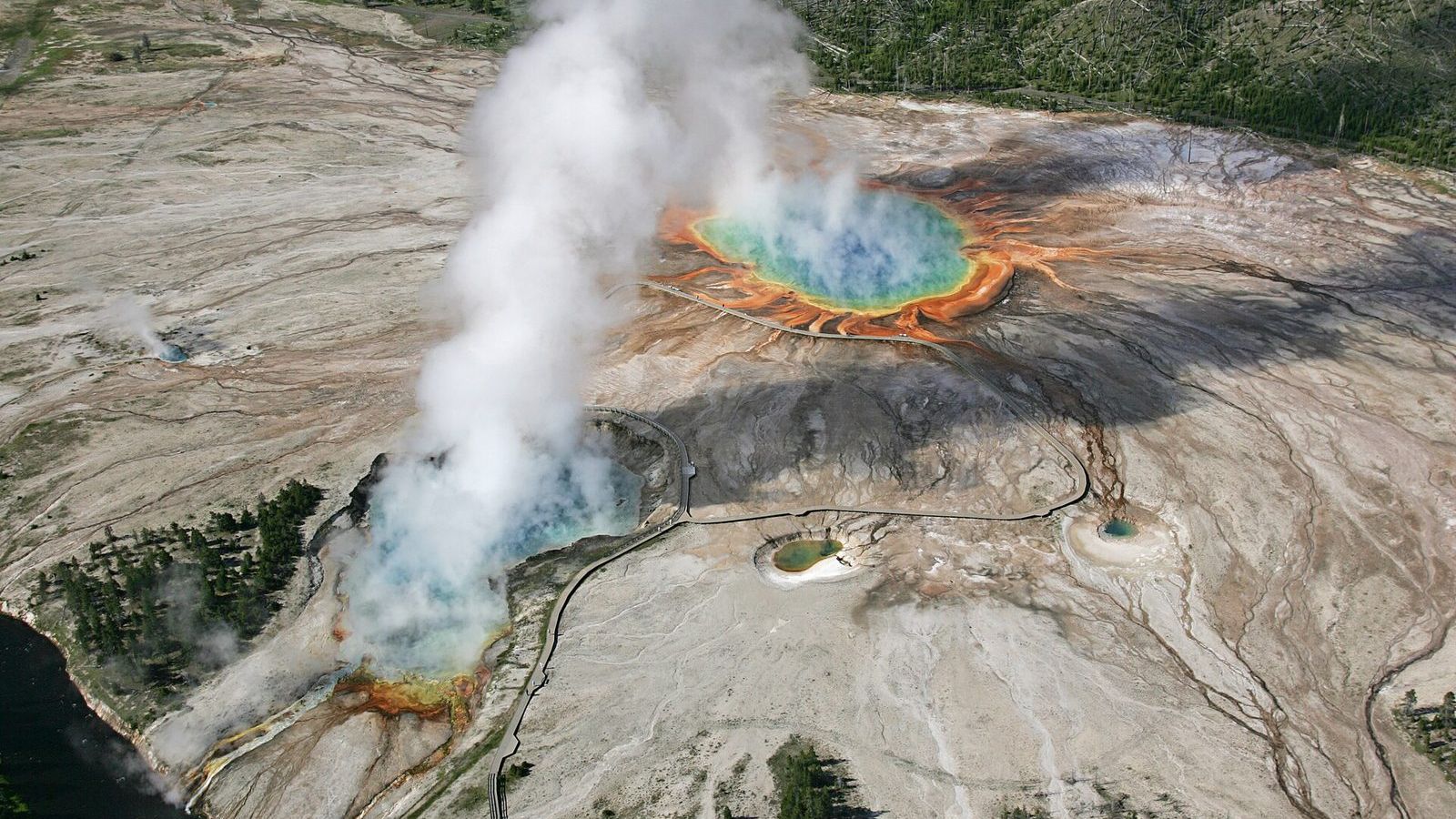
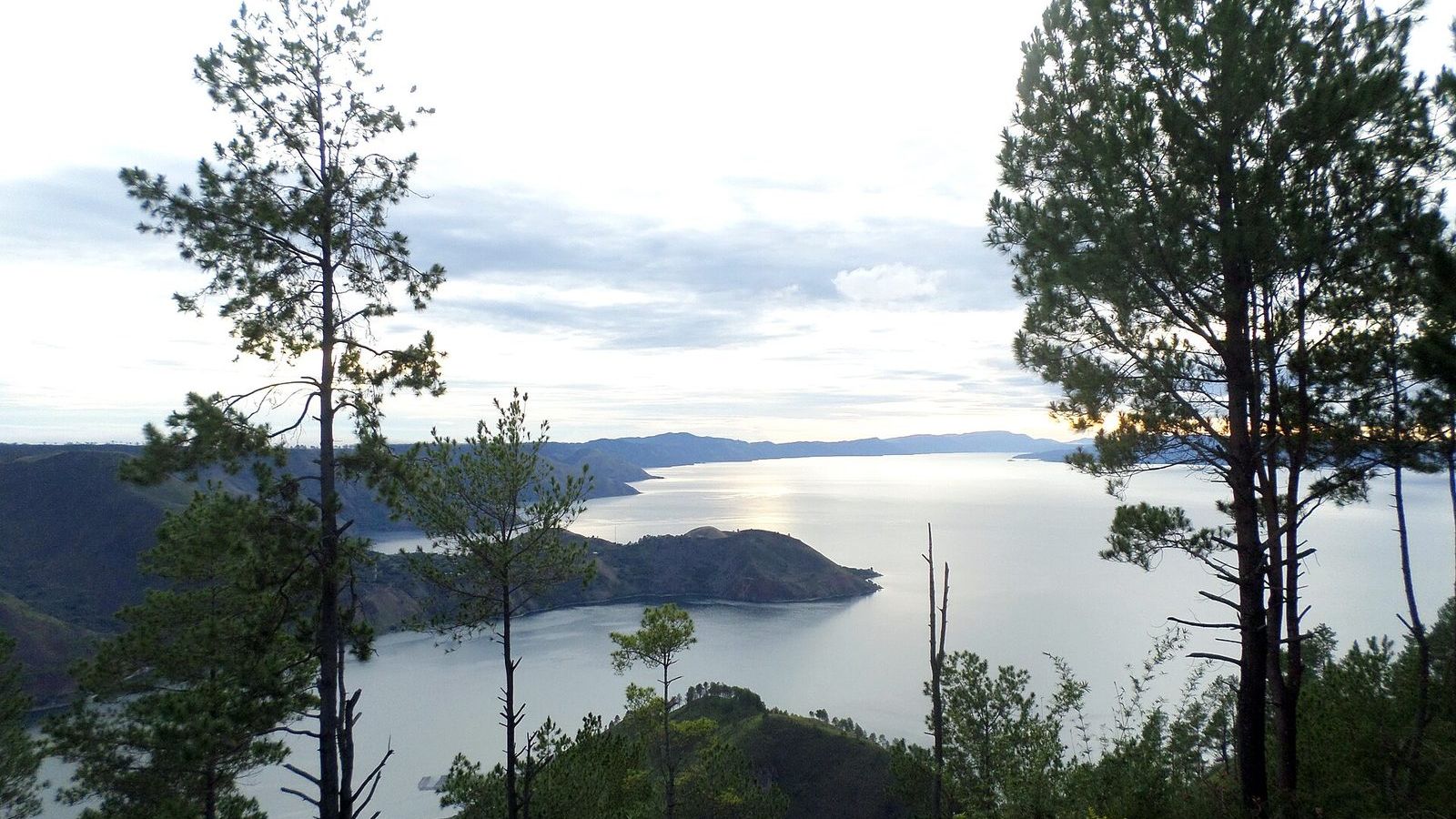
Every super-eruption in the record came from a caldera, because the only way to erupt 400 km³ of magma is to drain a reservoir of at least that size, and when a reservoir that size empties its roof collapses into the hole. The collapse is the caldera, a depression tens of kilometres across with a ring fault around it, and the eruption that made it is recorded as a sheet of ignimbrite, the welded deposit of the pyroclastic currents, hundreds of metres thick around the rim and running 100 km or more across the country. Lake Toba in Sumatra, 100 km long, is such a caldera. So are the Yellowstone caldera, 45 by 70 km, Long Valley in California, Lake Taupō in New Zealand, and La Garita in Colorado, the largest known.
The reverse does not hold. Most calderas never produced a super-eruption, and the caldera systems that did also erupt small, often: Yellowstone's last eruption, about 70,000 years ago, was a lava flow; Taupō's eruption of about 232 CE was a magnitude 7; Campi Flegrei's last, in 1538, built a cone 130 m high in a week. A caldera that has had a super-eruption is a volcano with a particular history, not a particular kind of volcano, and the word supervolcano suggests a type that does not exist.
What the systems share is a setting: thick, hot continental crust above a large and steady supply of basalt from the mantle, which heats the crust until hundreds of cubic kilometres of rhyolite can gather as a mush and, in the final step, as an eruptible body of melt. The gathering takes tens or hundreds of thousands of years; the final assembly, by the evidence of the crystals in the Bishop Tuff of Long Valley, may take only centuries. The physics is the subject of Units 9 and 13 of the masterclass.
The list
The record of the last two million years, which is the part of the record good enough to count, holds a few dozen eruptions of magnitude 8 or more, and the number falls steeply with age because old deposits are eroded, buried, or simply not yet found. The best-known entries are the Youngest Toba Tuff of about 74,000 years ago, at least 2,800 km³ of dense rock and by the newest estimates perhaps 5,300, the largest of the Quaternary; the Oruanui eruption of Taupō about 25,500 years ago, 530 km³ of magma and the most recent super-eruption on Earth; the Huckleberry Ridge Tuff of Yellowstone about 2.08 million years ago at about 2,450 km³ and the Lava Creek Tuff about 631,000 years ago at about 1,000; and the Bishop Tuff of Long Valley about 767,000 years ago at about 600 km³ of dense rock. Further back, the Fish Canyon Tuff of La Garita, about 28 million years ago, erupted about 5,000 km³ in one event, magnitude 9.1, and stands alone at the top of the list.
How often
Counting the entries by age and correcting for the ones that must be missing, Jonathan Rougier and his colleagues at Bristol estimated in 2018 that eruptions of magnitude 8 or more happen about once in 17,000 years, with a 95 percent range of roughly 5,000 to 50,000 years. Earlier estimates had put the figure at once in 50,000 to 100,000 years; the new one was shorter because the counting was more careful, and the wide range is a statement about the record rather than about the volcanoes. Eruptions of magnitude 7, the Tambora class, happen one or two times per thousand years, and there is roughly a one-in-six chance of one in this century.
The arithmetic is worth doing. If magnitude 8 eruptions happen at random with a mean spacing of 17,000 years, the probability of at least one in the next 100 years is 1 − e−100/17,000, which is about 0.6 percent. In an 80-year lifetime it is about 0.5 percent. Take the pessimistic end of the range, a spacing of 5,000 years, and the century's probability rises to about 2 percent; take the optimistic end and it falls to 0.2 percent. None of these numbers depends on how long it has been since the last one, because a mean spacing is not a schedule, and the Oruanui eruption 25,500 years ago makes the next one neither more nor less likely. That point is the subject of the masterclass's unit on Yellowstone.
What one would do
The effects of a super-eruption are a matter of scaling from the eruptions that have been measured, and the scaling is not simple. Ash would fall over a continent: the Toba ash is found as a layer across India and the Indian Ocean, and the Lava Creek ash reached from California to the Mississippi. The sulfur injected into the stratosphere would cool the planet for several years, by several degrees in the largest climate model runs, though a very dense veil forms large droplets that fall out faster, so the cooling grows more slowly than the sulfur. The archaeological evidence from South Africa and India is that people lived through Toba in both places, and the idea that the eruption nearly ended the human species, popular in the 1990s, has not survived the excavations. A super-eruption today would be a global catastrophe on the scale of agriculture, trade, and aviation, and nobody who studies them says otherwise; it would also be one with months to years of warning, because a reservoir of that size does not assemble itself in silence.
The useful question is therefore which calderas are restless now and what their unrest means, since there is no supervolcano to ask about. That is a question about Campi Flegrei, Taupō, Long Valley, and Yellowstone in the present tense, and the subject of the last unit of the program. Unit 13 of the masterclass gives the definition, the caldera mechanics, the list, and the return period with its arithmetic, and Unit 14 takes the three great systems one by one. The return period estimate is in Rougier and colleagues (2018), and the one-in-six figure for a magnitude 7 in Cassidy and Mani (2022).