

Volcanoes and the Earth System
The volcano as a chimney of the planet: the gases it releases, the evidence that they outgassed the oceans and the atmosphere, and the long carbon cycle that kept the Earth habitable. The unit measures what a large eruption does to the climate for a year or two, with Pinatubo in 1991 and Tambora in 1815 as the cases and the ice cores as the archive, sets the carbon dioxide of volcanoes against that of people, and turns to volcanic soils, the gases that kill, the eruptions that changed history, and the heat that is now harvested as energy. It closes the Foundation masterclass with the big picture.
A volcano is a chimney as well as a mountain. Every eruption of the earlier units, from the quiet lava of Unit 5 to the Plinian column of Unit 6, releases gas into the air, and over the age of the Earth those gases added up to the oceans and the atmosphere. The same chimney can cool the whole planet for a year or two, feed the soil on which a tenth of the world’s people live, and kill a valley in a night. This unit follows the gases out of the vent and asks what they have done to the air, the climate, the soil, and the history of the people who live on volcanoes, and it closes the Foundation masterclass by putting the seven earlier chapters into one picture of the planet.
1 The volcano as a chimney
Unit 3 described the gas dissolved in the melt and Unit 6 its bubbles; here the gas has left the magma, and the questions are what it is made of and where it goes. By mass, water is almost always the main volcanic gas, carbon dioxide comes second, and sulfur dioxide third, with hydrogen sulfide, the acids hydrogen chloride and hydrogen fluoride, hydrogen, carbon monoxide, and nitrogen behind them. Table 1 gives three analyses that volcanologists have quoted for decades, of a basalt at a hotspot, a basalt in a rift, and an andesite above a subduction zone. The values are given as mole percent of the whole gas, water included, which means the share of the molecules rather than the share of the mass. The hot basaltic gases are rich in carbon dioxide and sulfur dioxide, and the cooler andesitic gas is almost all water with a few percent of hydrogen chloride (Unit 4 explained where the water comes from). How such gases are collected and measured, and how much of each the world’s volcanoes release in a year, lies beyond the Foundation units.
| Gas | Kīlauea, 1918 | Erta Ale, 1974 | Momotombo, 1982 |
|---|---|---|---|
| Temperature of the sample | 1,170 ° C | 1,130 ° C | 820 ° C |
| Water, \(\mathrm{H_2O}\) | 37.1 | 77.2 | 97.1 |
| Carbon dioxide, \(\mathrm{CO_2}\) | 48.9 | 11.3 | 1.44 |
| Sulfur dioxide, \(\mathrm{SO_2}\) | 11.8 | 8.34 | 0.50 |
| Hydrogen, \(\mathrm{H_2}\) | 0.49 | 1.39 | 0.70 |
| Carbon monoxide, \(\mathrm{CO}\) | 1.51 | 0.44 | 0.01 |
| Hydrogen sulfide, \(\mathrm{H_2S}\) | 0.04 | 0.68 | 0.23 |
| Hydrogen chloride, \(\mathrm{HCl}\) | 0.08 | 0.42 | 2.89 |
| Hydrogen fluoride, \(\mathrm{HF}\) | not measured | not measured | 0.26 |
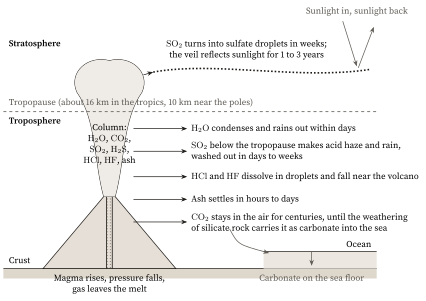
Figure 1 draws the fate of each gas. Water condenses and rains out within days. Hydrogen chloride and hydrogen fluoride dissolve in cloud droplets at once and fall near the volcano, which is why they matter for the farmer downwind and hardly at all for the planet. Ash settles in hours to days. Sulfur dioxide takes two roads, and the boundary between them is the tropopause, the top of the troposphere, which is the lowest layer of the atmosphere, where the weather happens, and the bottom of the dry, stable stratosphere above it. Below the tropopause, sulfur dioxide becomes acid haze and acid rain and is washed out in days to weeks. Above the tropopause there is no rain, so sulfur that gets there stays for years (Section 3). Carbon dioxide takes neither road, because it neither condenses nor dissolves quickly; it stays in the air for centuries, until the slow weathering of rock removes it (Section 2). The tropopause lies at about 16 to 17 km above the tropics and about 10 km near the poles, so the height of the eruption column, which Unit 6 computed from the eruption rate, decides which road the sulfur takes.