 Image: NASA, public domain
Do volcanoes emit more carbon dioxide than people?
The claim turns up every few months: volcanoes put out more carbon dioxide than all of human industry, so the carbon dioxide people add to the air cannot matter much. It is wrong, and it is wrong by a factor of about a hundred. The volcanic number is a measured quantity with a known uncertainty, the human number is one of the best-known numbers in environmental science, and the comparison is short. The longer story, of what volcanoes actually do to the climate on the scale of years and on the scale of millions of years, is more interesting than the myth.
Measuring what volcanoes emit
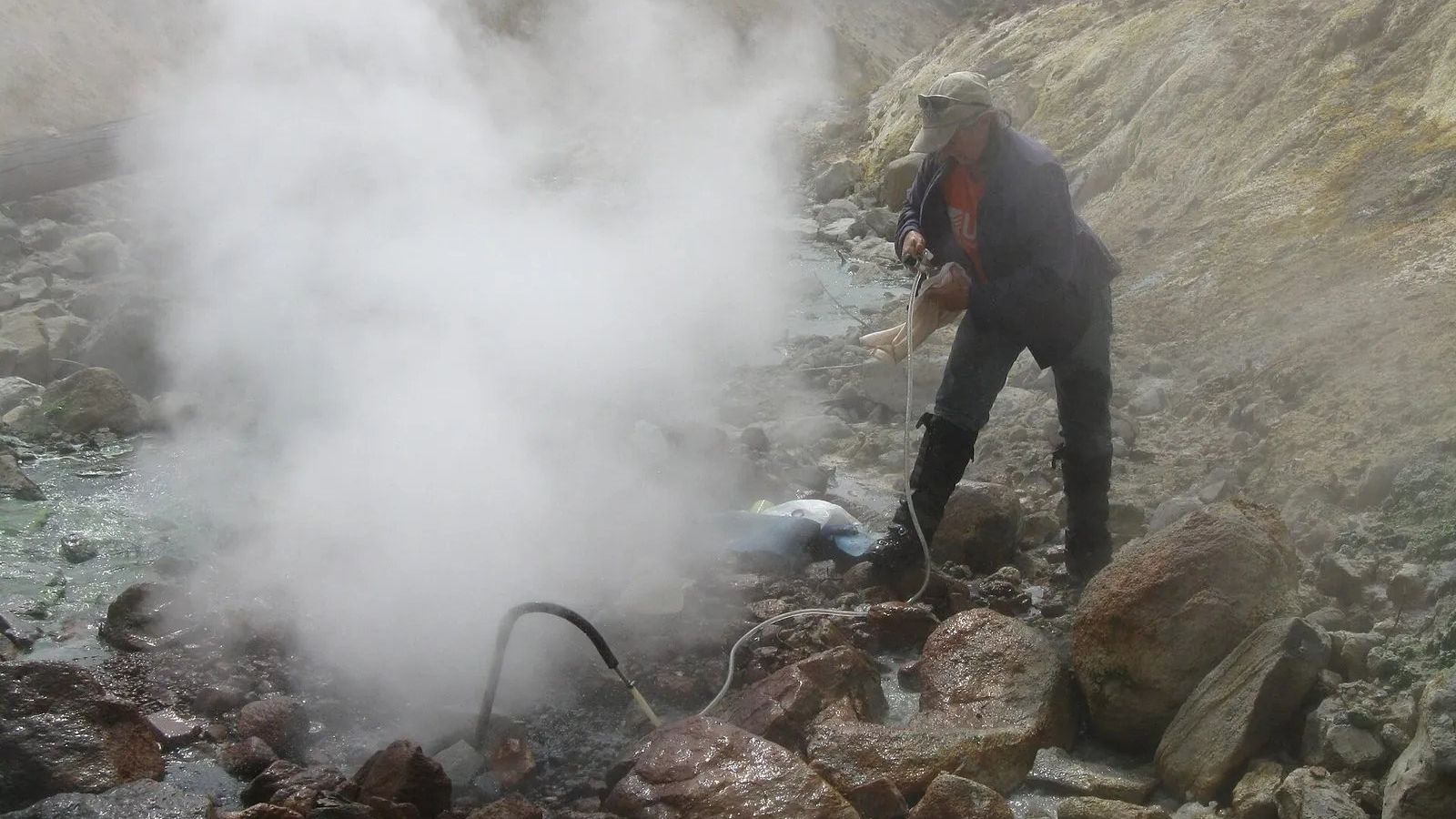
Carbon dioxide is the second most abundant volcanic gas after water, and the hardest to measure, because the air already contains 420 parts per million of it and a volcanic plume is a small addition to a large background. Volcanologists measure it in three ways. At the crater, a MultiGAS instrument carried into the plume or mounted on the rim reads the concentrations of carbon dioxide and sulfur dioxide together, and the ratio between them, combined with the sulfur dioxide flux measured by ultraviolet spectrometers along a road beneath the plume, gives the carbon dioxide flux. On the flanks, where carbon dioxide seeps out of the ground without any plume, chambers placed on the soil measure the flux square metre by square metre. And for the volcanoes nobody visits, the sulfur dioxide measured by satellites is converted into carbon dioxide with a ratio typical of the volcano's type.
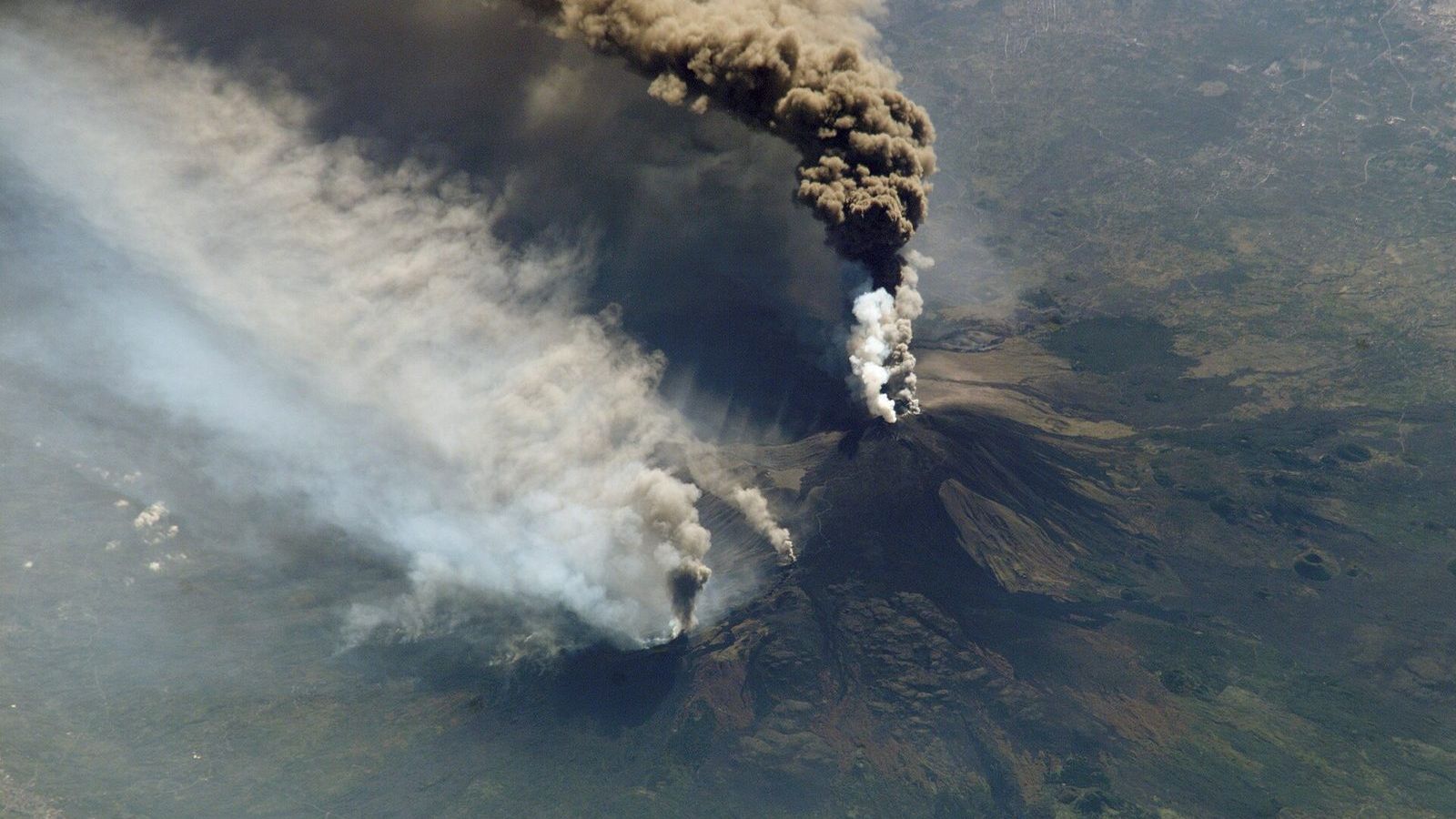
The sum of these measurements, extended to the volcanoes that have never been measured and to the mid-ocean ridges and the hydrothermal systems, is the global volcanic emission, and the published estimates of the last fifteen years fall between about 200 and 500 million tonnes of carbon dioxide a year, with most of them around 300 to 400 million. The Deep Carbon Observatory's review of 2019 put the subaerial volcanoes, those on land and above the sea, at about 280 to 360 million tonnes a year and the ridges at a few tens of millions more. The uncertainty is about a factor of two, which is honest for a global sum built from a few hundred volcanoes. Etna alone is a few percent of the total.
The comparison
Human emissions of carbon dioxide from fossil fuels and cement were about 37 billion tonnes in 2023, by the Global Carbon Project's annual budget, with land-use change adding a few billion more. Thirty-seven billion tonnes against a few hundred million: volcanoes emit about one percent of what people do, and even the highest volcanic estimate against the lowest human one gives less than two percent. Put the other way, humanity emits in three or four days what all the volcanoes of the world emit in a year.
Take a single eruption as the worked number. Pinatubo in 1991, the largest eruption since 1912, released about 50 million tonnes of carbon dioxide along with its 17 to 20 million tonnes of sulfur dioxide. Human emissions of 37 billion tonnes a year are about 100 million tonnes a day. So the largest eruption of the last century emitted, in a few hours, about as much carbon dioxide as human activity emits in about twelve hours, and then nothing more. The comparison was made by Terrance Gerlach of the US Geological Survey in a short paper in 2011 that is still the clearest statement of it.
There is also a direct check. The carbon dioxide in the air has been measured continuously at Mauna Loa in Hawaiʻi since 1958, on the flank of an active volcano. The record shows the steady rise and the seasonal cycle of plant growth, and it shows no bump after Pinatubo, after El Chichón in 1982, or after any other eruption; the small dip after Pinatubo is the opposite sign, because the cooler, hazier years that followed changed how much carbon the land and the oceans took up. If volcanoes emitted a hundred times what people do, the record would be unrecognizable.
Where the myth comes from
Part of it is a confusion of scales. An eruption is the most powerful natural event most people will ever see, and the instinct that it must dwarf a car exhaust is reasonable until the arithmetic is done. Part of it is a confusion of gases: an eruption does put a large mass into the air, but that mass is mostly ash, water, and sulfur, not carbon dioxide. And part of it is a confusion of time. Over the whole history of the planet, volcanoes have supplied all of the carbon dioxide that the atmosphere and the oceans contain, and the great flood basalt eruptions of the geological past did raise carbon dioxide and warm the climate. Those facts are true and are taught in the masterclass. They say nothing about the rate at which volcanoes emit today, which is the only number that bears on the comparison.
What volcanoes do on short time scales
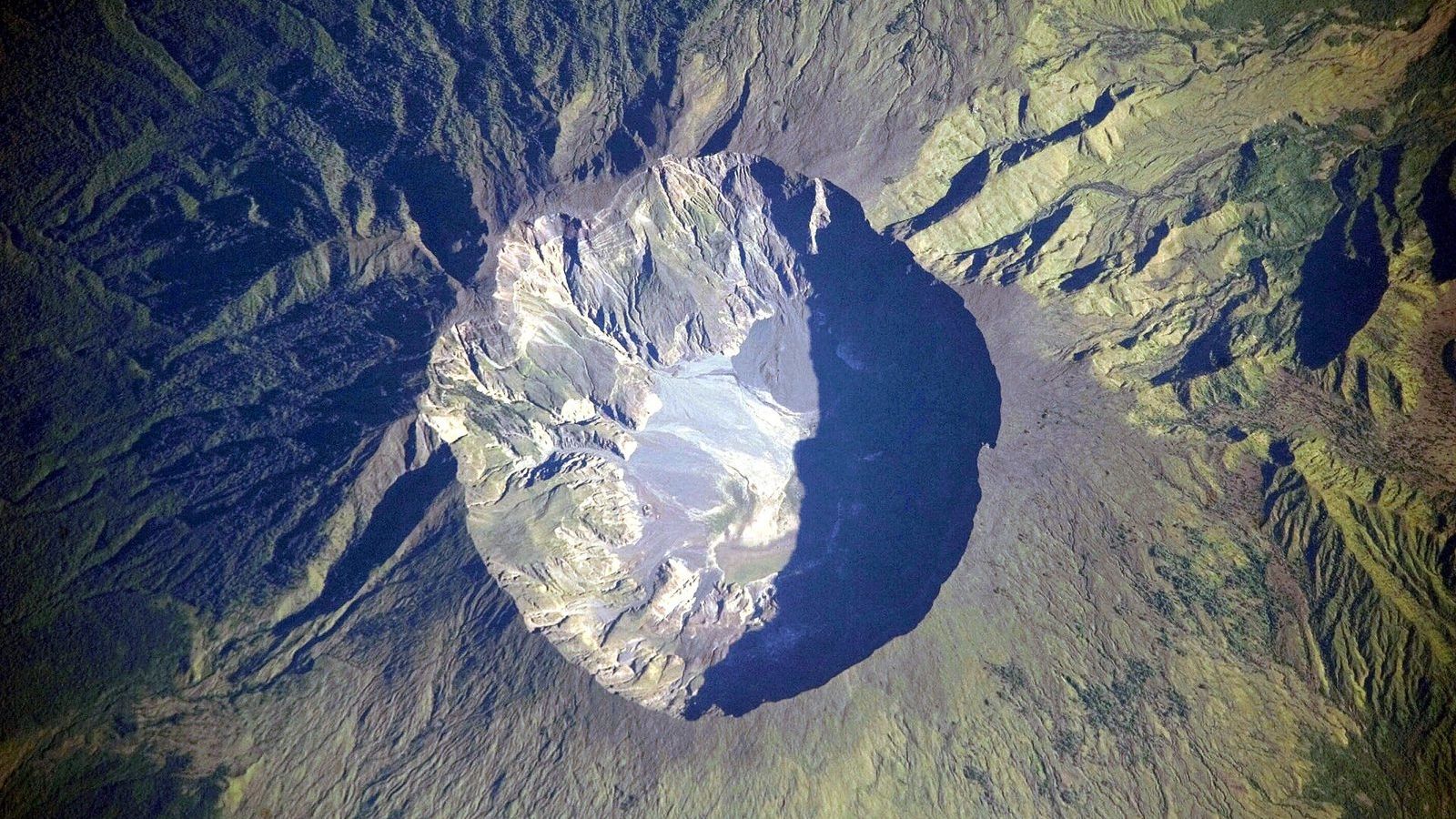
On the scale of years, volcanoes cool the planet rather than warm it. The agent is sulfur, not carbon. An explosive eruption that reaches the stratosphere leaves a veil of sulfate droplets that scatters sunlight for a year or two. Pinatubo's veil cut the sunlight reaching the ground by a few percent and lowered the global average temperature by about 0.5 °C in 1992. Tambora in 1815 caused the year without a summer in 1816. The eruptions of 536 and 540 gave the coldest decade of the last two thousand years. The effect is real, measurable, and short, because the sulfate falls out and the carbon dioxide released alongside it is too little to notice.
What volcanoes do on long time scales
On the scale of millions of years, the picture inverts, and the sulfur disappears while the carbon dioxide accumulates. Over geological time, the carbon dioxide that volcanoes release into the air is removed by the weathering of silicate rocks, which consumes the gas and carries the carbon to the sea as bicarbonate, where it is buried as limestone. The two fluxes nearly balance, and the balance acts as a thermostat: when the planet warms, weathering speeds up and draws more carbon dioxide down; when it cools, weathering slows and the volcanic supply builds the gas back up. That thermostat is one of the reasons the Earth has kept liquid water through four billion years of a brightening Sun.
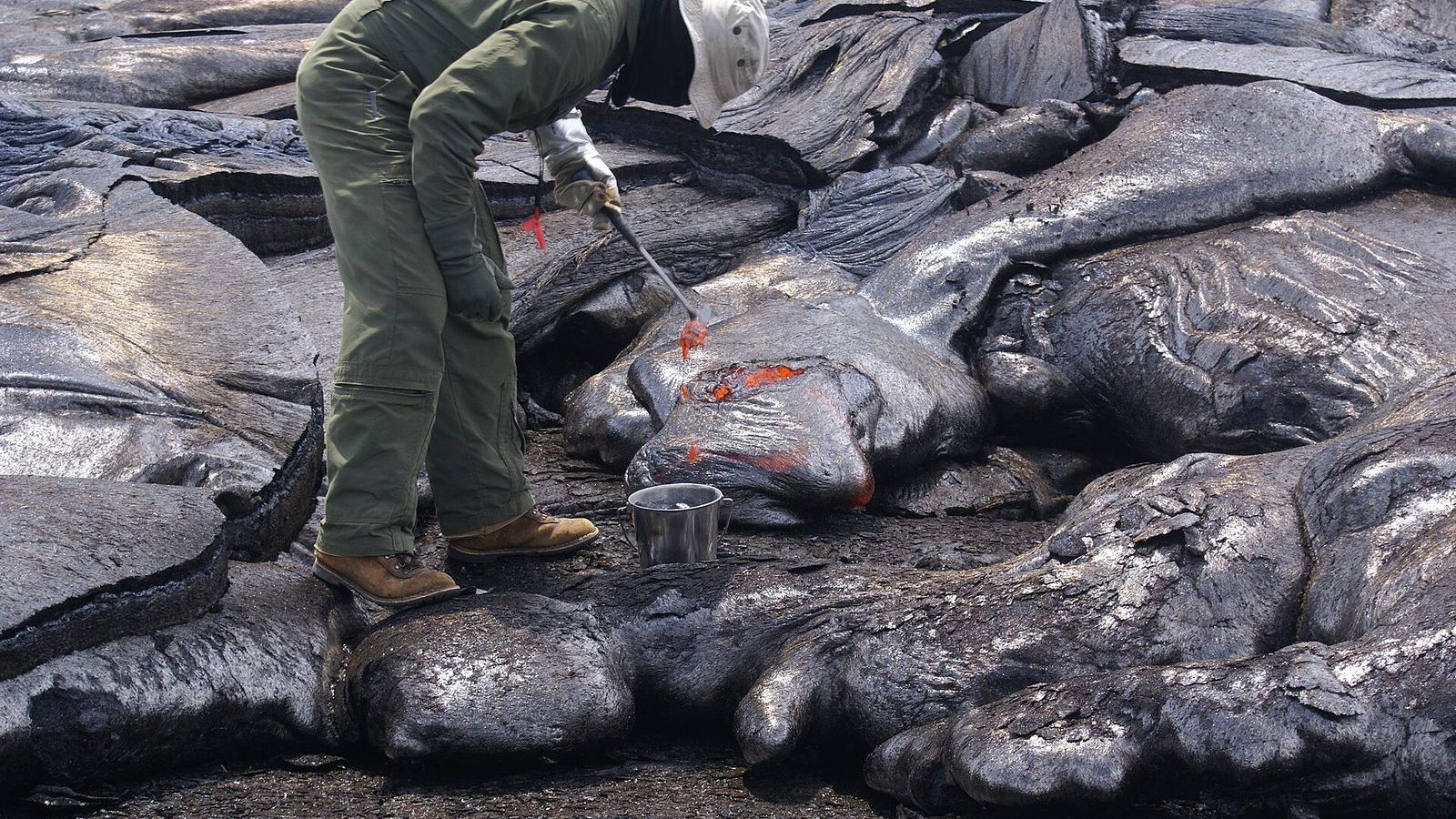
The thermostat can be overwhelmed. A flood basalt province, such as the Siberian Traps about 252 million years ago or the Deccan Traps about 66 million years ago, erupts a million cubic kilometres or more of basalt in less than a million years and releases carbon dioxide faster than weathering can remove it, from the lava and, in Siberia, from the coal and limestone that the intruding sills cooked. The result was warming of several degrees that lasted tens of thousands of years, ocean acidification, and in the Siberian case the largest mass extinction in the history of life. Those are the volcanic climate catastrophes, and they operated at rates of carbon release that, in most estimates, were still lower than today's human rate, spread over a far longer time.
The sentence to remember
Volcanoes emit about one percent of the carbon dioxide that people do. They cool the climate for a year or two after a large explosive eruption, through sulfur. They warm it only in the rare flood basalt episodes that come once in tens of millions of years, and those warmings are the geological record's own demonstration of what a fast release of carbon does. None of that is a reason for comfort about the human number.
Unit 8 of the masterclass sets out the long carbon cycle, the sulfur veil, and the flux comparison with its sources, and Unit 10 explains how the carbon dioxide of a plume is measured from the ground and from orbit. The annual human emissions, with their uncertainties, are published by the Global Carbon Budget.