 Image: US Geological Survey, public domain
What a volcano's gases tell before it erupts
Gas is the reason a volcano erupts, and it is also the first thing to arrive. A magma a few kilometres down is already losing its gas, which rises through cracks and the hydrothermal system to the crater, the fumaroles, and the soil on the flanks, days to months ahead of the magma itself. The mixture that comes out is not fixed. It changes with the depth at which the magma is degassing, and a change in the mixture can be read as a change in the depth, which is why every well-equipped observatory measures the gas every day and why a shift in one ratio can be the first word of an eruption.
The solubility ladder
The principle is that the gases dissolved in a magma come out of it at different pressures. Carbon dioxide is the least soluble of the main species. A basalt at 100 MPa, the pressure at about 4 km depth, can hold only about 500 parts per million of it, so a basalt that started with a few thousand parts per million in the mantle has lost most of its carbon dioxide by the time it is 10 or 20 km below the surface. Sulfur comes out at a few kilometres. Water is the most soluble: a basalt holds about 3 wt% at 100 MPa and a rhyolite about 4 wt%, and most of it stays in the melt until the last kilometre. The halogens, chlorine and fluorine, leave last of all.
The consequence is a ladder. Gas released from a magma 10 km down is rich in carbon dioxide and poor in sulfur. Gas released at 1 km is rich in sulfur and water and poor in carbon dioxide, because the carbon dioxide left long before. The ratio of carbon dioxide to sulfur dioxide in the gas at the surface is therefore a measure of the depth from which the gas is coming, and when a fresh batch of magma arrives from depth and begins to degas, the ratio rises before anything else is seen. Units 3 and 10 of the masterclass give the solubility laws that make this quantitative.
Etna's warning
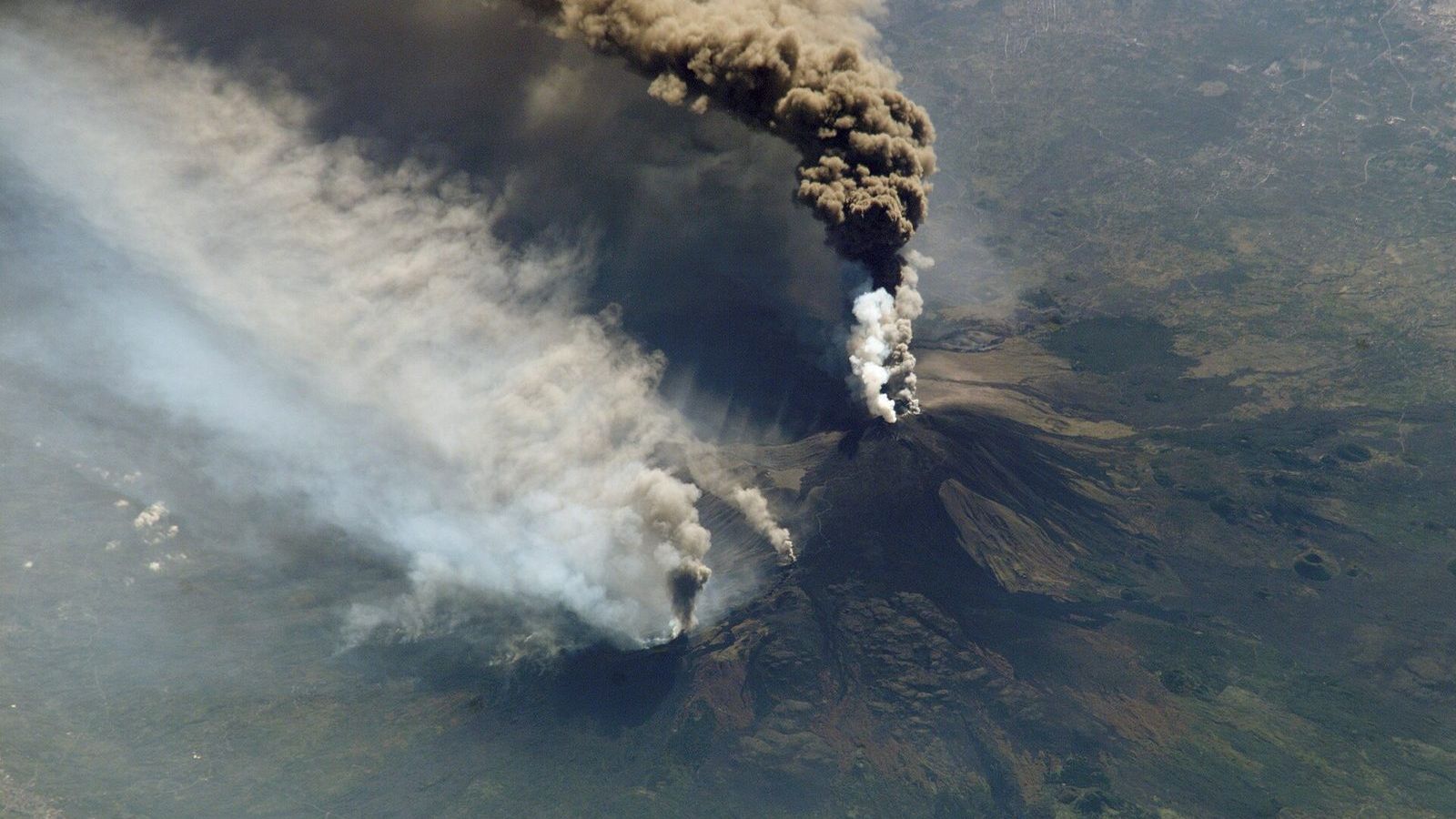
The best-documented case is Etna. From 2005 Alessandro Aiuppa and his colleagues at the University of Palermo ran instruments on the volcano's summit that measured the composition of the plume continuously, and they found that the ratio of carbon dioxide to sulfur dioxide rose, from a background of a few units to 25 or more, in the weeks before each of the eruptions of 2006, and fell back as the eruption released the sulfur. The rise was the signature of deep magma rising into the shallow system and degassing its carbon dioxide on the way. The method has since been applied at Stromboli, at Turrialba and Poás in Costa Rica, and at volcanoes in Japan and the Aleutians, and a rising carbon dioxide ratio is now one of the signs an observatory raises an alert on. The original Etna paper was published in 2007.
The opposite signal is just as important. In January 1993, during a conference of volcanologists at Galeras in Colombia, the sulfur dioxide flux from the crater had fallen to a low value over the preceding weeks. The fall was read by some as the volcano quietening. It was the opposite: the conduit had sealed, the gas was accumulating under the seal, and on 14 January an explosion through the seal killed six scientists and three visitors who were in the crater. A drop in the gas flux at a volcano that is known to be degassing is a warning that the pressure is building where it cannot be seen.
The instruments
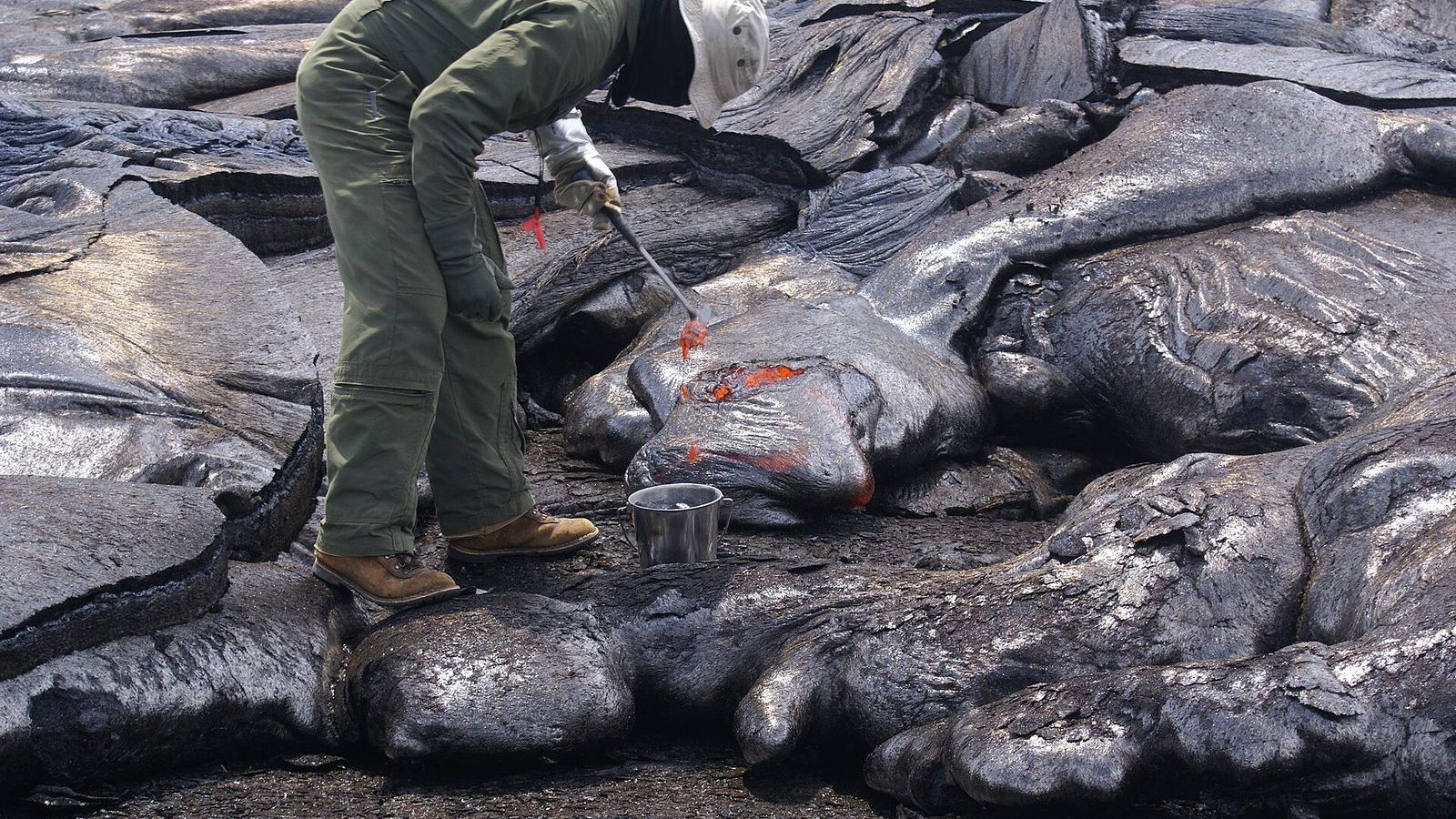
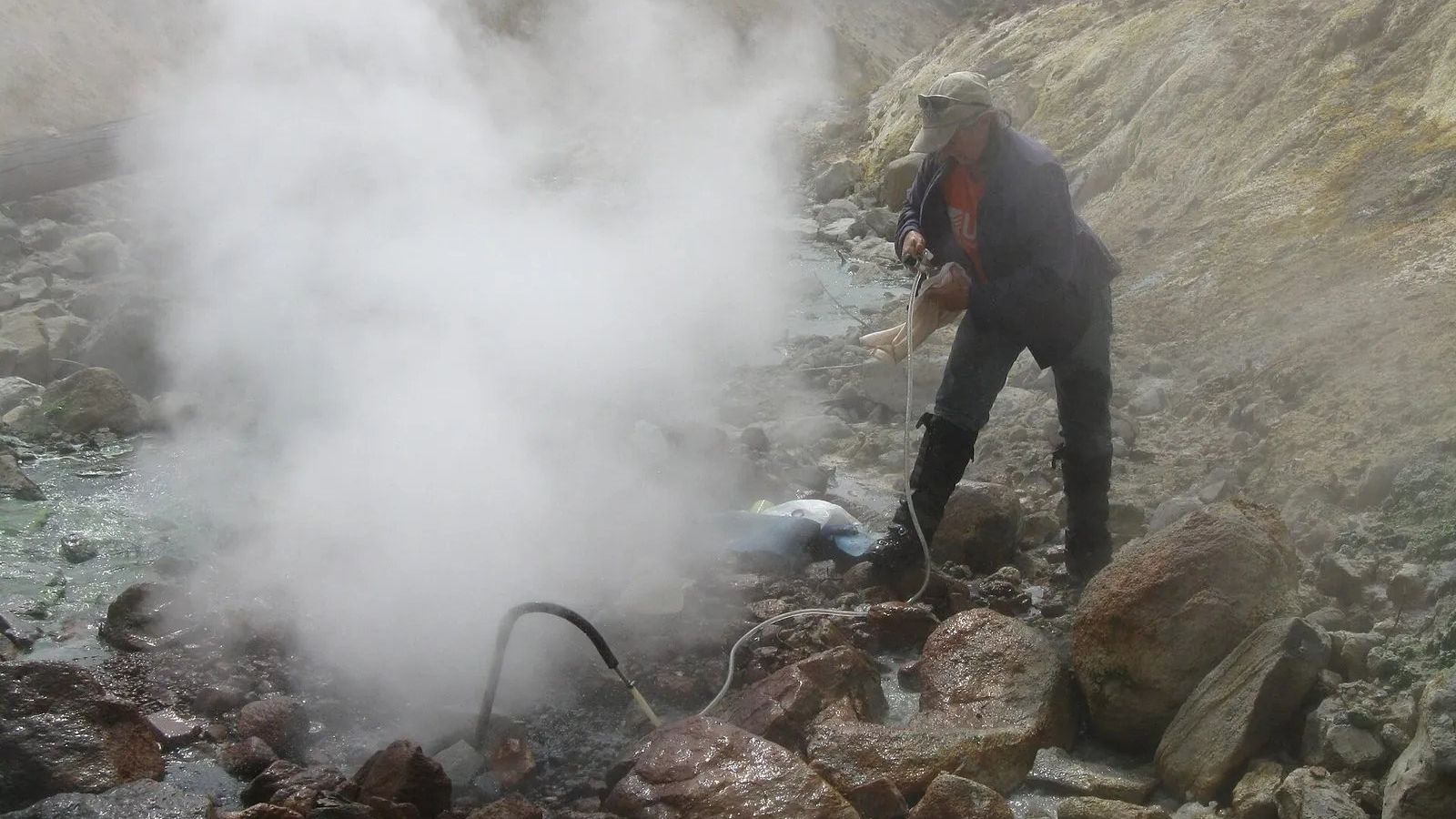
The oldest method is the Giggenbach bottle, an evacuated glass flask with a solution inside it, connected by a tube to a fumarole; the gas bubbles through the solution and is carried back to the laboratory, where its full composition is measured. It gives the best analysis and the worst time resolution, and it requires someone to stand at the fumarole.
The flux of sulfur dioxide, the most easily seen gas, has been measured since the 1970s with ultraviolet spectrometers that look up through the plume and read how much of the Sun's ultraviolet light the gas absorbs. The original instrument, the correlation spectrometer, was driven along a road beneath the plume; its successor, the differential optical absorption spectrometer, is small enough to be carried, mounted on a car, or set up in a scanning network that sweeps the sky from fixed points all day. A traverse gives the worked number. A traverse under a plume measures the column amount of sulfur dioxide, the mass above each square metre of ground, at each point along the road. Suppose the plume is 2 km wide where the road crosses it and the mean column amount across it is 1 gram per square metre. The amount of gas per metre of the plume's length is 1 g/m² × 2,000 m, which is 2 kg/m. If the wind carries the plume at 8 m/s, the flux is 2 kg/m × 8 m/s = 16 kg/s, which is about 1,400 tonnes a day. That is Etna on a quiet day; in its paroxysms it reaches ten times that.
The carbon dioxide is measured by the MultiGAS, a box of electrochemical and infrared sensors developed in the 2000s that is carried into the plume on foot, flown through it on a drone, or left on the rim to transmit the ratios of carbon dioxide, sulfur dioxide, and hydrogen sulfide every few minutes. Infrared spectrometers on the crater rim read the composition of the hot gas at the vent from a distance. And from orbit, the OMI instrument on NASA's Aura satellite since 2004 and TROPOMI on Sentinel-5P since 2017 map the sulfur dioxide of every volcano on Earth every day, which is how Simon Carn and colleagues measured the global emission of about 23 million tonnes a year from the volcanoes that degas between eruptions.
What the gas says about the reservoir
The gas can also show what the magma cannot. When Pinatubo erupted in 1991 it released 17 to 20 million tonnes of sulfur dioxide, but the 5 km³ of magma it erupted, by the sulfur measured in the melt inclusions trapped in its crystals, could have held less than a tenth of that. The rest had already left the melt and was sitting in the reservoir as a separate gas phase, bubbles accumulated over the years of storage, before the eruption released it all at once. The excess sulfur problem, as it is called, is one of the main pieces of evidence that a magma reservoir carries a gas phase, and that the gas, not the melt, is what sets the pressure.
The hazards of the gas itself
Gas is a hazard as well as a messenger. On the night of 21 August 1986, Lake Nyos in Cameroon, a crater lake that had been accumulating carbon dioxide from the magma below in its deep water for decades, overturned and released the gas in a cloud that flowed down the valleys and suffocated about 1,700 people in their villages. The volcanic smog of Hawaiʻi, sulfur dioxide and sulfate from Kīlauea, affects breathing across the island when the trade winds fail. The fluorine of the Laki eruption in 1783 poisoned the grass and killed most of Iceland's livestock. And at Kawah Ijen in Java, where miners carry sulfur out of the crater by hand, the gas is a daily occupational hazard for the people who work in it.
Unit 10 of the masterclass works through the species, the solubility ladder, the measurement from a traverse, the global budget, and the hazards, with the research spotlight on the satellite inventory. Unit 12 puts the gas beside the earthquakes and the deformation as the three signs of unrest. The daily sulfur dioxide maps are at NASA's Global Sulfur Dioxide Monitoring page, where you can see which volcanoes are degassing today.