Magma Reservoirs and Crystal Mush
The textbook magma chamber was a tank of liquid; the reservoir of today is a crystal mush through much of the crust with melt in its pores and small lenses ready to erupt. The unit lays out the evidence that forced the change of mind (seismic images, deformation, exposed plutons, and above all the crystals), what a zoned crystal records about depth, temperature, and time, how rhyolite is squeezed out of a mush, the two time scales of a reservoir, what triggers an eruption, and why most of the magma under a volcano never erupts.
Every drawing of a volcano in a school book shows the same thing beneath the mountain: a red balloon of liquid, the magma chamber, with a pipe up to the summit. The picture is about a century old, and in the last twenty years volcanologists have stopped believing it. Four kinds of evidence, seismic images, ground movement, the eroded roots of old volcanoes, and above all the crystals that eruptions bring up, agree that most of what lies under a volcano is a hot, crystal-rich sponge with melt in its pores, which reaches from the mantle to a few kilometres below the vent, and that the liquid an eruption draws on is a small and short-lived part of it. This unit lays out the evidence, explains how a crystal the size of a sand grain records the depth, temperature, and water content of the magma it grew in and how long ago it was disturbed, shows where rhyolite comes from, and ends with what sets a reservoir off and why most of its magma never erupts.
1 From chamber to mush
The word magma chamber entered geology in the nineteenth century for the space below a volcano that held its magma, and the drawings that followed gave that space a shape: a rounded tank of liquid in solid rock. Norman L. Bowen (1887-1956) showed in the 1920s how a basaltic liquid in such a tank changes composition as its crystals form and settle, which is the fractional crystallization that Unit 2 mentioned, and generations of geophysicists set out to find the tank. What they found, from the 1980s on, did not fit the tank, and four findings in particular were awkward.
- Seismic waves slowed down over large volumes under volcanoes, but only by amounts that meant a few percent of melt.
- Ground deformation pointed to small sources that inflated and deflated within months.
- The roots of eroded volcanoes were stacks of thin sheets rather than frozen balloons.
- The crystals in erupted rocks, once they could be dated and read one by one, were older than the melt around them and had spent most of their lives in magma too cold to move.
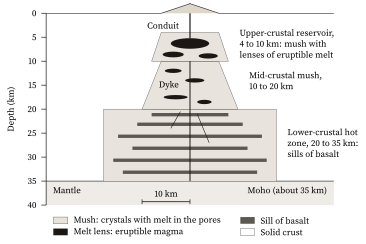
By the early 2000s the pieces had been put together into a different picture, which petrologists such as Olivier Bachmann and George Bergantz argued for in 2004 on the strength of the chemistry of large rhyolite eruptions, and which Katharine Cashman, Stephen Sparks, and Jon Blundy drew as a whole in the journal Science in 2017. In this picture the magma beneath a volcano is mostly mush: a framework of touching crystals with silicate melt in the spaces between them, which behaves as a solid because the crystals carry the load, like wet sand on a beach. A mush holds between a few percent and about half melt by volume. Above roughly 50 percent melt the crystals lose contact and the material becomes a liquid with crystals suspended in it, and only this material can flow and erupt; the exact fraction is the locking fraction of the Einstein-Roscoe relation of Unit 3, and Section 4 returns to it. Such liquid exists under a volcano only in melt lenses, which are pockets and sills (flat sheets of magma that spread between layers of rock) of melt-rich magma inside or on top of the mush; a lens holds a few cubic kilometres at most in a typical arc volcano and lasts for years to centuries. The whole arrangement, from the sills of basalt near the base of the crust to the lenses a few kilometres under the vent, is a trans-crustal magmatic system, and Figure 1 draws one to scale. The word reservoir in this unit means any part of the system that stores magma, mush and lenses together; the word chamber survives in the names of old ideas and of the Icelandic cave of Section 2.2.