 Image: Dave Harlow, USGS, public domain
What the Volcanic Explosivity Index measures
Mount St Helens in 1980 was a VEI 5. Pinatubo in 1991 was a VEI 6. Tambora in 1815 was a VEI 7, and the Toba eruption of about 74,000 years ago was an 8. The Volcanic Explosivity Index is the scale that every news report reaches for when a volcano erupts, and it is one of the few things in volcanology that fits in a sentence. It is also easy to misread, because it measures one thing and people assume it measures several. Here is what it measures, where the famous eruptions fall, and what it leaves out.
A ladder of volumes
The index was proposed in 1982 by Christopher Newhall of the US Geological Survey and Stephen Self of the University of Hawaiʻi, who needed a way to rank thousands of historical eruptions, most of them described only in words, so that the catalogue of the Smithsonian Institution could be searched by size. They chose the volume of tephra, the fragmented material an eruption throws out, as the main criterion, because it is the quantity most often preserved and measured. Each step of the index is a tenfold increase in that volume.
The steps are these. VEI 0 is an eruption that produces less than 10,000 cubic metres of tephra, which is to say a non-explosive one, a lava flow or a lake that merely bubbles. VEI 1 reaches 1 million cubic metres, VEI 2 10 million, VEI 3 100 million, and VEI 4 1 cubic kilometre, which is 1,000 million cubic metres. VEI 5 is 1 to 10 cubic kilometres, VEI 6 is 10 to 100, VEI 7 is 100 to 1,000, and VEI 8 is anything above 1,000 cubic kilometres. The one irregular step is the first: VEI 1 spans a factor of a hundred rather than ten, a compromise made so that the small Strombolian bursts of everyday volcanism would land in a sensible place.
The volume is the bulk volume of the deposit as it lies on the ground, pumice and ash with all the air in them, and that is a convention worth remembering. Fresh tephra has a bulk density of about 1,000 kg/m³, against about 2,500 for the solid rock it came from, so a cubic kilometre of tephra is only about 0.4 cubic kilometres of magma. Volcanologists call that second figure the dense rock equivalent, and the two numbers are quoted for the same eruption often enough to confuse anyone who does not know which is meant. The index uses the bulk figure.
Newhall and Self added other criteria to help where the volume is unknown: the height of the eruption column, the duration of the main phase, the words used in old descriptions, and the style. A VEI 3 typically has a column of 3 to 15 km, a VEI 4 one of 10 to 25 km, and a VEI 5 or more a column above 25 km. These are guides rather than definitions, and when the volume and the column height disagree the volume wins. You can read the original paper, which is short and still the reference.
Where the famous eruptions fall
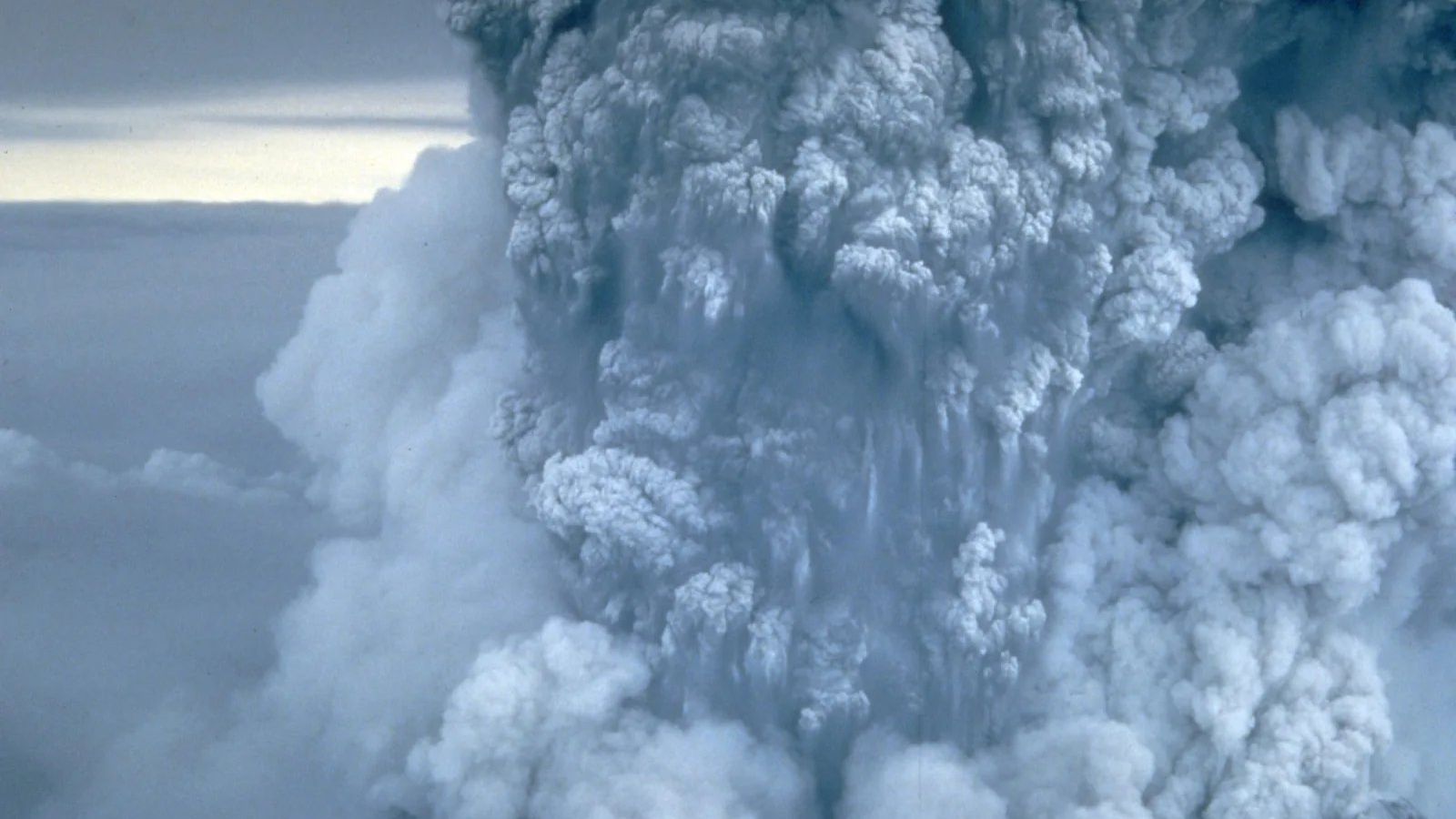
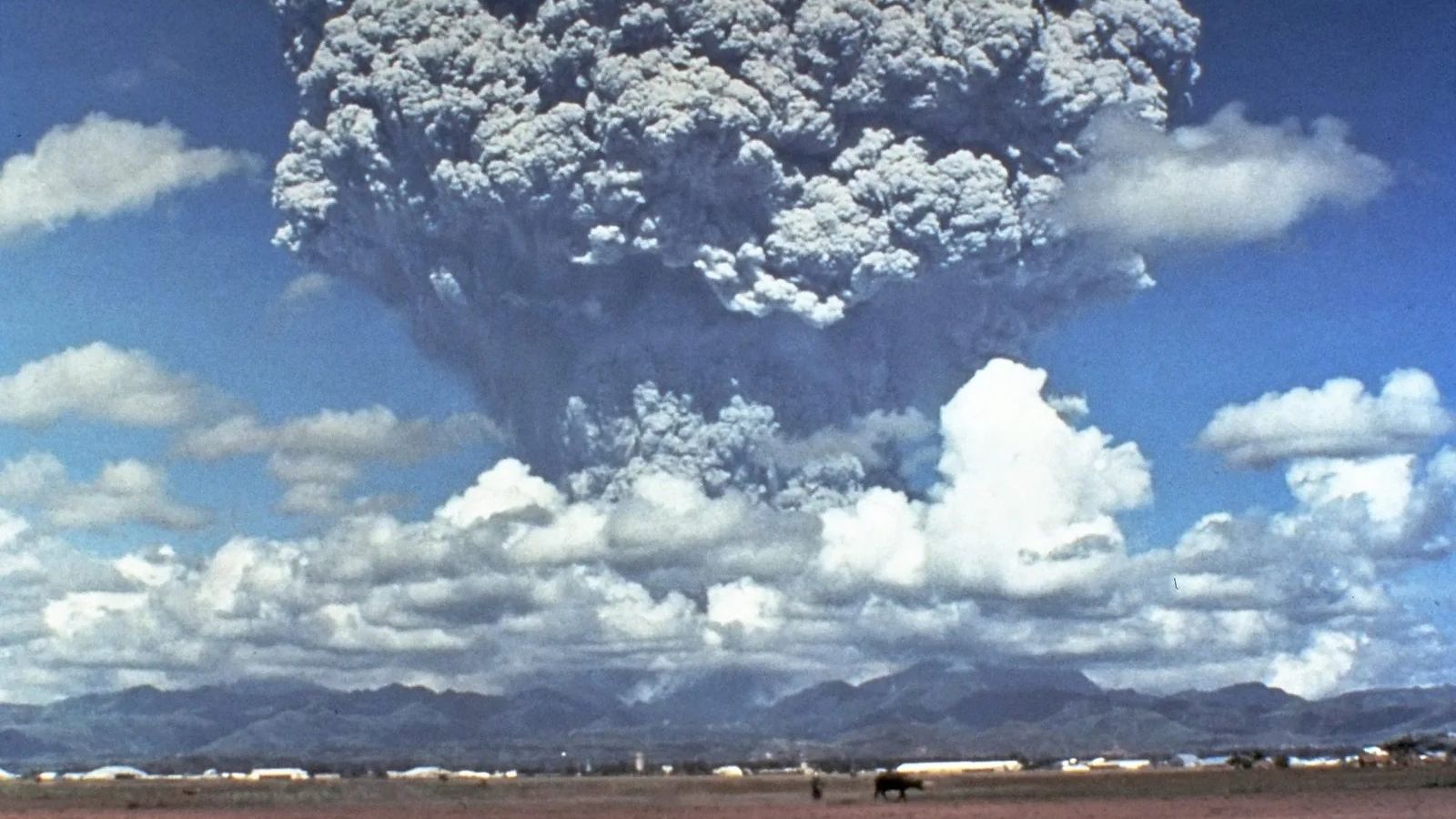
Mount St Helens on 18 May 1980 produced about 1 cubic kilometre of tephra, a column of about 24 km, and nine hours of sustained eruption. That is a VEI 5, at the bottom of the step. Pinatubo on 15 June 1991 produced about 5 cubic kilometres of dense rock, which is roughly 10 cubic kilometres of bulk tephra, with a column of about 35 km: a VEI 6. Tambora in April 1815 erupted 30 to 50 cubic kilometres of dense rock, about 100 to 150 cubic kilometres of tephra, and is the only VEI 7 of the last thousand years. The Youngest Toba Tuff, erupted about 74,000 years ago in Sumatra, is at least 2,800 cubic kilometres of dense rock, far above the threshold of VEI 8.
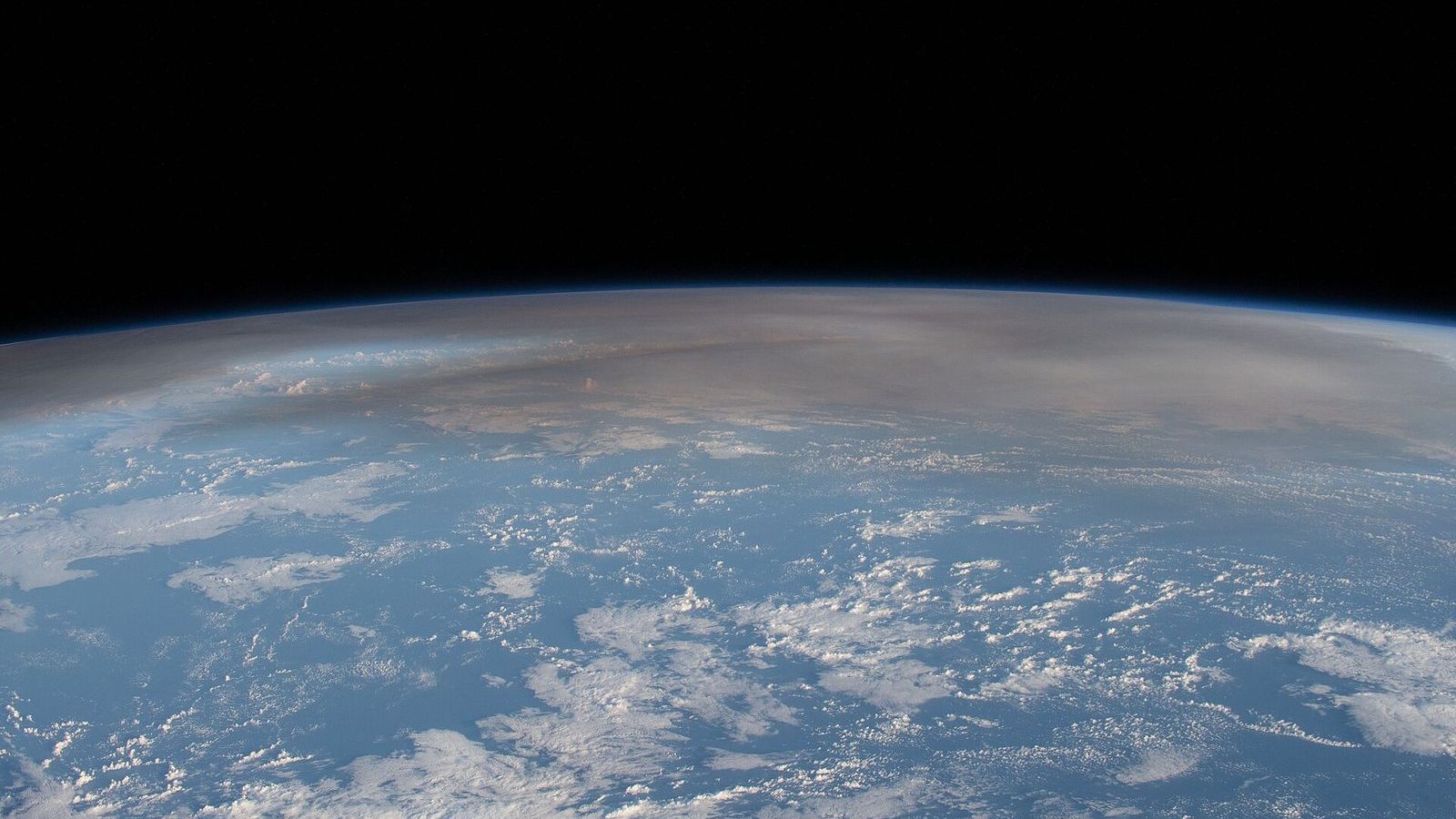
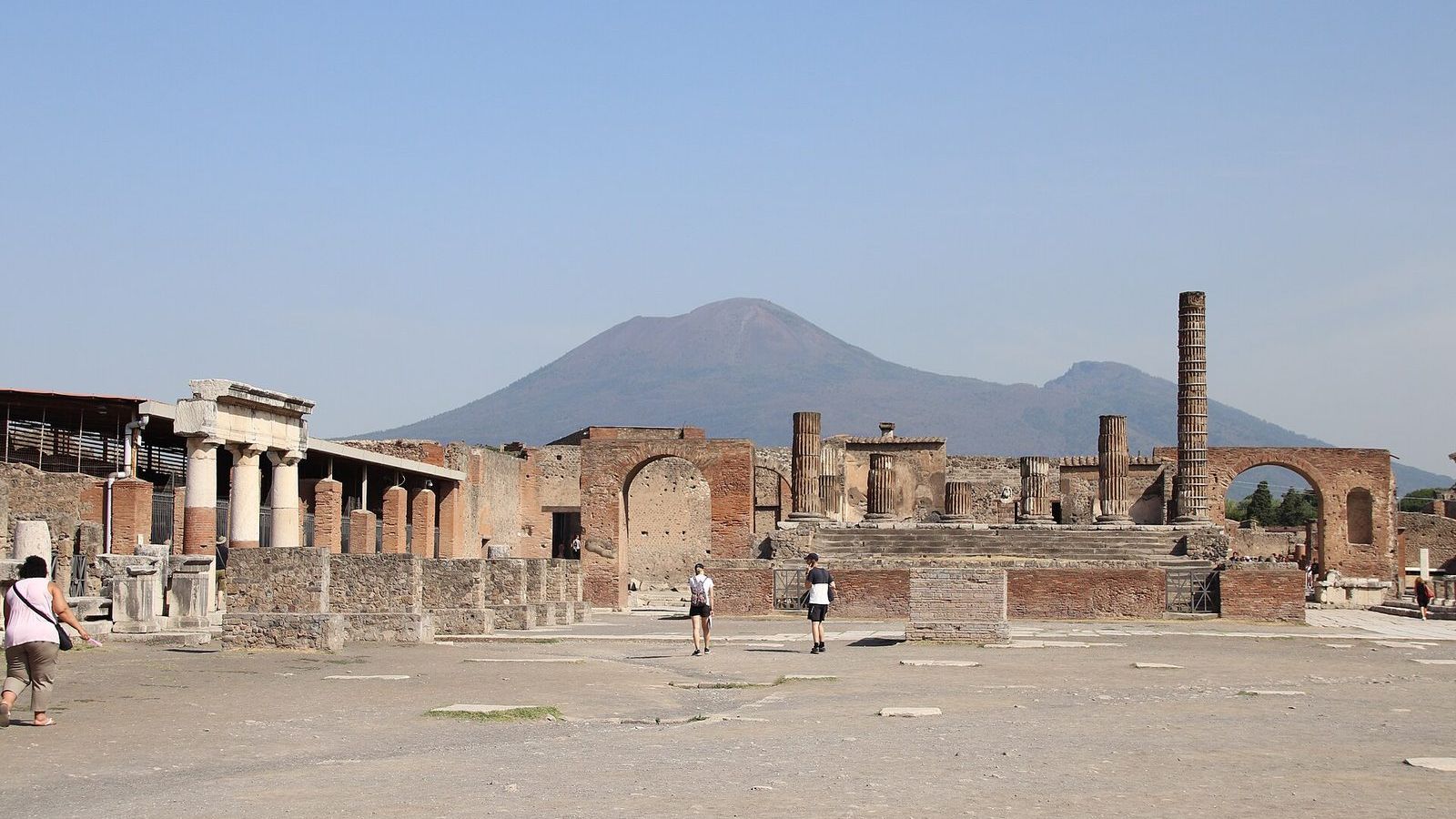
Krakatau in 1883 was a VEI 6, Vesuvius in AD 79 a VEI 5, Eyjafjallajökull in 2010, for all the flights it cancelled, a VEI 4, and the Hunga eruption of January 2022, whose cloud reached 57 km, is still being measured and is placed at VEI 5 or 6 depending on how much of its deposit on the sea floor is counted. The eruptions of Stromboli that tourists photograph every night are VEI 1 or 2. In a typical year the world has a few dozen eruptions of VEI 2, a handful of VEI 3, perhaps one VEI 4, and a VEI 5 roughly once a decade.
The magnitude scale behind it
Because the index is a set of steps, two eruptions of VEI 6 can differ by a factor of ten, and an eruption at the top of VEI 5 is closer to the bottom of 6 than to the bottom of its own step. For research, volcanologists therefore use a continuous scale, the magnitude, proposed by David Pyle in 2000 on the model of earthquake magnitudes. The magnitude is the logarithm to base 10 of the erupted mass in kilograms, minus 7. It uses mass rather than volume, so the bulk density problem disappears.
The worked number goes like this. Tambora erupted about 40 cubic kilometres of dense rock, which at a density of about 2,400 kg/m³ for the magma is a mass of about 1014 kg. The logarithm of 1014 is 14, and 14 minus 7 is 7.0: magnitude 7.0, which matches its VEI 7 because the scales were built to agree at the top. Pinatubo's 5 cubic kilometres give about 1.2 × 10¹³ kg and magnitude 6.1. Mount St Helens' 0.4 cubic kilometres of dense rock give 1012 kg and magnitude 5.0. On this scale a super-eruption is defined as magnitude 8 or more, and the Fish Canyon Tuff of Colorado, the largest known, is about 9.1.
Each step about ten times rarer
The index has a property its authors did not design into it. When the eruptions of the last few thousand years are counted by index, each step holds roughly a tenth as many eruptions as the step below it. VEI 7 eruptions happen one or two times per thousand years, VEI 8 eruptions about once in 17,000 years, with wide uncertainties, and the small ones in their thousands. The relation is an observation with scatter rather than a law, and it depends on a record that is badly incomplete for anything older than a few centuries, as the research spotlight in Unit 1 of the masterclass explains. But it is the basis of every estimate of the odds of the next large eruption.
What the index does not measure
The index measures the volume of fragmented material and nothing else, and four things slip through.
It ignores lava. The Laki eruption of 1783 to 1784 poured out 14.7 cubic kilometres of basalt, the largest lava eruption of historical time, with a haze that reached across Europe and a famine that killed a fifth of Iceland's people; its tephra was small, and it is a VEI 4. The flood basalt provinces that erupted a million cubic kilometres are, by the index, barely explosive at all.
It ignores time. A VEI 4 that happens in a day and a VEI 4 that happens over a year of small explosions have the same index, though the first is far more dangerous. Pyle's intensity scale, the logarithm of the mass eruption rate, was introduced to capture this, and the column height, which depends on the rate rather than the total, is the better guide to the hazard in the air.
It ignores sulfur. The climate effect of an eruption depends on how much sulfur dioxide reaches the stratosphere, and that depends on the magma's chemistry as much as its volume. El Chichón in Mexico in 1982 was a VEI 5, no larger than Mount St Helens, but it released about 7 million tonnes of sulfur dioxide against St Helens' roughly 1, and it cooled the northern hemisphere where St Helens did not.
And it ignores people. The deadliest eruptions of the last century were not the largest. Nevado del Ruiz in 1985 was a VEI 3, a small eruption by any measure, and its lahars killed about 23,000 people in the town of Armero. The index is a measure of the eruption, and risk is a measure of the eruption, the people, and the warning together.
Used for what it was made for, as a quick, honest ranking of size, the index is as good a tool as volcanology has. Unit 1 of the masterclass introduces it as a measuring scale with the examples above, and Unit 6 gives it its physics: why each step needs ten times the magma, how a column height is read from an eruption rate, and how the volume of a tephra blanket is measured from the map of its thickness.