 Image: Donald A. Swanson, USGS, public domain
Why Mount St Helens exploded and Kīlauea does not
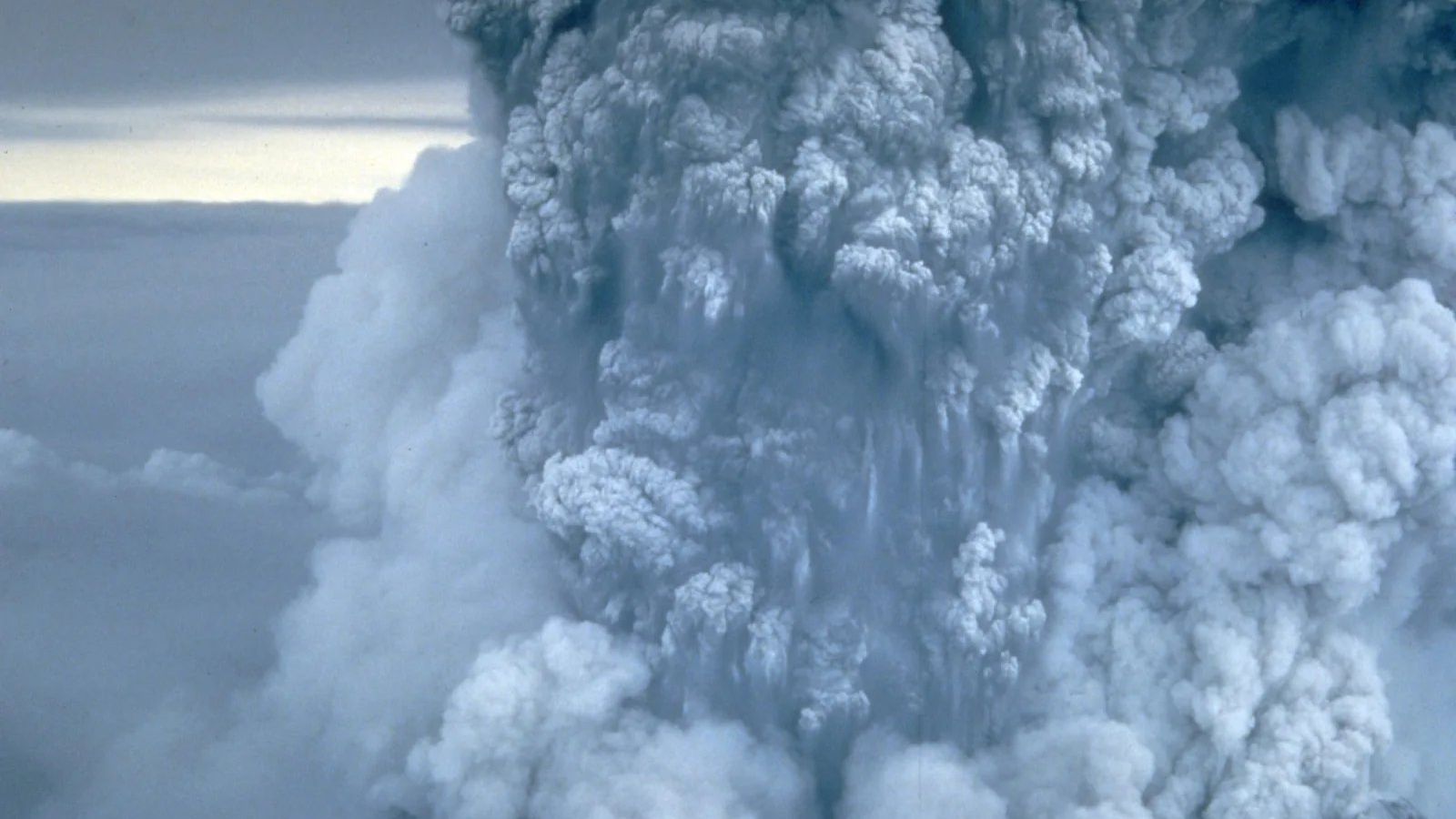
At 8:32 on the morning of 18 May 1980 an earthquake of magnitude 5.1 shook Mount St Helens, and the north flank of the mountain, which had been bulging outwards at up to 2 m a day for weeks, slid away. The landslide, about 2.5 km³ of rock, was the largest in recorded history. It uncovered the magma inside the mountain, which exploded sideways in a blast that flattened forest over about 600 km² and then upwards in a column of ash that reached about 24 km and lasted nine hours. Fifty-seven people died. The summit was lowered by about 400 m.
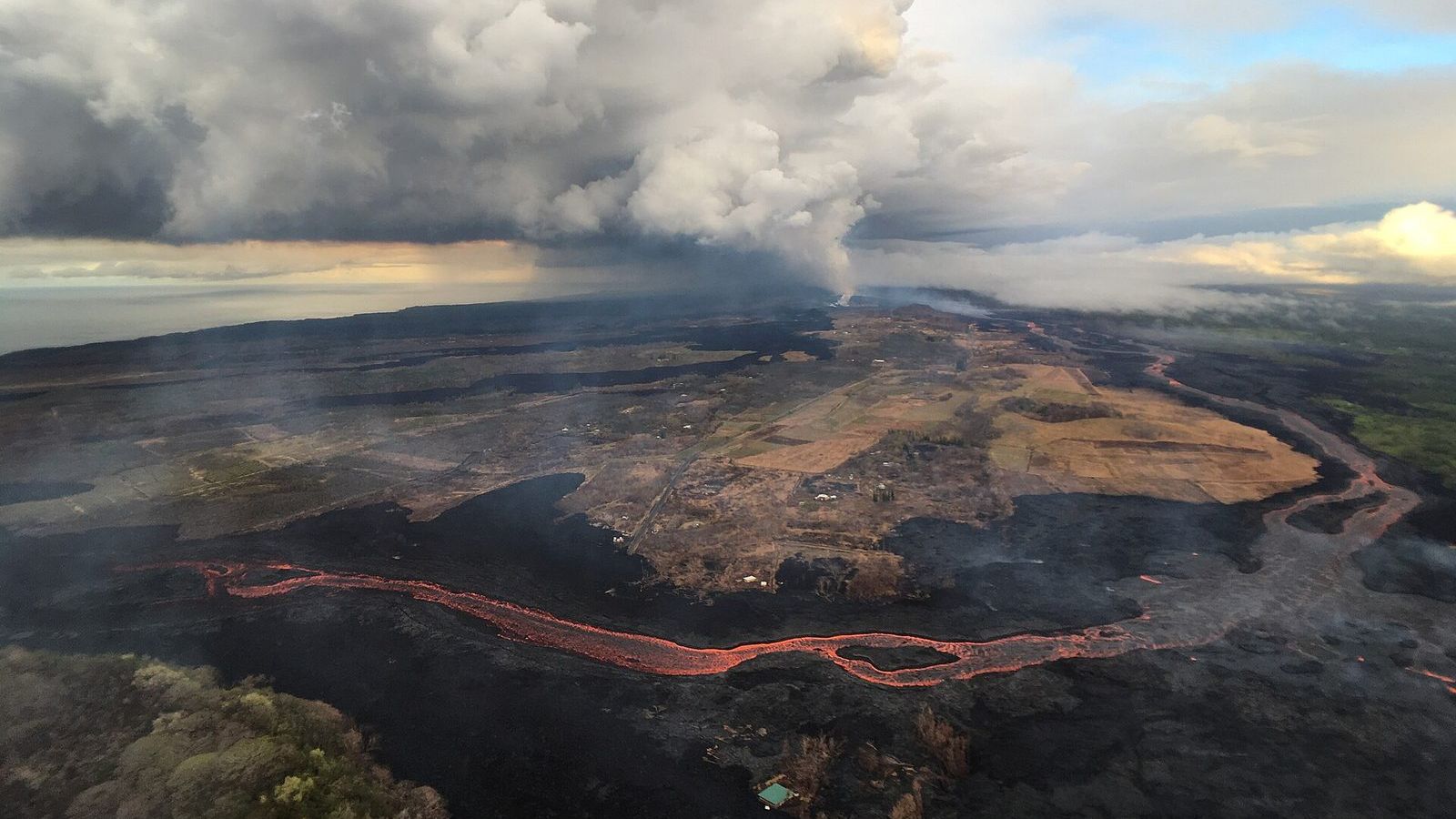
Kīlauea, on the Island of Hawaiʻi, erupted almost without a pause from 1983 to 2018, and in the summer of 2018 poured about 0.8 km³ of lava through a residential district to the sea and destroyed more than 700 buildings. Nobody died in the lava. Visitors watch Kīlauea's eruptions from an overlook with a car park. Both volcanoes are fed by magma that came from the melting of the mantle. The difference in their behaviour comes down to two properties of that magma, how much gas it holds and how stiff it is, and both come down to where the volcano stands.
Water in the magma
Magma is a melt with dissolved gas in it, mainly water, with carbon dioxide and sulfur behind. At the pressure of several kilometres' depth the water stays in solution, in the way that the carbon dioxide stays in a sealed bottle of lemonade. A rhyolite or a dacite can hold about 4 wt% water at 100 MPa, the pressure at about 4 km down, and about 6 wt% at 200 MPa. As the magma rises and the pressure falls, the melt can hold less, and the excess comes out as bubbles. Then the bubbles expand, because the pressure on them keeps falling.
How much they expand is the point. The arithmetic is short. One cubic metre of dacite with 4 wt% dissolved water contains about 2,400 kg of melt and therefore about 92 kg of water. If all of that water came out as steam at atmospheric pressure and 850 °C, the ideal gas law gives its volume: 92 kg is about 5,100 moles, and 5,100 × 8.314 × 1,123 K divided by 100,000 Pa is about 480 m³. Four percent of water by weight becomes several hundred times the volume of the melt it came from. That expansion is the energy of an explosive eruption, and whether it ends as an explosion depends on whether the gas can get out of the way first.
Hawaiian basalt holds about half a percent of water, because the mantle beneath a hotspot carries little. The dacite of Mount St Helens held about 4 to 6 wt%, because the volcano sits above the subduction zone where the Juan de Fuca plate sinks under North America, carrying sea water and wet sediment down with it, and the water released from the sinking plate is what makes the mantle above it melt. Subduction zone magmas are wet magmas. That is half of the difference.
Silica and stiffness
The other half is viscosity, the resistance of the melt to flow. A basalt has about 50 wt% silica, and at its eruption temperature of about 1,150 °C it has a viscosity of about 10 to 1,000 pascal seconds, between honey and thick syrup. A dacite has about 64 wt% silica, erupts at about 850 to 900 °C, and has a viscosity of 106 to 108 pascal seconds, a million times more, like cold pitch or window putty. In a silicate melt the silicon and oxygen atoms link into chains and networks, and the more silica, the more tangled the network and the harder it is for the liquid to move. The lower temperature of the dacite stiffens it further. Dissolved water breaks the network, so a wet dacite is less stiff than a dry one, but still enormously stiffer than any basalt.
The shaken bottle
Open a bottle of lemonade slowly and the gas bubbles rise through the liquid and escape at the top; the drink goes flat and stays in the bottle. Shake it and open it fast and the bubbles form everywhere at once, grow faster than they can rise, and carry the liquid out as spray. A volcano does the same, and the viscosity decides which case applies.
In a basalt the bubbles can move. They rise through the runny melt, gather, and burst at the surface, which is what the fountains of Kīlauea and the bursts of Stromboli are. The gas leaves and the lava, now mostly degassed, flows away. In a dacite the bubbles cannot move through the stiff melt. They grow where they are, the magma becomes a foam, and when the bubbles make up about three quarters of the volume the walls between them break. The foam shatters into fragments of glass and pumice, the gas expands into the open, and the mixture of gas and fragments accelerates up the conduit at hundreds of metres a second. That moment is called fragmentation, and it is the explosion. The ash that fell on Washington, Idaho, and Montana on 18 May 1980 was the broken foam of the magma, in pieces smaller than a sand grain.
Fragmentation has a second trigger that matters for the stiffest magmas. A melt that is stretched faster than it can flow breaks like a solid, the way a stick of toffee snaps if you pull it quickly but bends if you pull it slowly. A rhyolite or dacite accelerating up a conduit can cross that limit before the bubbles reach three quarters, and the result is the same.
Why the landslide mattered
The magma under Mount St Helens had been rising since March 1980 and had pushed the north flank out by about 150 m, a bulge that the US Geological Survey measured day by day. Inside the mountain sat a body of gas-rich dacite under the weight of the rock above it, with its water still largely in solution. The landslide took that weight off within seconds. It was the shaken bottle opened all at once, and the blast that followed was directed sideways, through the gap the landslide had left, before the vertical column took over. The sequence was seen from a small aircraft over the summit and photographed from the north-east in a series of frames seconds apart, and it is the reason observatories now watch the shape of a volcano as closely as its earthquakes.
The same rules everywhere
The pair of volcanoes is an example of a rule that holds around the world. The volcanoes of the ocean ridges and the hotspots, Iceland, Hawaiʻi, Réunion, the Galápagos, erupt dry basalt and mostly pour. The volcanoes of the subduction zones, the Cascades, the Andes, Japan, Indonesia, the Philippines, erupt wet andesite, dacite, and rhyolite and mostly explode. There are exceptions on both sides: a basalt with unusual gas can fountain violently, as Kīlauea did in 1959 with fountains of about 580 m, and a degassed dacite can ooze out as a dome, as Mount St Helens itself did from 2004 to 2008. But the setting predicts the style most of the time, which is why a volcanologist's first question about an unfamiliar volcano is what plate it stands on.
The physics of the two cases is spread over two units of the masterclass. Unit 3 sets out the four controls on viscosity, the solubility of water, and the four magma types in one table, and Unit 6 follows a parcel of magma from its first bubble through fragmentation to the eruption column, with Mount St Helens and Pinatubo as the worked cases. The free viscosity calculator of the University of British Columbia gives the million-fold difference between the two magmas from their compositions.