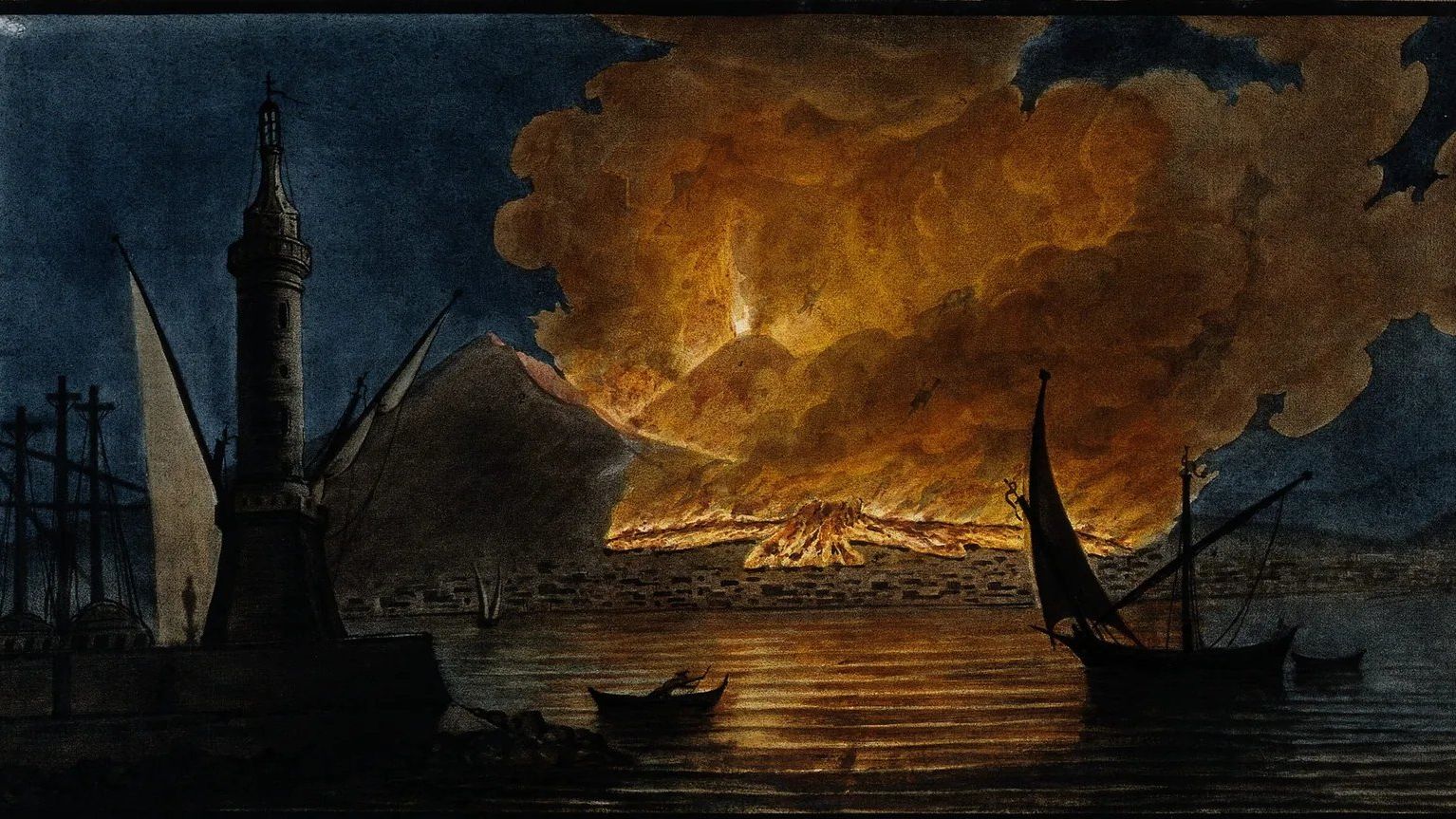
 Image: Pietro Fabris, Wellcome Collection (CC BY 4.0)
Sir William Hamilton and the volcanoes of Naples
On 19 October 1767 Vesuvius opened a new vent on its flank and sent a lava flow towards the royal palace at Portici. The British envoy at Naples, William Hamilton, was on the mountain that day, close enough to be showered with stones, and he wrote down what he saw: the fountain at the vent, the speed of the flow, the sound, the colour of the cloud, and the hour of each change. The letter went to the Royal Society in London and was printed in its Philosophical Transactions. Nine years later Hamilton published a book of such observations with fifty-four hand-coloured plates, and volcanology, as a science of watching volcanoes rather than theorizing about them, began with it.
An envoy with a volcano in his garden
Hamilton arrived in Naples in 1764 as envoy extraordinary to the court of the Kingdom of the Two Sicilies and stayed for thirty-six years. His official work was diplomacy, and his private work was collecting: Greek vases, which he sold to the British Museum, paintings, and, from the first eruption he witnessed, in 1766, the volcano itself. He climbed Vesuvius again and again, often at night and often during eruptions, had a house at Portici under its slopes, and kept a record that no scholar before him had kept, because scholars before him had mostly read about volcanoes in Pliny and Strabo rather than looked at them.
He was elected a Fellow of the Royal Society in 1766, and from then on his letters to the Society were the main source of news about Vesuvius in northern Europe. In 1772 they were collected as Observations on Mount Vesuvius, Mount Etna, and Other Volcanos. Then came the larger project. Hamilton commissioned the painter Pietro Fabris, who had been drawing the Neapolitan countryside for the tourist trade, to paint the volcano and the volcanic country around it in gouache, and had the paintings engraved and coloured by hand in Naples. Campi Phlegraei, Observations on the Volcanos of the Two Sicilies, appeared in 1776, with the text in English and French. A supplement in 1779 added the eruption of August that year.
What the plates show
The plates are not decoration. Plate X shows Vesuvius from the sea with the old rim of Monte Somma beside it, and Hamilton's text argues that Somma is the remains of an earlier, larger mountain that destroyed itself, which is what a volcanologist would now call a caldera rim. Other plates show the lava flows of 1760, 1767, and 1771 with their channels and the walls at their sides, the new cone growing in the crater, the eruption of 1767 by night, a cross-section of the mountain as Hamilton understood it, and the specimens he collected: lavas, scoria, salts from the fumaroles. One plate is a view of the crater floor in a quiet year, with Hamilton and a guide walking across it.
The book then leaves Vesuvius for the country to the west, the Campi Phlegraei of its title, the Phlegraean Fields. Fabris painted the Solfatara with its steaming floor, the Astroni crater with its woods, the Monte Nuovo, which had grown in a week in 1538 and was still fresh enough to be read as a volcano, Lake Avernus in its crater, and the islands of Ischia and the Lipari group, with Etna and Stromboli as the last stops. Hamilton's point was that the whole region, where Naples stands, was volcanic ground, built by eruptions and still active, and that the gentle hills of the Fields were volcanoes as much as Vesuvius was.
Hamilton's method
What makes the book the start of a science is less the pictures than the habit behind them. Hamilton watched, timed, measured where he could, and wrote down what he saw before he explained it. He noted the height of the ash column against the mountain, the distance a flow advanced in an hour, the stones that fell and their size, the smell of the gas, and the temperature of the ground. He noticed that the lava moved as a crusted, sluggish mass that stopped and started rather than as a liquid like water, and that it carried a cargo of solid blocks. He sent samples to London and asked chemists what they were.
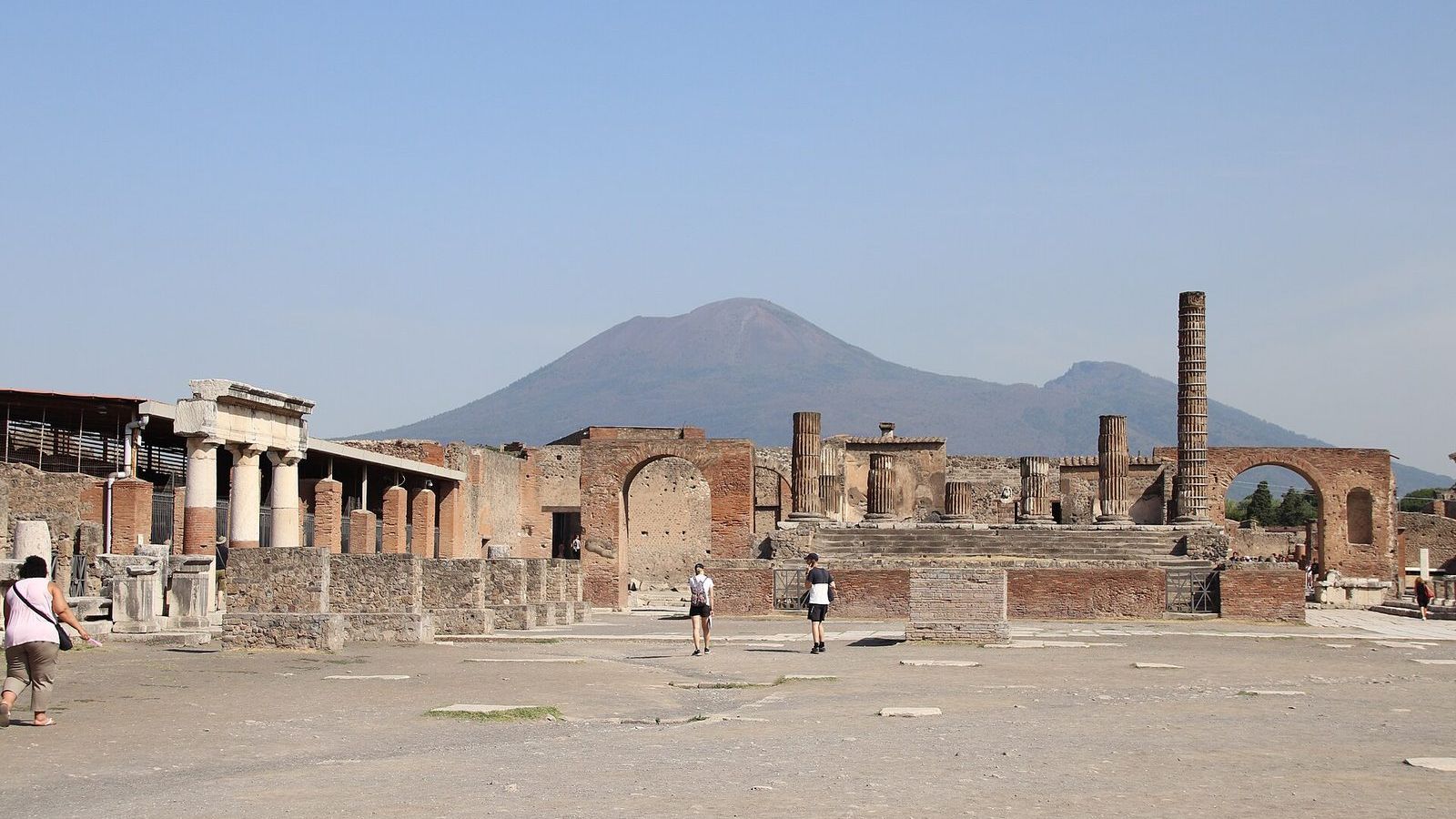
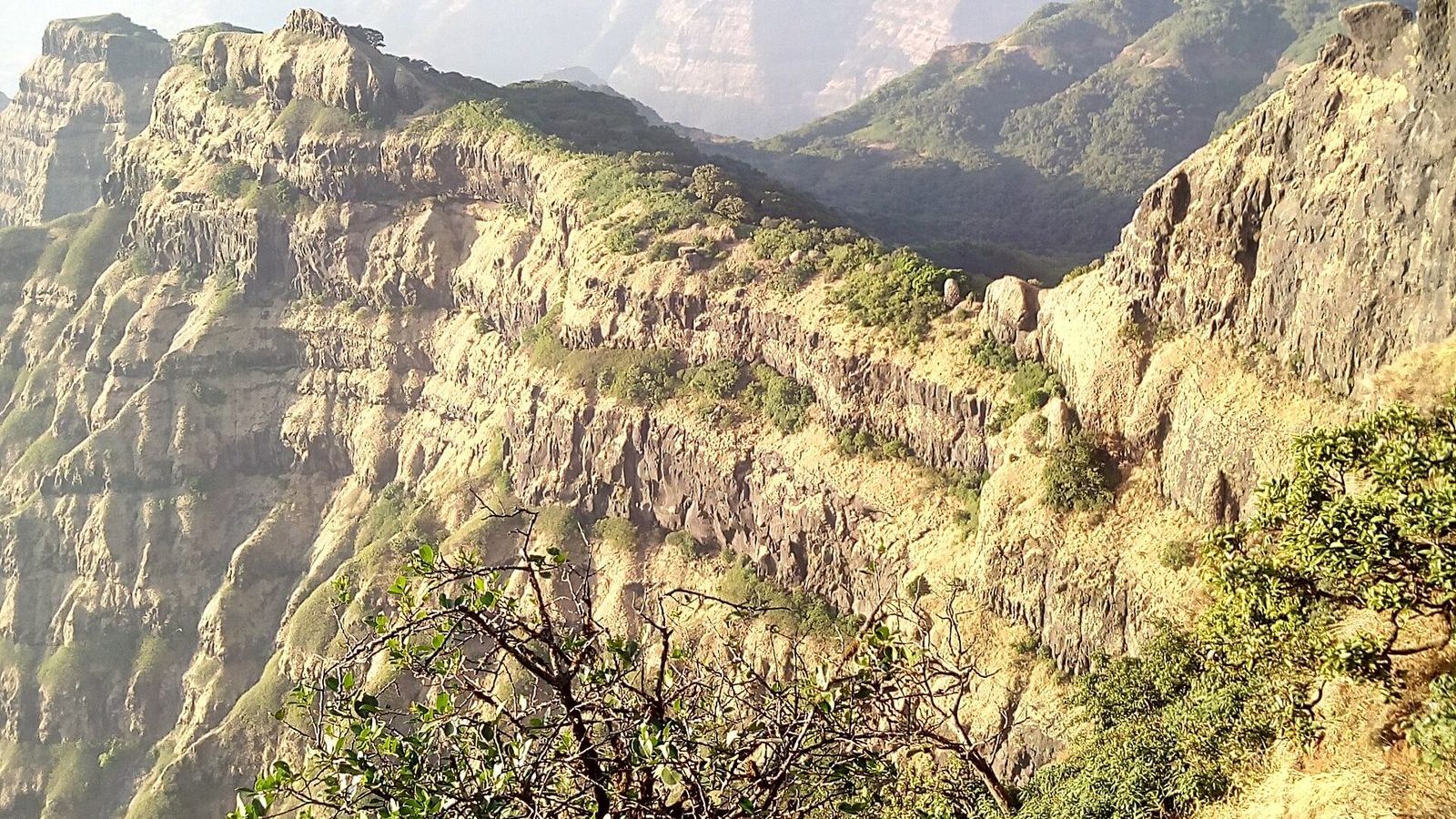
He also reasoned from what he saw. The layered flows exposed in the cliffs of Somma told him that the mountain had been built by many eruptions over a long time, each adding a sheet of lava or ash, rather than raised in one event. That was a quiet argument against the biblical time scale, and Hamilton made it carefully. He argued that the Phlegraean craters were older volcanoes in the same family as Vesuvius, that Monte Nuovo had been born in days, and that a volcano could lie quiet for centuries and return, which is exactly what Vesuvius had done between 1139 and 1631. The lesson that a dormant volcano is a volcano, which the masterclass states in its first unit, is in Campi Phlegraei.
One measurement of his still gets quoted. On the night of 8 August 1779 Hamilton watched a fountain of lava rise from the crater and reckoned its height, against the mountain beside it, at least three times the height of Vesuvius above the sea, which is about 1,280 m. A fountain of that size, if his estimate was anywhere near right, means a column of about 3 to 4 km, which is enormous for a lava fountain; the great fountains of Kīlauea in 1959 reached about 580 m. Whether Hamilton overestimated in the dark or whether 1779 was an exceptional night, the number is the first of its kind, an eruption height written down by a witness who was trying to measure rather than to impress.
The eruptions he lived through
Hamilton saw Vesuvius erupt in 1766, 1767, 1771, 1779, and 1794. The last was the worst. On the night of 15 June 1794 a fissure opened on the south-west flank and the lava reached the sea at Torre del Greco, destroying most of the town; Hamilton walked through the ruins afterwards and described the lava standing in the streets and the church with its doors blocked. By then he was sixty-four, and his report of the eruption was his last long letter to the Royal Society. He also described the earthquakes that devastated Calabria in February 1783, travelling to the region to see the ground that had moved.
Outside science his name is attached to other things: the collection of vases that shaped the taste of a generation, and his second wife Emma, whose friendship with Admiral Nelson is the part of his life most people have heard of. He left Naples in 1800 when the French drove the court out, and died in London in 1803. The Royal Society has his letters, the British Museum has his rocks, and copies of Campi Phlegraei, now among the most valuable volcanological books ever printed, are in the libraries he gave them to.
Why a volcanologist still reads him
A modern observatory does what Hamilton did, with instruments: it records the hour, the height, the distance, the sample, the change, and it explains afterwards. The Osservatorio Vesuviano, founded in 1841 on the slope of the mountain, is the institutional descendant of the envoy's night watches, and its weekly bulletins on Campi Flegrei still report on the ground Fabris painted. The craters of the Fields have risen by more than a metre since 2005, and Hamilton's remark that the region was alive has been borne out in a way he would have found interesting.
The plates are reproduced in Unit 1 of the masterclass, which uses Hamilton as the first entry in its history of the field, and the restless caldera he walked across is the subject of its last unit. The Wellcome Collection in London has digitized its copy of the 1776 edition under a free licence, which is where the cover of this article comes from.