 Image: US Geological Survey, public domain
How hot is lava, and how do we know?
A basalt flow at Kīlauea leaves the vent at about 1,150 °C. A rhyolite dome in New Zealand or California grows at 700 to 900 °C, and an andesite at Merapi or Mayon sits in between, at about 950 to 1,100 °C. These numbers appear in every textbook, and almost nobody who quotes them has held a thermometer to lava. Here is where they come from, and what the colour of a glowing flow can tell you before any instrument is switched on.
Four magmas, four temperatures
The temperature at which a magma erupts depends mostly on its chemistry, and the chemistry is summed up by one number: the silica content. A basalt with about 50 wt% silica leaves the mantle hot and stays hot, erupting at 1,100 to 1,250 °C. An andesite with about 60 wt% erupts at roughly 950 to 1,100 °C, a dacite with about 65 wt% at about 800 to 1,000 °C, and a rhyolite with more than about 69 wt% at about 700 to 900 °C. The ranges overlap, because water and crystals shift them, but the ladder is real: the more silica, the cooler the eruption.
The ladder matters because temperature and silica together set the viscosity, the stiffness of the melt, and the viscosity decides whether a volcano pours or explodes. A hundred degrees of cooling raises the viscosity of a melt by roughly a factor of ten, which is why a cooling flow slows, thickens, and finally stops. So the temperature is the first number a volcanologist wants from a new eruption. The question is how to get it.
The thermocouple
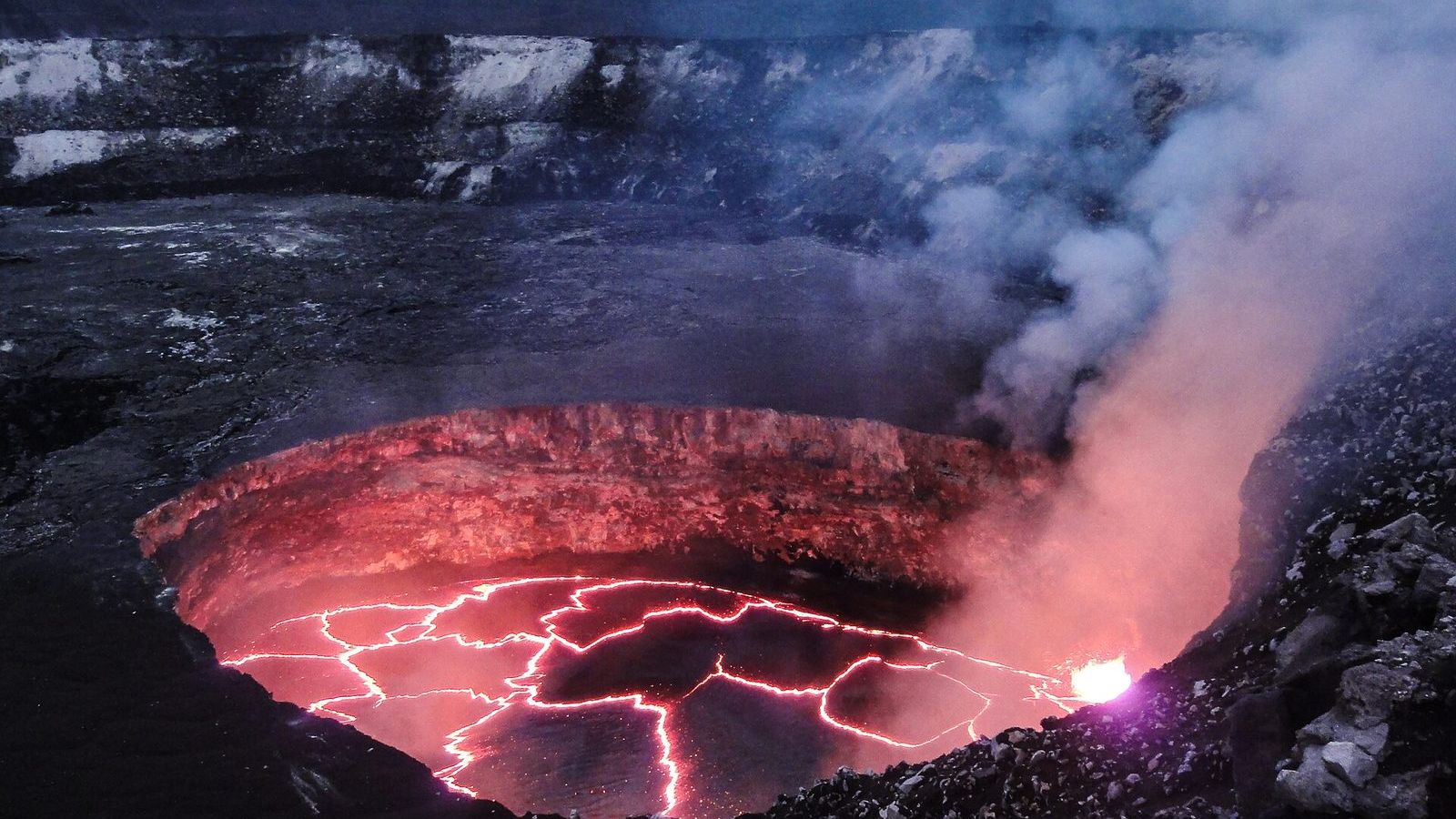
The direct way is to push a thermocouple into the lava. A thermocouple is a junction of two different metals, and the voltage across the junction depends on its temperature. Thomas Jaggar and Frank Perret made the first such measurements at the lava lake of Halemaʻumaʻu, at the summit of Kīlauea, between 1911 and 1917, lowering the probe on a cable from a rig built over the crater. Geologists of the Hawaiian Volcano Observatory still do the same today with a probe on a long pole, pushed into the toe of an advancing pāhoehoe flow or into the spatter around a vent.
The method is honest but limited. The probe has to reach the hot interior of the flow rather than only the cooling crust, which can be a hundred degrees colder, and it has to survive. Thermocouples of platinum and rhodium stand up to the heat; the person holding the pole stands in radiant heat that can be felt through a fire suit. The measurement is also one point in a flow that may be a kilometre long, and the point is always at the edge, where the lava is coolest. At Kīlauea the thermocouple values for fresh basalt cluster around 1,140 to 1,160 °C, which is where the textbook 1,150 °C comes from.
Reading the glow
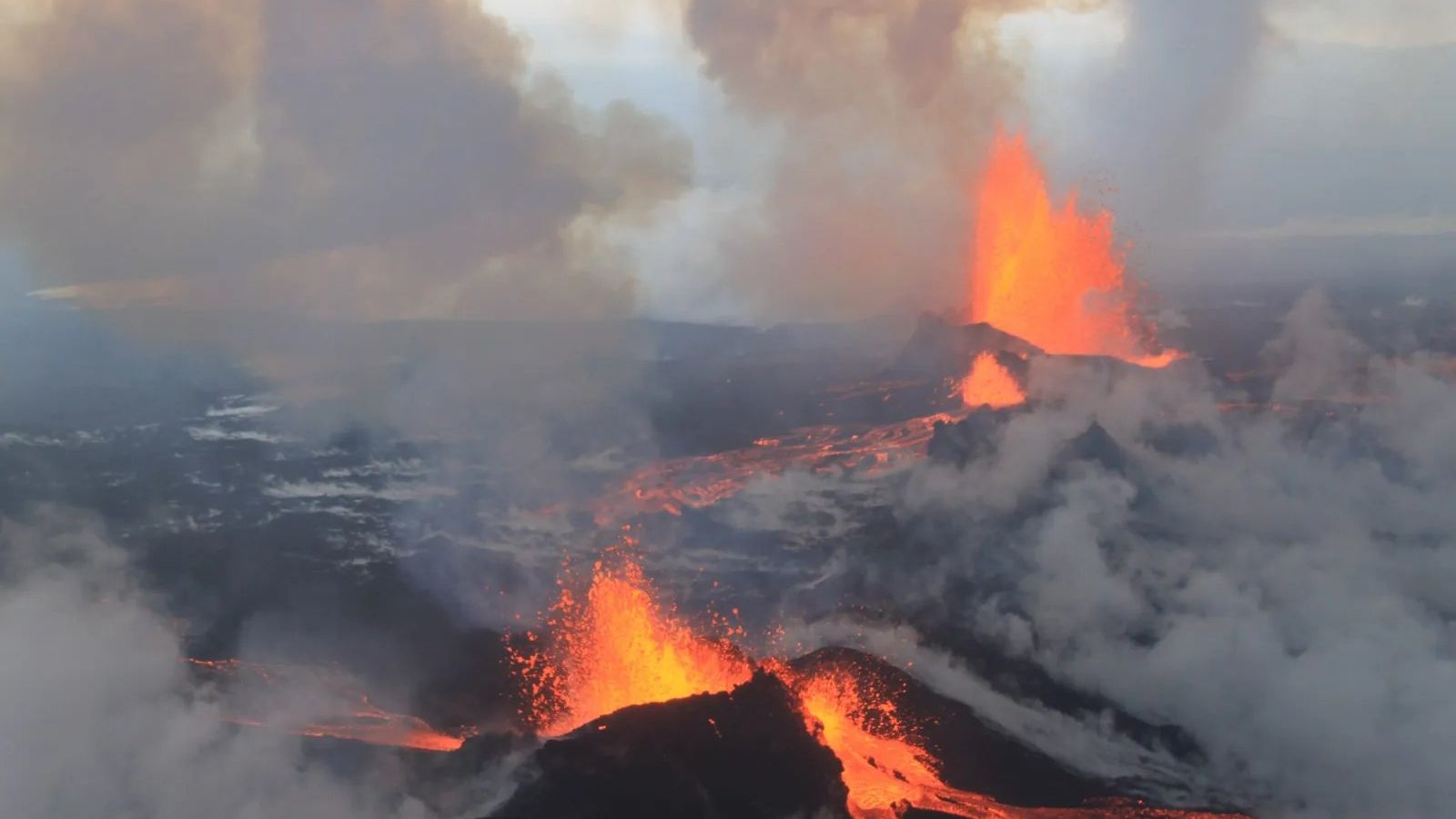
Everything hot radiates, and the hotter it is, the more it radiates and the shorter the wavelengths at which it does so. That is Planck's law, and it is the physics behind the colour of lava. A surface at about 500 °C glows a faint red that is visible only in the dark. At 700 to 800 °C it is a clear cherry red, at 900 to 1,000 °C orange, at 1,100 to 1,200 °C a bright yellow, and above about 1,300 °C it approaches white. A volcanologist who has watched a few flows reads the temperature from the colour to within a hundred degrees, and a fountain that is yellow at the vent and red at the edges is showing you its cooling in real time.
The colour reading can be made into an instrument. An optical pyrometer compares the brightness of the glowing surface at one wavelength with a calibrated lamp, and from the brightness gives the temperature without touching anything. Pyrometers were used at Vesuvius and Kīlauea a century ago and are still carried in the field, because they are small, cheap, and work from a safe distance.
The worked number is this. The wavelength at which a hot body radiates most strongly is given by Wien's law: the peak wavelength in micrometres is 2,898 divided by the temperature in kelvin. Kīlauea's basalt at 1,150 °C is 1,423 K, so its radiation peaks at about 2.0 micrometres, in the infrared. The yellow light you see is only the short-wavelength tail of the spectrum. Most of the energy leaves the flow as invisible heat, and the amount is large: by the Stefan-Boltzmann law a surface at 1,423 K radiates about 230 kilowatts per square metre, more than two hundred times the power of noon sunlight on the ground. That is why a lava flow can be felt from tens of metres away and why the crust forms within seconds.
The thermal camera
The modern version of the pyrometer is the thermal infrared camera, which measures the radiation of every pixel in its field of view at wavelengths of 8 to 14 micrometres or, for hot targets, around 4 micrometres, and converts it into a temperature map. Observatories fly them in helicopters over flow fields, mount them on crater rims, and read them from drones. The map shows the hot channel inside a crusted flow, the breakout that will become the next lobe, and the place where a lava tube runs under the surface.
The camera has its own difficulties. The conversion from radiation to temperature assumes a value for the emissivity of the surface, which for basalt is about 0.95 but varies with the crust and the viewing angle. The atmosphere between the camera and the lava absorbs part of the radiation, and volcanic gas and steam absorb more. And a pixel that covers a few square metres of a flow records the average of a glowing crack and the dark crust beside it, which is colder than the melt below. Thermal cameras therefore give reliable maps and less reliable absolute values, and the observatory checks them against a thermocouple where it can.
Satellites do the same thing from orbit with coarser pixels. The MODIS and VIIRS sensors on NASA's and NOAA's satellites detect hot spots on volcanoes several times a day, and the MIROVA system at the University of Turin turns each detection into a radiative power in watts. A satellite pixel is a kilometre across, so the temperature it reports is a mixture and the number it really measures is the heat output, which is a good proxy for how much lava is coming out.
The thermometer in the rock
For an eruption that happened before anyone could measure it, the temperature is read from the rock itself. Minerals that grow together from a melt divide elements between them in proportions that depend on temperature, and once the proportions have been calibrated in the laboratory, the composition of a pair of crystals in an old lava gives the temperature at which they grew. Two pyroxenes, an olivine and the glass around it, and the iron-titanium oxides are the classic pairs, with uncertainties of a few tens of degrees.
The simplest thermometer of all is the glass. In a Kīlauea basalt the magnesium content of the quenched glass falls as the melt cools and olivine crystallizes out of it, and the relation is nearly linear. Helz and Thornber calibrated it in 1987 from samples taken at known temperatures in the Kīlauea Iki lava lake: the temperature in degrees Celsius is close to 20 times the weight percent of magnesium oxide in the glass, plus 1,014. A glass with 7 wt% MgO gives about 1,155 °C. The measurement needs a polished chip and an electron microprobe rather than a fire suit, and it works on lava that cooled a thousand years ago. The original paper is still the calibration the Hawaiian Volcano Observatory quotes.
What the number is good for
Put together, the methods agree to within a few tens of degrees, and that agreement is what allows a textbook to print one value per magma type. The value is then used everywhere. The viscosity models that predict how far a flow will go take the temperature as their first input; the forecast of when a crusted flow will stop depends on how fast it cools from that starting point; and the eruption temperature of an old deposit, read from its crystals, says what kind of magma it was and how it was stored.
If you want to try the colour thermometer yourself, the interactive element in Unit 3 of the masterclass shows a glowing surface whose colour you set by its temperature, and Unit 1 introduces the four magma types with their temperatures, densities, and viscosities in one table. The free viscosity calculator of the University of British Columbia lets you see what a hundred degrees does to a basalt and to a rhyolite.