 Image: peterhartree (CC BY-SA 2.0)
How fast does lava flow?
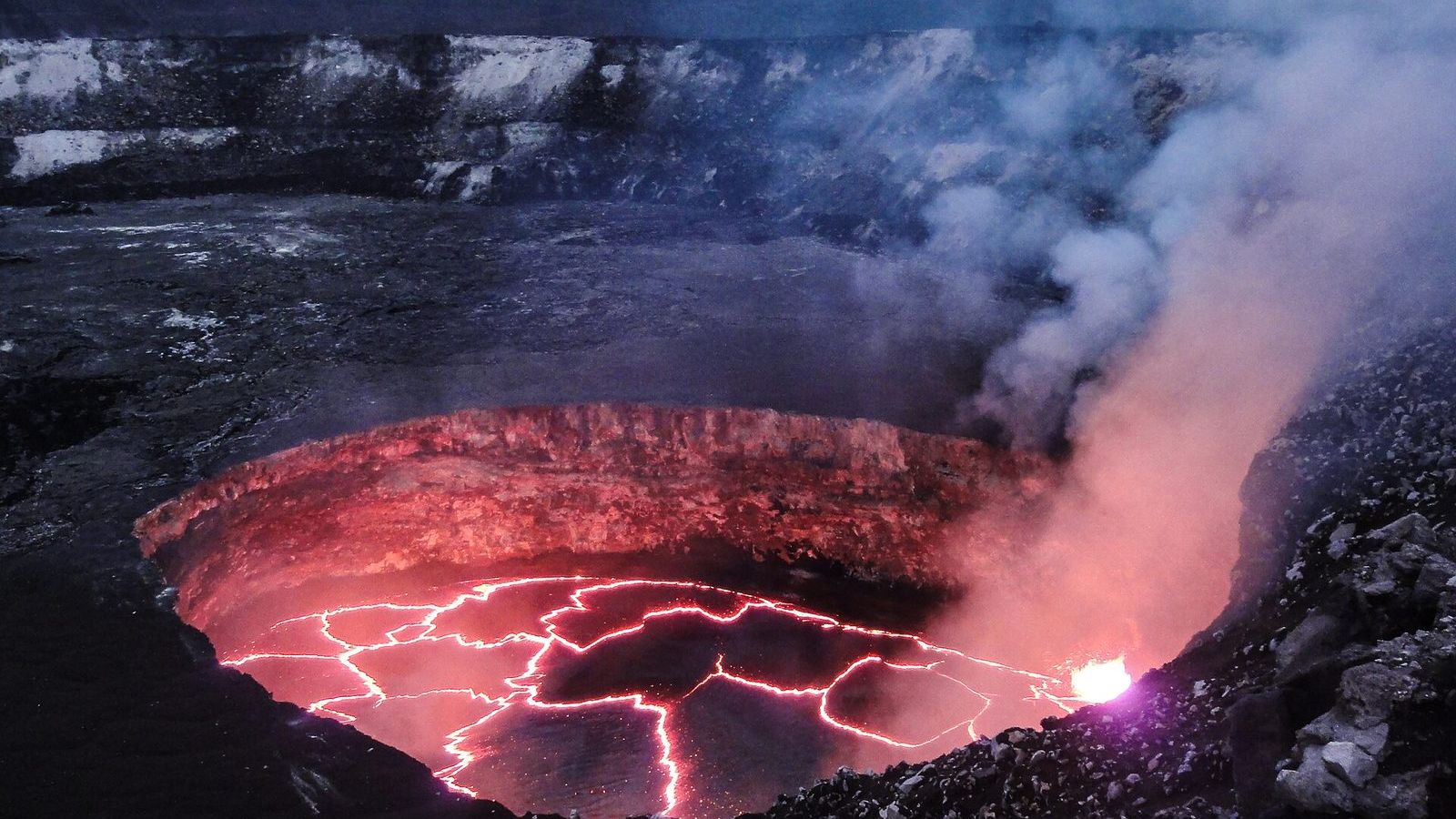
The honest answer is that most lava flows move slower than you walk. A pāhoehoe toe at Kīlauea advances a few metres an hour; a thick ʻaʻā flow on Etna creeps at a few hundred metres a day; tourists stand beside both and take photographs. The dishonest answer, the one in films, is a wall of fire chasing a car. Between the two there is a real physics, and it comes down to three things: how thick the flow is, how steep the slope is, and how stiff the lava is. An equation written down a century ago puts them together.
Jeffreys's equation
In 1925 the geophysicist Harold Jeffreys treated a lava flow as a sheet of viscous liquid sliding down an inclined plane, the same problem as honey running down a tilted plate. For a sheet of thickness h on a slope of angle θ, with density ρ and viscosity η, the mean speed is
u = ρ g h2 sin θ / (3η)
where g is the acceleration of gravity. Everything in it makes sense. A heavier liquid is pulled harder, so the speed rises with density. A thicker sheet moves faster, and faster than in proportion, because the drag of the ground is felt only at the base; the speed rises with the square of the thickness. A steeper slope pulls harder along the surface. And a stiffer liquid resists, so the speed falls as the viscosity rises.
Put numbers in. Take a basalt of density 2,700 kg/m³ and a viscosity of 1,000 pascal seconds, which is a reasonable value for a Kīlauea lava a little below its eruption temperature, flowing 1 m thick on a 5° slope. The sine of 5° is 0.087, so the numerator is 2,700 × 9.81 × 1 × 0.087, about 2,300, and divided by 3,000 that gives about 0.8 m/s, a brisk walk. Make the flow 2 m thick and the speed quadruples to about 3 m/s, a run. Now let the same lava cool and crystallize until its viscosity is 10,000 pascal seconds and put it on a 1° slope, which is the ground in the lower flow fields of Hawaiʻi: 2,700 × 9.81 × 4 × 0.017 divided by 30,000 is about 0.06 m/s, 200 metres an hour, a slow walk. The whole range of everyday flow speeds comes out of one formula and the viscosity.
The equation has limits, and volcanologists use it knowing them. It assumes the lava is a Newtonian liquid, which basalt is near its eruption temperature and stops being as crystals grow; a crystal-rich ʻaʻā flow has a yield strength and will not move at all below a certain thickness, which is why it builds walls at its sides and stops with a steep front. It assumes a wide sheet rather than a channel, in which the sides add drag. And it assumes a steady state, while real flows surge and stall as the supply from the vent changes. But as an estimate of how fast a flow of known thickness and viscosity will go on a known slope, it works, and it explains why the speed varies so much.
The fast ones
The exceptions are flows that are unusually fluid or unusually steep. The lava of Nyiragongo in the Democratic Republic of the Congo is a nephelinite, a rock with so little silica that its melt is thinner than any basalt, and the volcano is a steep cone. On 10 January 1977 the crater walls of its lava lake broke open and the lake drained through fissures on the flanks in less than an hour. The flows reached speeds that eyewitnesses put at tens of kilometres per hour, with figures of 60 km/h quoted for the upper slopes, and they caught people in the villages below; the number killed was never properly counted and estimates range from dozens to several hundred. It is the fastest lava flow on record.
On 17 January 2002 Nyiragongo did it again, and this time one of the flows ran 18 km down the southern flank into the city of Goma, through the centre and into Lake Kivu. In the city it moved at walking pace, a metre or two a second on the steep streets and slower on the flat, and most people walked away from it; the deaths, about a hundred, came mostly from a petrol station that exploded and from people who crossed the hot flow too early. About 120,000 people lost their homes. The speed on the mountain had been far higher, and the hours it took to reach the city were the warning.
Basalt in a channel can be fast too. During the Kīlauea eruption of 2018 the lava of fissure 8 ran in an open channel 13 km to the sea, and the Hawaiian Volcano Observatory measured the surface moving at up to about 25 to 30 km/h near the vent, where the channel was steep and the lava hot and bubble-rich. Downstream it slowed to a few kilometres an hour. A lava fountain is faster still, but a fountain is gas-driven and not a flow.
How far a flow goes
Speed is the less important number. What decides whether a flow reaches a town is its length, and in 1973 George Walker noticed, from the lavas of Etna, that the length of a flow depends on the rate at which lava leaves the vent, the effusion rate, more than on the total volume erupted. A flow fed at 1 m³/s dribbles out a short, thick field however long it lasts; a flow fed at 100 m³/s runs far before its front cools and stops. The relation has scatter, but it has held up on every volcano where it has been tested.
The reason is cooling. A flow advances until its front has lost enough heat to stop moving, and a flow that moves fast carries its heat farther before that happens. Volcanologists call such flows cooling-limited. The other case is the volume-limited flow, which stops because the vent shuts off before the front has cooled. Kīlauea's long flows of the 1980s and 1990s were a third case: the lava ran through tubes under a crust that insulated it almost perfectly, so that it reached the sea 10 km away having cooled by only a few tens of degrees. A tube-fed flow is the exception to Walker's rule, because the tube removes the cooling.
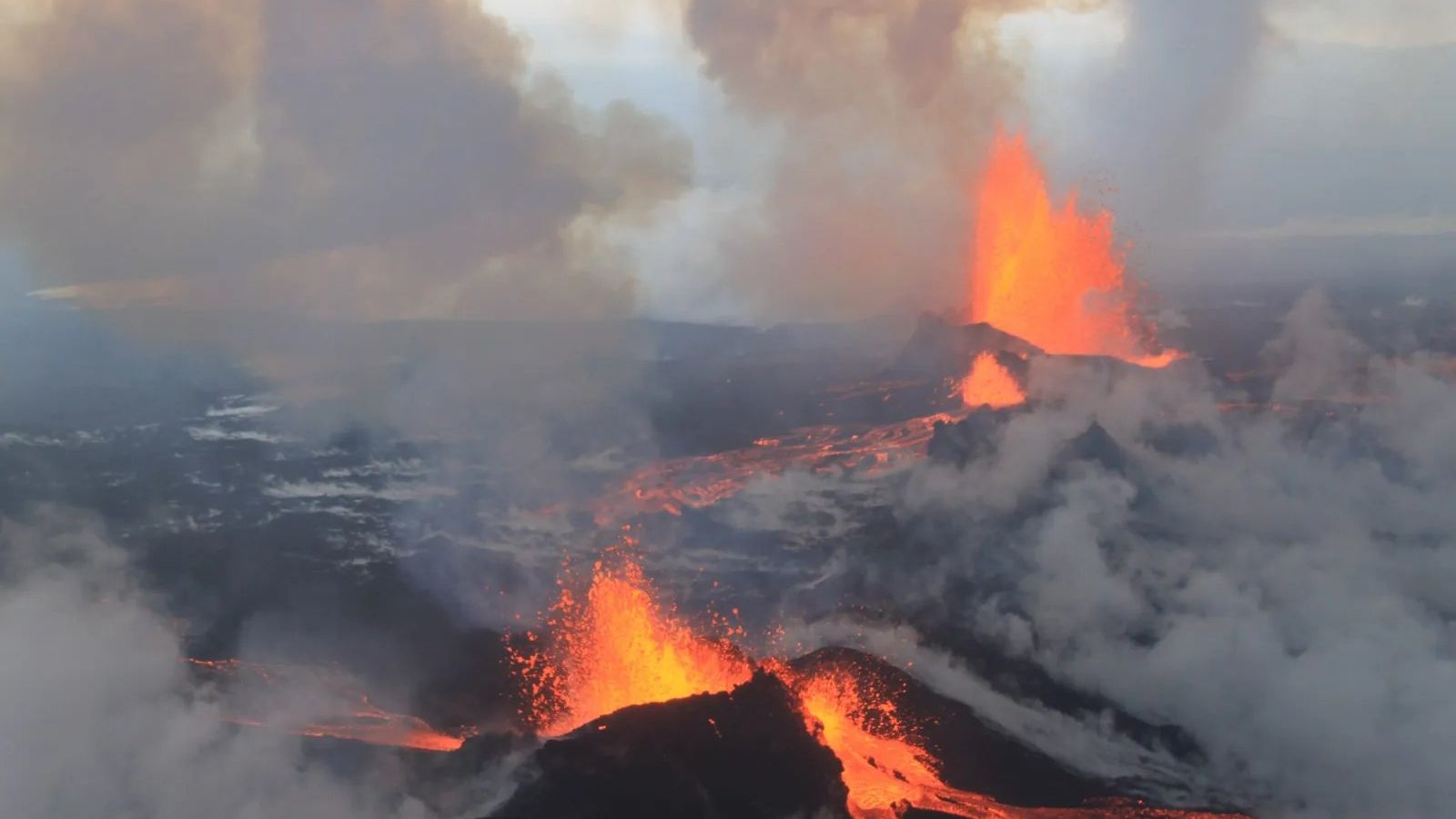
Effusion rates of real eruptions span four powers of ten. Kīlauea's long eruption of 1983 to 2018 averaged about 4 m³/s. The fissure 8 phase of 2018 averaged about 100 m³/s. The Holuhraun eruption in Iceland in 2014 to 2015 began at several hundred cubic metres per second and poured out about 1.4 km³ in six months. The Laki eruption of 1783 to 1784 erupted 14.7 km³ in eight months, a mean of about 700 m³/s, about ten times the mean flow of the Thames at London, and its flows ran 40 km down the valleys to the coast.
Why lava rarely kills
Because almost all flows move slower than a person, lava is far down the list of volcanic killers. Of the roughly 280,000 people killed by volcanoes since 1500, only a few hundred died in lava, nearly all of them in the two Nyiragongo eruptions. Pyroclastic currents, lahars, tsunamis, and famine account for most of the rest. You can outrun lava; you cannot outrun a pyroclastic current at 100 to 700 km/h.
What lava does instead is destroy completely. It does not flood a house and recede; it fills it, burns it, and leaves several metres of rock where the street was. The 2018 eruption of Kīlauea destroyed more than 700 buildings in the Puna district. The 2021 eruption of Tajogaite on La Palma, in 85 days, buried about 3,000 buildings, the main coastal road, and the banana plantations under flows up to 70 m thick. Goma in 2002 lost about 15 percent of the city. The hazard of lava is slow and total, and the response to it is a map rather than a sprint: a forecast of the path from the topography and the effusion rate, and an evacuation in time.
Unit 5 of the masterclass works through Jeffreys's equation, Walker's rule, and the 2018 Kīlauea eruption, with an interactive element in which you set the thickness, slope, and viscosity of a flow and watch what it does. The viscosity itself, and why it ranges over twelve powers of ten between magmas, is the subject of Unit 3. The near-real-time thermal maps of MIROVA show which volcanoes have lava moving on them this week.